submitted by Joyce Bromley; photos by Mike Engelberger & Neil Fauerbach
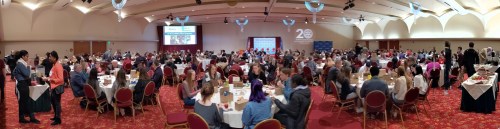
Our 20th Annual Rotary Club of Madison Ethics Symposium was held on Friday, February 14th, at Monona Terrace with over 200 juniors from 19 different high schools in Dane County in attendance.
Evidence of the success of the 2020 Rotary Ethics Symposium was clearly revealed by the comments from students at the end of the day:
- “After discussing these ethic situations, I am ready to take on the world, and I want to be a partner with Rotary’s advocacy.”
- “Thank you for taking me outside my comfort zone and teaching me to appreciate discussing ethical dilemmas. I gained new skills that will be helpful to me.”
- “The thoughtful discussion allowed me to better take in other’s ideas.” “I appreciated having a discussion with people from different backgrounds who brought different perspectives.”
- “As the next generation to be leaders, do not underestimate us. We shared ideas and some are different from ours, but everyone had an opportunity to participate. We will take the skills that we learned into the rest of our lives.”
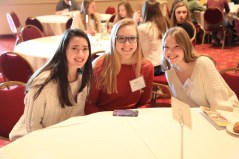
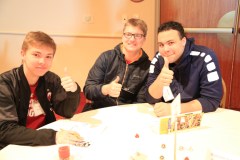
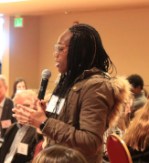
Students expressed surprise at the impact this program had on them. They attended out of curiosity, they knew someone who attended in the past, or as one student honestly admitted—he would receive a free lunch. This program provided skills to help them impact social changes for the betterment of the community.
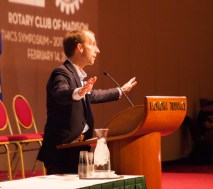 In this 20th anniversary of our Rotary Ethics Symposium, we continue to provide a valuable format for preparing students to take on challenging ethical issues. The day began with a session for all students, school representatives, and Rotary members. Mike Gotzler, Chair of the 2020 Rotary Ethics Symposium, welcomed everyone and gave an overview of the wide range of contributions Rotary and Rotarians make to their communities and to the world.
The Edgewood College Theatre group warmed up the audience by playing out various scenes and scenarios of ethical dilemmas that students could encounter. Instead of resolving the dilemma on stage, the actors asked students in the audience to identify the dilemma and asked what issues should be considered in order to resolve the problem (e.g. a student not fulfilling her part of a group project, a friend stereo-typing a Hispanic student) and the audience responded.
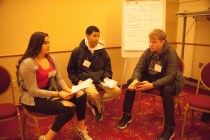
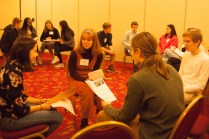
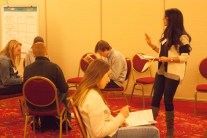
Next, the scattering of 200 students into 11 different discussion rooms began. The Rotary Ethics committee assigned students to assure a broad representation to enrich each discussion. In each discussion room were students who represented urban and rural schools, various ethnic groups, various races, and various nationalities. The facilitators developed them as a group. The first principle was to establish the ground rules that began and ended with “Treat every person in the room with complete and unconditional respect.”
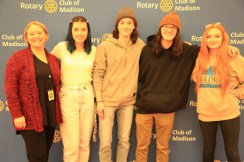
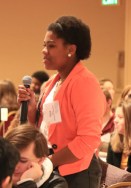
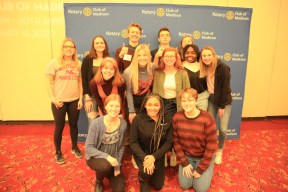
They were taught the R-O-T-A-R-Y Framework at which they would practice through three workshops: Recognize an ethical issue; Obtain information; Test alternative actions from various perspectives; Act consistently with one’s best judgment; Reflect, with more information be willing to adjust your thinking; Yield on ethical judgments to exemplify human beings “at our best.”
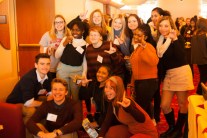
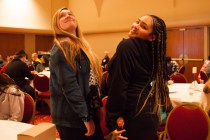
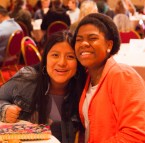
They were then prepared to face their dilemmas, but first—before they begin using the Rotary Framework—they were asked what their gut reaction is to the dilemma. Then they began the skills building based on the Rotary format taking into consideration more information and from different perspectives. They had the prerogative to change their minds—and they often did.
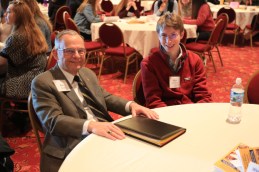 Rotarians working on the Ethic Symposium taskforce provided a challenging dilemma for each session that ranged from: (1) to skip school in order to participate in a march to support a friend and their cause; (2) the role of students to object to having the school purchase inexpensive sports clothes made by companies using child labor; and (3) how to react to anti-Semitism.
The day was a success because of the leadership provided by Mike Gotzler, Chair of the 2020 Rotary Ethics Symposium. Over several months, he met regularly with his committee to fine-tune the arrangements. They worked diligently to broaden the demographics in each session to provide the broadest experiences for students. He put together a taskforce of Rotarians who developed compelling ethical dilemmas for the students to consider. He chose outstanding trainers—Jason Ilstrup, Sandy Morales, Dave Scher—to prepare facilitators and breakout room hosts for their roles. By February 14th, we were ready and altogether over 50 Rotarians volunteered.
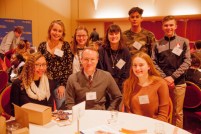
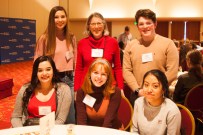
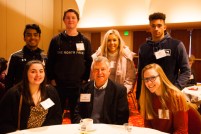
Thanks to all for making our 20th annual Rotary Ethics Symposium a huge success.
Visit our club’s Facebook page for more photos.

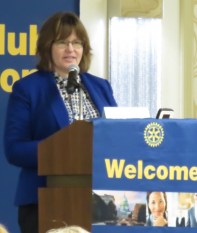 On February 19, 2020, Becky Schigiel, Sr. Partnership Specialist with the U.S. Census Bureau, spoke to Downtown Rotarians about the upcoming 2020 United States Census. Becky spoke to us about the three top reasons that the Census is so important: 1) It’s the basis of our democracy. The Constitution specifically calls out that everyone in the United States will be counted every ten years so that we can determine representation, 2) It the basis by which $675 billion dollars are distributed by the Government annually. Census data is used to determine the amount of funding for important things such as roads, school lunches, foster care, special education and much more. It’s estimated that for every person missed in Dane County, we lose about $2,000 annually for each of the next 10 years, and 3) Census data is heavily relied upon by leaders (community, faith, business) when making decisions that impact our local communities.

 At this week’s Rotary meeting, we heard from Dr. Joshua Mezrich and how he creates life from loss, transplanting organs from one body to another. He spoke about his desire to write a book, a little about the process to write a non-fiction book and some tips his famous author brother gave him. His book was released last year, When Death Becomes Life: Notes From a Transplant Surgeon, and in it he illuminates this extraordinary field of transplantation that enables this kind of miracle to happen every day.

 Rotary Club of Madison, Wisconsin