Transformation of Policing

–submitted by Jocelyn Riley; photo by Valerie Johnson
Noble Wray 4 12 2017

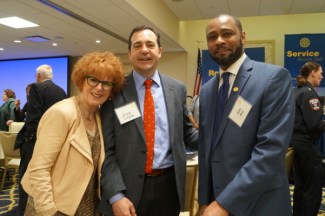
From Left: Susan Schmitz and Doug Poland with Noble Wray

Former Rotarian Noble Wray spoke at the April 12 Downtown Rotary meeting at the Park Hotel on the topic “From Leading the Madison Police Department to Leading the U.S. Dept. of Justice’s Policing Practices and Accountability Initiative: What I have Learned about Community Policing.”  Wray served as the Madison Police Department’s Chief of Police from 2004 to 2013.  After his retirement, Wray was asked by the Obama administration to lead a national U.S. Department of Justice taskforce on policing practices.

Wray began his remarks by asking for a moment of silence in memory of the Wisconsin State Trooper who died on the job this week.  Then he asked “How do you change an institution?”  He cited previous commissions that attempted to “reform” police work.  But we are still faced with the age-old, intractable problems of poverty, limited access to housing, and discrimination.  Wray urged that changes in policing be driven by transformation rather than reform.  “Reform comes from the outside,” he said, “as a result of something that went wrong.”  He said that transformation, on the other hand, comes from inside.  “We have to be constantly improving,” he said.

Wray said that in order to transform police work, “courageous police leadership” is needed, as well as “rank-and-file support.”  Wray also said that the road to improving policing always involves community-oriented policing and that it can’t come in a top-down approach from the federal government.  “Washington should be the catalyst to make sure that change happens at the local level.”

If you missed our meeting this week, you can watch the video here.
Pevehouse: International Order is Costly But Necessary

–submitted by Valerie Johnson

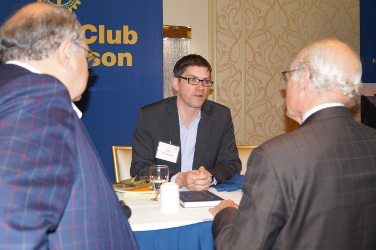
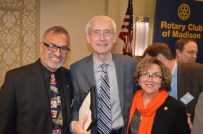
Jon Pevehouse 4 5 17Jon Pevehouse, UW Political Science Professor, asked and answered the question, “How should the Trump administration balance power with constraint to maximize our legitimacy and prosperity?” at the April 5 Rotary meeting.
With graduate student Ryan Powers and Carnegie Foundation grant-funded opinion polls, Pevehouse has a wealth of information on what Americans want in international trade policy:

  • The last 5-6 years have found more people interested in trade barriers
  • Older, non-college educated people are more interested in trade barriers (these tend to be Trump supporters)
  • People want to keep jobs in the US, a platform Bernie Sanders also ran on as evidenced by the many “NO TPP” signs seen at the Democratic convention
  • Most American still want free trade (12% margin) even with job losses
  • Both political parties are pro-free trade; Hillary Clinton ran on this and Bill Clinton began NAFTA
  • Interest in trade barriers follows the economy; people like trade better than trade agreements.

Trump has indicated an interest in re-negotiating NAFTA.  Wisconsin has a positive balance of trade with Mexico, even though US does not.  The rules of origin Trump complains about were already re-negotiated by Obama as part of the TPP, but Trump threw that out; it would increase the percent of product manufactured/labeled required to be created in Mexico (for example) from 65% to perhaps 85%, decreasing what can come from China.

The concern is the Trump administration likes the power of the US economy, but not the traditional constraints we have used with other countries, such as the foreign ad Bush quietly used or the traditional tools such as the World Bank, WTO, etc.

“But without constraint,” Pevehouse said, “the fear is our power endangers our foreign policy.  International order is costly, but gives us legitimacy, as we have had with the last 60 years of prosperity.

Professor Pevehouse’s research in the areas of international relations, international political economy, American foreign policy, international organizations, and political methodology. Topics on which he has recently published include regional trade agreements, human rights institutions, exchange rate politics, and international organizations. He is the author, with Joshua Goldstein, of International Relations, the leading textbook on international politics. He is currently the editor of International Organization, the leading journal in the field of international relations.

Pevehouse has a Ph.D. in Political Science from Ohio State University and a B.A. in Political Science from University of Kansas.

If you missed our meeting this week, you can watch the video here.

Superintendents Candidates Forum

–submitted by Stan Inhorn; photos by Pete Christianson

A week before the election, Rotarians were privileged to hear the two candidates for the office of State Superintendent of Public Instruction describe their qualifications and goals for improving educational achievement in Wisconsin.

Holtz Mtg 3 29 2017

Amanda Brink, Dawn Crim & Lowell Holtz

In his opening statement, challenger Lowell Holtz noted the failure of many schools in minority districts in Wisconsin to achieve reasonable graduation rates. These failures are occurring not only in large urban districts but in rural areas as well.

Evers Mtg 3 29 2017

From left: Oscar Mireles, Tony Evers & Roberta Gassman

Incumbent superintendent Tony Evers has headed the Department of Public Instruction for 8 years. He noted that scores on standardized testing have increased through the years and are near the top in several categories. He believes that some of the problem is due to inadequate state funding that has led to citizens voting for local tax referenda.

Five questions were presented to the candidates. In answer to the question – “Why do we need a state department of public education,” Evers noted that federal money for professional development and afterschool programs has been sharply reduced in the proposed federal education budget. Holtz responded by indicating that the federal budget included a significant amount for students with disabilities and for teacher training. In response to a question about innovation, Holtz described a Tennessee innovation zone program that allowed parents and teachers to design a system that improved the climate and culture within the classroom. Evers noted that Pewaukee had integrated special education students into the regular classrooms with extraordinary success.

Regarding transfer of public money to private schools, Evers indicated that funding of public schools is inadequate, so dividing it into 2 to 4 systems will only make public education worse. Holtz pointed to the successes that have occurred in districts where voucher schools are present.

The issue of improving the environment for teachers, including salaries, classroom respect, Act 10 in Wisconsin, is important. Holtz suggested that principals must help create a nurturing environment. Evers recommended that students should also be involved in planning activities that include projects that could evolve into actual jobs. In his summary statement, Holtz indicated that bureaucratic tasks are taking too much classroom teaching time away from teachers. Evers again stated that the state is not doing its fair share in providing funding for public education in Wisconsin.

If you missed our meeting this week, you can watch it here.  Our thanks to WisconsinEye for videotaping our meeting.

Nowruz – A Celebration of the Iranian New Year

–submitted by Joyce Bromley; photos by Ted & Joan Ballweg

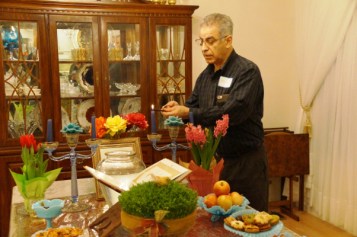
Iranian New Year Celebration 016Who could not use some Nowruz (celebration of spring and annual renewal)?  Majid Sarmadi brought the rich Iranian new year celebration to the Cultural Awareness Fellowship Group and their guests in this year of 2595.  This 3000 year Persian tradition is a celebration of renewal and hope with prepared foods that represent the seven angelic heralds.  Hyacinth (one of the first flowers of spring) brings beauty and its fragrance permeated the room.  The eloquently set table was a sight to behold.  Garlic bulbs decorated with a string of tiny pearls bring good health; vinegar takes a long time to make and requires patience; a beautiful tureen of sprouts (lentils) prosperity—good harvest and a year without hunger; elaborately decorated eggs promise fertility–rebirth; goldfish swimming in a bowl, a symbol of life; the illumination of candle-light brings happiness—good over evil; fresh fruit and sweets bring joy; and we ended with a taste of ground sweet sumac.  A book of poetry lay open reminding us of the eloquent Persian language.  This was the experience of haft sin and only the beginning of the evening.

Iranian New Year Celebration 060  Iranian New Year Celebration 004  Iranian New Year Celebration 036  Iranian New Year Celebration 013

After an enthralling slide show of Iran–the culture, the geography, and its people—we traveled the gastronomic route.  Appetizers of eggplant paté, and hummus; a table display of basmati rice with saffron, casserole of assorted beans, braised eggplant with filet mignon; saffron chicken; and basmati rice with lima beans and dill—all of which were as sumptuous as they were beautiful.  All of these delicacies were entirely prepared by Majid.  Oh yes, the desserts!  Cream puffs (made earlier in the day), fresh fruit, rice-flour cookies, cardamom muffins, sohan (almond toffee), were enjoyed with a cup of tea.  At the end of the evening Majid gave us a gift to extend the evening.  We each received a freshly pressed one-dollar bill for good luck.

Iranian New Year Celebration 058  Iranian New Year Celebration 029    Iranian New Year Celebration 022  Iranian New Year Celebration 024


We became Majid’s extended family and together we celebrated the joy of friendship in the Persian tradition and are richer for the experience.

Iranian New Year Celebration 044

Holistic Support for Returning Veterans and Their Families

–submitted by Donna Hurd; photo by Pete Christianson

Will Beiersdorf 3 22 2017

From left: Club President Michelle McGrath, Will Beiersdorf, Nasra Wehelie and Susan Schmitz

After recognizing and showing appreciation for all Rotarians and guests who have provided military service to our country, fellow Rotarian Will Beiersdorf provided a brief but comprehensive overview of an organization that provides holistic support and care for those service men and women who have returned home with physical and often, severe invisible wounds of war.

With first-hand knowledge of the stress of deployment, Will was called into active duty after the events of September 11, 2001, leaving his wife and three young children behind.  Since that time, 800,000 service men and women have been deployed multiple times. This was almost unheard of prior to that date.  The toll of numerous deployments affects not only the servicemen and women but also their families.  The services available for many who have served are often inadequate and in all cases, only treat the wounded, leaving their families to seek help from other providers or caregivers.  Two million children and parents sought mental and behavioral healthcare since 2001.  One-third of the men and women returning from war suffer some type of trauma.  Approximately 400,000 have suffered a traumatic brain injury.  Besides the wounds suffered, approximately 22 veterans end their life every day, leaving family members to carry on.

In March 2013, Will was invited to assist with the formation of the Road Home Center for Veterans and their families.  Since that time, the organization has seen 400 – 500 veterans and their families each year.  They remove all barriers to receiving the needed services.  The organization’s mission is, “Help heal the invisible Wounds of War.”  They accomplish this by going beyond the level of care expected and needed.  The continuum of care provided by the Road Home Program incorporates clinical care, counseling, outreach services, and education.  The program employs Outreach Managers who have experienced the trauma of war, either directly or indirectly and can tell the story of why their services and this program are so needed.

Service Above Self, not only exemplifies Rotarians but also the brave men and women who choose to serve to protect the freedoms we all enjoy.  The bottom line of this program’s existence is, “We owe it to them to give back and help.”


Fostering Diversity in the Workplace

–submitted by Kevin Hoffman; photo by Pete Christianson

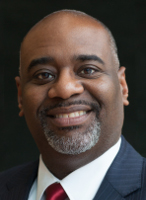
DSC_0003Karen Lincoln Michel challenged us to think in a different way about workplace perceptions, the importance of fostering diversity in our workplaces (particularly if we are leaders), and to be sensitive to the welcome our workplace culture extends to those with different ethnicity, gender, or cultural background.
Leaders with hiring responsibility need to be aware of affinity bias – the tendency to hire those who look like us or have the same background.  Our perceptions can powerfully influence our decision-making process, often without us realizing it!  By selecting people with similar characteristics we miss out on key insights and perspectives that someone outside of our experience and background can bring.  She challenged leaders to have the courage to step out of their comfort zones to realize the benefits that increased diversity can bring.

True workplace diversity demonstrates benefits in terms of being able to attract top talent, improved customer relations, improved employee satisfaction, better decision-making, and retaining talented employees.  The business environment is a diverse place and hiring and retaining staff to effectively address that environment only makes good business sense.  On a tangible basis, Ms. Lincoln cited a McKinsey study that indicated that firms with greater diversity showed a greater likelihood to financially outperform their peers.

Finally, culture matters.  Workplace and community culture is important to the success of diversity efforts.  Is the culture welcoming?  Do persons of color feel isolated?  Programs and policies are not enough – leaders have to truly engage and drive the initiative and commit to recruiting and supporting diverse candidates.

Ideas for true engagement in workplace diversity programs include having an officer or position in charge of fostering diversity, mission statements that include diversity as part of the organization’s core values, creation of an inclusive and positive atmosphere, widely seeking out candidates, and providing mentoring relationships to support individual success.

If you missed our meeting this week, you can watch the video here.