
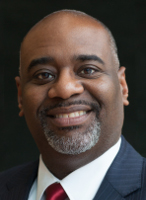
–submitted by Ben Hebebrand; photo by Valerie Renk
 Self-identifying as the “Benedict Arnold of conservatism,” Wisconsin conservative radio talk show host and author of several books Charlie Sykes addressed members of the Rotary Club of Madison on Jan. 3 to promote his book “How the Right Lost its Mind.”
“I left (the conservative radio talk show circuit) on my own, but I have been excommunicated from the conservative movement,” remarked Sykes, who now works for MSNBC. But Sykes was rather firm in proclaiming that “I have not changed, but the Republican Party has,” indicating that conservative values are still very much part of who he is.
While the vast majority of Sykes’ comments centered on the performance and behavior of President Donald Trump, Sykes made it clear that “I am less bothered by Trump himself, but rather the normalization of his behavior.”
Sykes identified three specific current political thought movements afoot in our country. Firstly, there are those who are “horrified by everything – both the policies and the behaviors.” Secondly, there are the MAGA Republicans, those who want to Make America Great Again; and thirdly, there are what Sykes termed as “mainstream Republicans,” who are looking the other way as regards to the President’s behavior, since his policies represent wins. “You get what you want (in terms of policies), but the price is too high,” he said.
The price is too high because one has to ignore behaviors such as name-calling, bullying, withdrawal as a world power, or classifying the media as fake news, said Sykes. But the most important litmus test on whether the price is too high is that “we have to accept the indifference on our democracy by the Russians.”
Sykes included several other items one must ignore such as the endorsement of Roy Moore, the Republican Senate candidate from Alabama, as well as the President’s erratic behavior in regards to the escalation of the potential of a nuclear war in the showdown with North Korea.
“The bottom line is that we have to realize that our political culture is more fragile than we thought,” said Sykes. We could go down the path of other democracies,” said Sykes. He characterized Trump as a cause of our current situation, but also referred to the President as “a symptom of a pre-existing condition.” While Sykes did not directly identify the pre-existing condition, he implied that it is our current tribalism that is at the root of the current political climate. Disagreement has turned to hate, he said, resulting in a “binary, polarized culture.”
In offering a glimpse of improvement to the current political landscape, Sykes offered that the current modus operandi may lead to a revitalization of democratic norms. Potentially, a coalition of Center Right and Center Left could restore the norms.
Our thanks to WisconsinEye for videotaping our meeting this week. You can watch the video here.

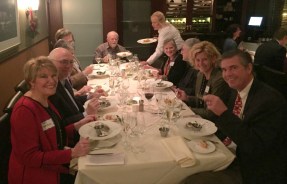
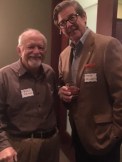 Twenty Rotarians enjoyed an evening of haute cuisine and interesting conversation during our Culinary Arts Fellowship on December 4, 2017. Many thanks to Boris Frank (pictured here with Steve Wallman) for planning an innovative dining experience with Chef Tim Van Doren from Johnny Delmonico’s Steakhouse. Our server, Cynthia McDonald, was well known to our group for her service at our weekly Rotary meetings. She made the evening special.
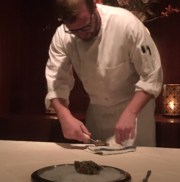 Our first course began with Chef’s demonstration on how to correctly shuck oysters as we learned the difference between the briny East Coast oysters and the more fruity flavor of the West Coast variety. Also, it’s OK to eat oysters year round because they are farmed around the world dispelling the idea of eating them only in a month ending in “R”. The oysters were accompanied by a charred scallion mignonette and sparkling wine.

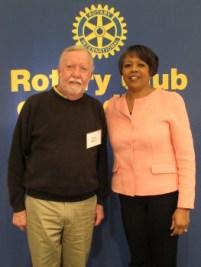 The river that stretches 2,350 miles dissecting the United States has earned many monikers throughout its storied history– it has been referred to as America’s lifeblood, Ol’ Man River, or the Big Muddy. Dennis McCann, who addressed the members of the Rotary Club of Madison on November 29, refers to the Mississippi as “This Storied River,” which is the title of his recently published book that celebrates particularly the Upper Mississippi’s history and role in shaping the Midwest.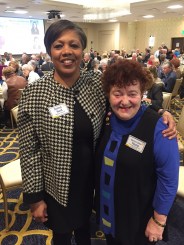
 When the US entered World War 1 in 1917, the war came to dominate the daily life of citizens in Wisconsin. There were initially concerns about our state since 38% of the population had been born in Germany or had a parent born in Germany. Riots were expected on the first day of the draft, yet they did not materialize. Instead 218,000 people (106% of the estimated eligible number) registered, and 5% of the state’s population served in the military. Families were urged to conserve food, grow a garden and avoid eating wheat, sugar, meat, and fat, all of which were critical to the war effort. There was not just social pressure, but aggressive action to ensure that people bought war bonds, and volunteers told those who bought fewer than their means allowed that they would be reported to the County Council on Defense. Dozens were indicted under the Espionage Act for criticizing the war, insulting the flag, opposing war bonds, and other “unpatriotic” remarks. Vigilante groups like the Knights of Liberty took the law into their own hands against “disloyal” citizens, and German language school books were burned.
 Rotary Club of Madison, Wisconsin