
 The past year has been a whirlwind of challenge and of change, starting with my unexpected appointment as club President and ending with our Rotary Club poised to transition back to in-person meetings as the pandemic continues. It has been my honor to be club President through this time. I’ve had the opportunity to experience firsthand our Rotary Club as a place where members CONNECT, SERVE and GROW.
Since I joined Rotary in 2013, I have valued the many new CONNECTIONS and friendships that have enhanced my life, whether through committee work, the hiking/skiing fellowship, community service projects, or my time on the board and as President. I’ve found that the more engaged I’ve been, and the more people I’ve worked, sung, chatted and laughed with, the more I’ve been able to learn and grow.
In my SERVICE to the club, I’ve learned that in Rotary you never have to meet a new challenge alone. As soon as I became President, several Past Presidents stepped up and offered their support. I would have been lost without the assistance, in particular, of Jason Beren and Pat Jenkins. And I want to give a special shout-out to Stacy Nemeth for setting the stage for this Rotary year through her diligent strategic planning work last year as President-Elect. Club service is a great way to get to know people and to help make our club a better place for a diversity of community leaders to connect, serve and grow.
I have GROWN through Rotary, especially in this past year. Here are some things I had to learn as President:
- I’ve learned that you need to hit the wider bottom part of the Rotary bell, not the narrow top part, if you want people to hear it. Not a big deal — it was just embarrassing!
- I’ve learned there are two strong stances represented in our club membership regarding singing at Rotary. I became President just when it was decided to try cutting back on our music. I hope we have arrived at a compromise that all members enjoy.
- The same goes for the Question & Answer periods with our speakers. That was a hot topic last summer, but I hope members are comfortable with our current approach.
- I’ve learned some technology, in particular how to pre-record my portion of the weekly meetings, so we could continue to meet online through the pandemic. Brian Basken and Jason Beren have done yeoman’s work to develop the technology needed to uphold the professional standards our weekly meetings are known for. This month Brian and Jason moved to live-streaming the meeting from Pearson Engineering, where they work. Next month we plan to live-stream our meetings with a limited number of members attending in person, abiding by good social distancing, while all others may participate from home.
- I’ve also learned from Teresa Holmes, Charles Tubbs and others about complex racial justice issues facing our community. I’ve learned from Karen Kendrick-Hands and Larry Hands about environmental sustainability. These are important issues we must address, and I value the opportunity to connect with people who know far more than I do.
Going forward, I believe the most important goal for our Rotary Club is that of striving to be more actively welcoming to all leaders in our community. In a few minutes you’ll hear from the Racial Equity and Inclusion committee that our intentional efforts in that area are working. To continue that progress, we need to accept that what has been comfortable in the past is not — and was not — comfortable for everyone. Good intentions are not enough. I’ve learned that we need to actively educate ourselves and speak out when we see injustice or hate. For white Rotarians like me who have benefited all our lives from the privilege of our race, this requires some humility to understand that there is a lot we don’t understand. The hard work is still ahead of us, and it’s good that we’ll have the steady leadership and vision of Jorge Hidalgo and then Mark Moody in the years to come.
With intention, patience and kindness as we work toward change, we will come closer to the Rotary Four-Way Test and build a club that is fair, that builds goodwill and better friendships, and is beneficial to all concerned. Thank you.
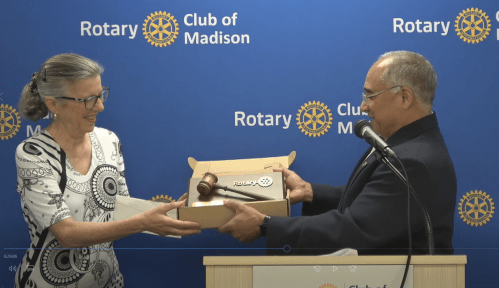 Well! This was quite a meeting.
 This week, UW-Madison School of Journalism Professor Michael Wagner spoke to the Downtown Rotarians on Pandemic Voting: Information, Geography and Polarization in the 2020 Elections. The J-School has done a lot of research on the impacts of media and voting and has tracked the polarization of Wisconsin voters since 1996. Since that time, we’ve seen a decline in local newspapers and local news reporting, a rise in talk radio and social media, as well as a stark rise in the amount of political advertising in our state. The School of Journalism has done a lot of research on the impact of changing information channels and has found that the broader your media diet, the more likely you are to vote outside of party lines. As an example, those who viewed a wide range of information sources were 50% more likely to split-ticket vote in an election (i.e., choose candidates from more than one party on the same ballot). Those who consumed a narrower range of media had nearly no likelihood of splitting a ticket.
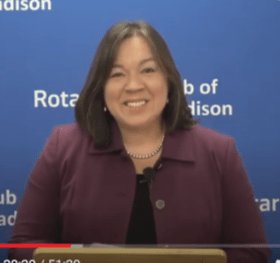 Renee Moe challenged Rotarians June 10 to improve race relations by being more willing to talk about the issue. Moe is President and CEO of United Way of Dane County, where she has held a variety of positions. She shared some of her personal challenges growing up bi-racial in rural Wisconsin. She said, “At 12, I remember praying to be killed, but as a teenager, thankfully, I knew it could be different from my early years abroad. Please know people are hurting because of how society comes together.”
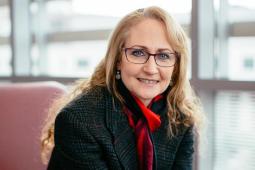 This week, UW-Madison Professor Jo Handelsman talked virtually with the Downtown Rotary about a project she began while working at Yale University in 2012 called Tiny Earth. This important project was developed to increase the number of students pursuing STEM degrees as well as address the growing antibiotic crisis. Researchers estimate that unless we do something soon, by 2050 the leading cause of death will be related to bacteria-related illness.
 On May 20, 2020, VA Secretary Mary Kolar gave an insightful presentation regarding the significance of Memorial Day. She first offered information regarding the Wisconsin Department of Veterans Affairs and the services and benefits provided for service members in Wisconsin, where 345,000 veterans reside. The WDVA works hard each day to ensure that veterans have access to all benefits available to them. The programs the WDVA oversees extend from administering the Wisconsin Veterans Museum (a Smithsonian affiliate that welcomes 90,000+ visitors each year), where it continuously educates the public with unique stories and histories of Wisconsin’s veterans, to veterans’ cemeteries where our veterans receive honorable burials, to providing access to mental health and housing assistance.
 Rotary Club of Madison, Wisconsin