
submitted by Valerie Renk; photo by Valerie Renk
 While 2019 is just starting, economists are already looking at their crystal balls. Steven Rick, CUNA Mutual Group Chief Economist started his Feb 13 Rotary speech with a “five-minute Federal Reserve Board Meeting.” Rick asked, “What is the economy’s most important price?” It’s money, measured by interest rates. The Federal Reserve (Fed) is targeting 2% interest. They also want labor fully employed and capital resources fully employed.
The Fed has five critical measures:
- First, we are hitting their two percent inflation (interest) goal. The 2019 forecast is slightly above this and will drive interest rates.
- Second, the unemployment rate goal is 5%; actual is 4%. This is one of the tightest labor markets in history, hindering economic growth. Rick expects this to rise again by 2020 and hinted at a slight recession a year and half out.
- The third measure is the economic output gap. The Fed’s goal is no gap. Actual is 2%. This is GDP output vs. federal funds rate.
- The fourth measure is Feds Funds Interest rate (overnight bank loan rate) which has a goal of 3% and actual of 2.4%.
- Fifth is the 10-Year Treasury Rate. That goal is 4% with actual of 2.75%. This means what you earn at your financial institution for savings and CDs will rise.
Rick said four things cause recessions: financial imbalances or excesses; external shock such as war; high inflation; and high inventories.
Home prices are rising 6% while incomes increase 3%. This could lead to another housing bubble. “But this time is different because there is not excessive demand due to low inventory,” Rick said.
Rick shared a quote: “Stability leads to instability. The longer things are stable, the more unstable they will be when the crisis hits.”
If you missed our meeting this week, you can watch the video here.
 UW-Madison Political Science Professor Barry Burden, on February 6, gave Rotarians an overview of the November 2018 election in Wisconsin, along with an analysis of how and why voting patterns differed from past midterm elections.
 We learned from Dr. Nathaniel Chin that lifestyle factors have a great deal to do with forestalling or preventing cognitive decline leading to Alzheimer’s Disease (AD). And positive change takes place no matter your age… if you do physical exercise, eat better foods, lower stress in your life and sleep better.
 Joe Parisi, Dane County Executive since 2011, shared information with downtown Rotarians about area lake cleanups; mental health assistance in our schools and an update on airport expansion.
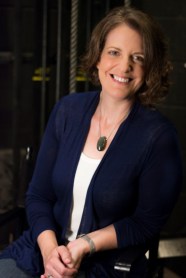 Founding artistic director Jennifer Uphoff Gray of Madison’s Forward Theater Company attributes their growth and success to the strong community involvement, much like the Rotarians gathered to hear about Forward Theater’s first decade. This has been a successful span, but their success was by no means a given in the early days. Gray noted the precarious economic climate in their founding days and how it confirmed their abiding commitment to a sustainable financial model for the theater and especially for the artists they employ.
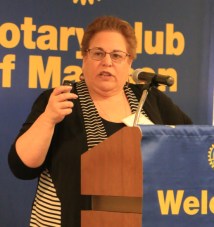 The recent claim by Chinese scientist He Jianjui that he successfully altered the DNA of twin girls to build up the twins’ HIV resistance served as a backdrop of the Rotary Club of Madison’s weekly meeting, whose guest speaker Dr. Alta Charo, a UW-Madison professor of law and bioethics, offered as a broad outline of ethical considerations concerning Human Genome Editing.
 Rotary Club of Madison, Wisconsin