
–submitted by Dawn Crim; photo by John Bonsett-Veal
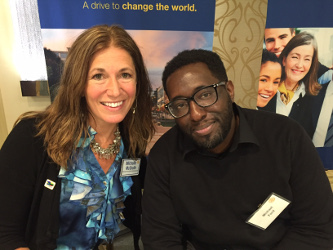
Club President Michelle McGrath and Michael Ford
What can Rotarians learn from the intersection between hip hop and architecture? Michael Ford educated Rotarians on the intersection first starting with history. How hip hop has influenced things over time with things ranging from chairs, boots and photos to artist evolutions. Michael Ford took Rotarians through the creative journeys of Pablo Picasso’s art and Le Corbusier’s architecture illustrating their connection to Hip Hop and the influence Hip Hop had on their work.
Michael Ford shared how Le Corbusier’s five design elements first introduced in Paris were brought to life in urban buildings in New York through Robert Moses’ designed buildings. Unfortunately, Robert Moses only took parts of Le Corbusier’s plan, just using the physical structure, missing the spirit of what the building could do for people. The result, Michael Ford described as an architectural ‘bad remix’ because the buildings in New York City, although similar in physical structure were considered ‘concrete jungles’, not contributing positively to the spirit and lives of the people living there.
According to the talk, it is no coincidence that rap was born in New York City, in the Bronx, because that is where many of these structures were built. One can trace rap songs in the 1970’s back to descriptions of these structures.
From the popularity of his lectures and expertise, Michael Ford is helping to design the Universal Hip Hop Museum in New York City. He is working with Hip Hop artists from the 70’s and 80’s like Kurtis Blow and the Sugar Hill Gang to design exhibits to tell their our story in the museum. The museum will include public housing, market rate housing, a hotel, children’s museum, retail space and an amphitheater.
Michael Ford has done talks and projects all around the country. He has also created Hip Hip Architecture Camps here in Madison. The camp’s mission is to introduce traditionally marginalized or underrepresented youth to architecture, urban planning and economic development through the lens of hip-hop culture.
He has partnered with the City of Madison Department of Planning, Community & Economic Development, The Madison Public Library and Capital Area Regional Planning Commission to help kids bring their visions and voices into the Imagine Madison Initiative. This initiative will provide input into the City’s 25-Year Comprehensive plan.
From the response to today’s talk, many Rotarians may also bring their ideas to the plan. Some of those ideas may be grounded in hip hop.
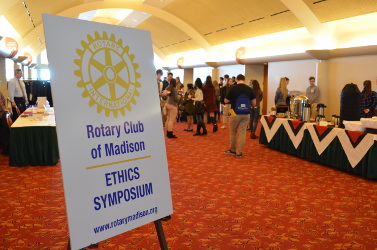 More than 200 students from 20 area high schools assembled at Monona Terrace Convention Center on February 17 for the 17th Annual Rotary Ethics Symposium, underwritten by our club’s Madison Rotary Foundation. They were welcomed by 2017 Ethics Symposium Chair Steve Johannsen, who noted that we all face ethical dilemmas several times a week. He explained that often it’s a small matter, for example, what to do when your cell phone starts ringing in a meeting. Other dilemmas can be gut-wrenching. Steve introduced the students to a hierarchy of four stages of ethical decision-making:
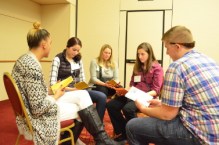
 The First Wave Hip Hop Theater then opened the event artistically with dramatizations of three ethical dilemmas that teens might have to face: what to do when the friend who drove you to a party gets drunk; what to make of a famous athlete’s protest during the national anthem; and how to talk with a friend about a decision he has made. First Wave is a cutting-edge, multicultural, artistic program for UW-Madison students. It was the first university scholarship program in the country centered on the spoken word and hip-hop culture. The actors portrayed the dilemmas with humor and insight, and the moderator (a First Wave alumnus who now teaches in the Verona schools) invited audience participation between acts.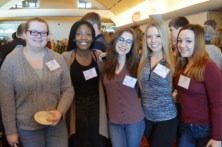


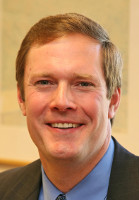 Entrepreneurship is one of the most important drivers of economic and job growth in our state and across the globe. It is also a topic that is of growing interest to today’s college students. On February 15, Dan Olszewski, the Director of the Weinert Center for Entrepreneurship at UW-Madison School of Business, spoke with us about how UW-Madison is one of the leaders in teaching and inspiring students interested in entrepreneurship as a potential career.
 Madison’s Mayor Paul Soglin, serving his 20th year as mayor, made his 26th appearance at our club. Here to discuss what Madison might be like in 2050, he gave a few facts about Madison in 1950: a population of 96,000; about 95% white; occupied an area of approximately 33 sq. miles. Today we have a substantially more diverse population and occupy about 80 sq. miles. By 2050 Madison will probably be a city occupying about 103 sq. miles. In 1950, the major employer was Oscar Mayer. Today the largest employers are UW Health, Epic, the UW Hospital, and American Family Insurance. Madison is one of 5 U.S. cities considered a bicycling community which is rare among metropolitan areas not in the south, but that is growing. It is also the 3rd coldest — after the Twin Cities and Anchorage, Alaska. Epic has created an atmosphere hospitable to tech companies and entrepreneurial businesses. As household numbers decline, we need more units; 1,000 new units per year barely keeps us even.
 What happens when you live in a society where the government and the majority of the people show a complete disregard for social and civil rights? Well, if you’re Carson Gulley you defiantly march on in the face of adversity and accomplish greatness against all odds.
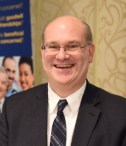 As Scott Seyforth noted, in 1954, Gulley was a speaker at our [then all-white] Rotary Club. It’s natural to think of Carson Gulley’s odyssey with admiration for his courage, yet one can’t help but think of the torment that he endured during a lifetime of discrimination.
 Rotary Club of Madison, Wisconsin