Tag Archives: Rotary Club of Madison

Wine Fellowshippers at Tasting on October 30

–submitted by Mike Wilson
dsc07990

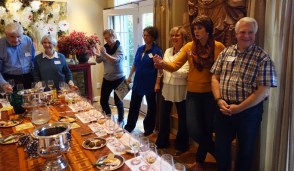
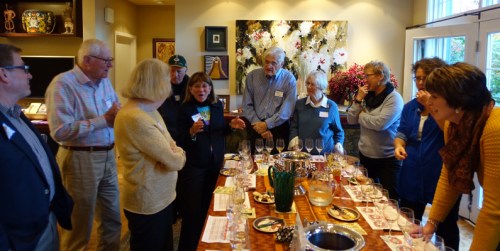
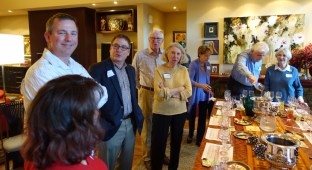
We had 18 people at the Rotary Wine Fellowship tasting at the Wilson’s on Sunday, October 30th, 2016.  We tried Loire wines as a result of an earlier BYO Rotary Fellowship tasting at Steve Mixtacki’s home when Erin Luken brought a Loire Chenin Blanc that tickled my fancy and made me look into the region.  In several instances we tried the Loire wine against a New World version for contrast.

The region is very old wine-wise, having been established in the Roman era.  It has a good proportion of all of the French AOC’s and is characterized by having famous red (Cabernet Franc, Beaujolais, Pinot Noir) and white (Chenin Blanc, Sauvignon Blanc, and Muscadet) wines.  The most famous is the Sauvignon Blanc, and a selection of good ones is a requirement of a good restaurant.
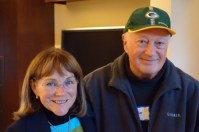
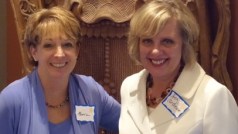
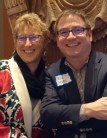
dsc08013  dsc08003  dsc08007

Photo 1: Jane & John Wegenke; Photos 2: Meryl Mixtacki & Ann Cardinale; Photo 3: Becky Steinhoff & Mike McKay

First we tried two Muscadets (unique to the Loire, and grown only in the Coastal Loire) and a Loire Sparkler made with Chenin Blanc.  All were very well liked with no definite favorite.  The sparkler (Methode Champenoise – Champagne wants us to call this MethodeTraditionale, so there is no mention of Champagne on the label at all) was very nice.  Next we had two Sauvignon Blancs: a Sancerre – the great Sauvignon Blanc of the Upper Loire – and an example from the Touraine – the Mid Loire – which much like the Mid Loire Anjou Region – grows the 4 major Loire grapes: Chenin Blanc. Gamay Beaujolais, Cabernet franc, and Sauvignon Blanc.  We contrasted this with a NZ Sauvignon Blanc as the New World comparison, where the fruit expression dominates the effect of the terroir.  The fruit was best detected in the NZ version, but tasters were again equally divided in their preference for a particular style.

We then tried Chenin Blancs.  We had one from the Anjou-Saumur, and one from Vouvray (the more famous Chenin Blanc region).  Vouvray specializes in Chenin Blanc and is surrounded upstream by the Anjou-Suamar and downstream by the Touraine-Chinon.  We contrasted this with a Washington State version.  Again all were liked without a marked preference.
dsc07988   dsc07989

Next we tried Cabernet Francs – a Bordeaux varietal famous in the Loire,  We tried one from Saumur and one from the more famous Cabernet Franc Chinon region that specializes in this red varietal. We contrasted these with a Paso Robles from Adelaida from Mike’s cellar that was older and rated well by Robert Parker.  All were nice, but this sequence demonstrated the winner of the tasting, with the New World wine being the winner by a significant majority vote.  This wine was significantly older and more expensive than the Loire counterparts, no doubt the explanation of it’s preference by most attendees.

At the end we had two Noble Chenin Blancs where the grape is desiccated by Botryitis fungus and we end up with a wine that is concentrated, sweet, and with a unique honeyed flavor.  We tried a 2002 Coteaux du Layon (a special appellation within Anjou) and a Quarts de Chaume (a special region within the Coteaux du Layon).  These wines are said to last forever!  These were the most expensive wines in the Loire, and were my personal favorite with the latter being the best, and rated variously as 95-96/100.  The latter was the most expensive wine ($43 for a 500 ml bottle).

dsc08005

Mike & Patty Wilson

The tasting was excellent.  Most attendees said that it was really the best collection of wines they ever had at one of our tastings.  The majority of these wines were suggested by the staff of Steve’s Liquor on University Avenue and were included in the tasting without Mike tasting them.  This is confirmation of the role of the individual sales persons in good wine shops, who can provide specialized advice even to frequent wine shoppers where you can get to know a salesperson with similar taste and also have access to sales regional sub-specialists.
Stories Abound From the Grave

–submitted by Moses Altsech; photo by Jeff Burkhart

mccann-dennis-10-26-16

Dennis McCann pictured here with Club President Michelle McGrath

Whatever you thought you’d do after retirement, chances are it didn’t involve looking up graves. And yet that’s exactly what Dennis McCann did after leaving the Milwaukee State Journal. The stories he told us were not of ghosts, but rather of fascinating historical events—like the Peshtigo Fire or the Bayfield Flood—that he got to know more intimately by visiting cemeteries.

More importantly, through his cemetery visits, McCann got to know the people buried there—sometimes ordinary and sometimes extraordinary: Their story is sometimes captured by unique gravestone inscriptions (“In 1958 a contest was held to find the meanest woman in the world. Alas, I married both the winner and the runner-up… But if either are buried in this lot beside me there is going to be a resurrection”) and sometimes left unsaid—as in the case of John Heisman, whose tombstone doesn’t mention his Heisman Trophy fame.

Here in Madison we have the graves of 140 confederate prisoners of war held at Camp Randall, alongside the grave of the woman who once took care of their gravestones.

“Cemeteries are full of stories,” said McCann, obviously relishing the quest for discovering and telling those truly captivating stories.  In one instance, McCann interviewed a grave digger who took great pride in taking care of his cemetery much like he kept his yard at home.  “You got to be a cemetery man,” the man told him. “You got to be dedicated.” In Dennis McCann’s case, it takes one to know one.

If you missed our meeting this week, you can watch the video here.

For the Love of Nature

–submitted by Andrea Kaminski; photos by Karl Gutknecht

aldo-leopold-3

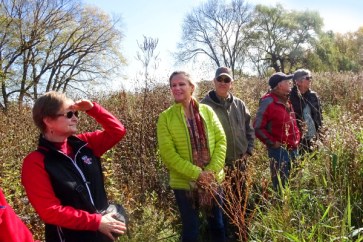
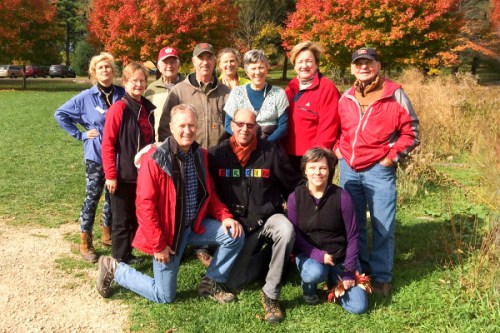
Many things brought a group of 10 Rotarians and guests to the Aldo Leopold Nature Center on Saturday, October 22. Did you know Debbie Gilpin is on the Nature Center’s board? Frank Stein quipped that only one tree grows in Brooklyn, where he grew up, and therefore he loves being among the trees in Wisconsin. Herman Baumann grew up not far from Brooklyn in New Jersey, and he became an outdoorsman and conservation writer after he moved here. Jeff Tews served on the Rotary Community Grants Committee when it made a grant to support the Center’s Campfire Fund, making it possible for 5 out of 14 economically-challenged children to attend summer camps at the Center this year. The rest of us simply were inspired by the opportunity to take a walk in this natural gem in an urban area on a beautiful fall day.

aldo-leopold-5aldo-leopold-4
Karl Gutknecht organized the outing and arranged for a guided tour of the property by Kelley Van Egeren, Director of Development and Stewardship. Kelley claimed to have the best job in the world, and she’s had it for 15 years. She loves the Center’s mission to connect kids, and all visitors, to nature.

aldo-leopold-6

Aldo Leopold Nature Center offers 21 acres of oak savanna, wetlands, prairies and woodlands, and it serves more than 20,000 kids per year. On our walk we encountered a group of Eagle Scouts engaged in a work project. They had obtained donated materials and were working to seat and build new workbenches near the pond. Several Brownies were busy identifying pond critters at a similar workbench nearby.

aldo-leopold-1

We finished our tour at a replica of Aldo Leopold’s home. Kelley explained that Leopold and his wife used a suspended, old-fashioned snow fence – the kind with wooden slats – as a bed for their five children. I wish I’d known about that 35 years ago. We could have saved a bundle on bedding for our kids!

aldo-leopold-7

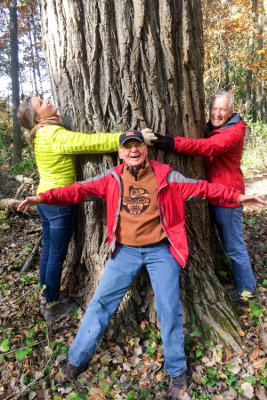
Hiking Fellowship  Downtown Rotarians and guests (front kneeling from left) Jeff Tews, Karl Gutknecht, and Deb Gilpin.  (Standing from left) Kelley Van Egeren, Aldo Leopold Nature Center; Leslie Overton, Dean Nelson, Herman Baumann, Susan Rather, Andrea Kaminski, Kay Schwichtenberg, and Frank Stein.

Reducing Madison’s Recidivism Rate

–submitted by Stan Inhorn; photo by Jeff Burkhart

ketcham-linda-10-19-16

Linda Ketcham, Executive Director of Madison-area Urban Ministry (MUM), told Rotarians about the many ways that her organization, in conjunction with many other agencies and non-profits, is working to increase prisoners successful return to community life. MUM has a long history of promoting social justice and studying issues such as transitional housing that bring partners to the table.

Incarceration is a major problem in the U.S. and in Wisconsin and Madison. More than 90% of prisoners return home after serving their terms, and they face daunting problems that often lead to serving additional time. Furthermore, the system is flawed so that people of color represent a large segment of the jail population. Children and other family members experience collateral damage from the incarceration of a mother or father.

MUM has a long history of helping returning prisoners. Circles of Support is a program that links volunteers with persons released from jail. Extensive research has produced a body of literature that identified 8 principles that lead to effective strategies. These include the need to assess the risk of a person committing new crimes. It is more productive to focus on the medium to high risk individuals rather than on the low risk ones. Create a needs assessment on each individual to determine if specific issues, such as addiction, should be addressed first. Target interventions to their learning styles. Provide skill training and provide positive interactions and ongoing support.

With all their efforts, in conjunction with United Way, MUM has helped to reduce the recidivism rate from 66% to 12% in Madison. MUM continues to work with other nonprofits to provide mental health programs, housing, building of credit scores, and employment. Even though these programs are expensive, they are far cheaper than keeping people in jail at a cost of $29,000 each year.

If you missed our meeting this week, you can watch the video here.

One of 63 Talks: District Governor Dean McHugh

–submitted by Valerie Johnson; photo by Jeff Burkhart

mchughdean-10-12-16

District Governor Dean McHugh pictured here with Club President Michelle McGrath

Dean McHugh, District Rotary Governor, addressed the October 12 meeting of the downtown Rotary as one of his 63 talks of the year.  Dean is from Holmen, a club of 38 members and ten years old, where he runs an excavation business with his father. Dean shared three stories, powerful to him, that illustrated why Rotary is important.

Dean’s first story was that he was asked to Rotary meetings twice before he attended, because he didn’t see the value proposition immediately.  They didn’t give him the complete story, so he declined.  Having been a foreign exchange while at UW-LaCrosse, he was in Colombia for 7 months.  He came home with a greater understanding of the world, with a love for a second country and with a second family.   “Holmen Rotary tapped that interest, asking me to help with our exchanges, so I joined,” he said.

Second, Dean told the story of a signature Rotary project that caught his attention.  Holmen Rotary raised $7,000 for a project in Lima, Peru.  This was turned into a $25,000 through Rotary matching funds.  They used bio sand water filters to give 15,000 people clean water.  They have now done five clean water projects impacting up to 50,000 people.  “It’s powerful to go see what one small club can do in the world,” McHugh said.

For his third story, McHugh told of trying to recruit Scott Ryan, a friend of 40 years, to join Rotary.  Ryan attended eight meetings before joining, thinking he wasn’t qualified.  Scott joined, but didn’t really become a Rotarian until he went on a Peru trip.  His daughter sent him hair clips to take to people he met. When distributing them, the girls hugged him; he saw they appreciated his caring and he wept.  It was a real Rotary moment.  Scott went on to become youth exchange officer and then club president.  He started four new clubs and is now a district officer.  McHugh says, “I’m proud I gave him the gift of Rotary.”

Dean warned 10% of members drop out each year and challenged the club to bring in at least 50 members.  He closed with, “May Rotary friends and Rotary ways continue to help you serve.”

If you missed our meeting this week, watch the video here.

Living with Epilepsy

–submitted by Donna Hurd; photo by John Bonsett-Veal

seaborg-kristin-10-5-16

Dr. Kristin Seaborg (left) with Club President Michelle McGrath

If asked, “What illness affects 1 in 26 people, 50 million people worldwide; greater than 100,000 soldiers coming from Iraq and Afghanistan; attributed to 1/3 of all sudden deaths in children?” Would your answer be: cancer, heart disease or diabetes? What if you were told that this illness contributes to $15.5 in indirect medical costs per year; more than 7 times higher than any other chronic disease, including diabetes and heart disease? The mystery is not in the disease, but in what is known about the disease and the number of individuals affected by it.

With 200,000 new diagnoses per year, Epilepsy is a neurological disease that affects individuals more than muscular dystrophy, multiple sclerosis, cerebral palsy and Parkinson’s Disease combined. It accounts for 50,000 deaths per year, but only accounts for one-fourth of research funding of all other neurological disorders.

So why don’t we talk about? The stigmas associated with this disorder would make the most confident person keep the secret to themselves. While the discussion has advanced beyond medieval thoughts of divine punishment for sinners and identification as witches, vexed with evil spirits (I hope), many continue to remain silent about this malady as a sense of shame continues to be invoked.

Our guest, Dr. Kristin Seaborg, presented a compelling argument for disclosure and discussion about this condition as it will encourage an open dialogue, dispel the sense of shame, and create a climate of discovery, not disdain.  Dr. Seaborg decided that she would not let Epilepsy rob her of her dreams and through her book: The Sacred Disease: My Life with Epilepsy, discloses her experiences with the disease and why this is a conversation we must have.

For more information about Epilepsy go to www.efa.org.

If you missed our meeting this week, watch the video here.