
–submitted by Jerry Thain; photo by Valerie Johnson
 Dr. Edward Coffey, President & CEO of the Menninger Clinic, as well as Professor of Psychiatry, Behavioral Sciences & Neurology at Baylor College of Medicine, was in Madison June 7-8 for a collaborative meeting of 150 health and other community organizations to discuss treatment of depression and the goal of zero suicide. He spoke at our meeting of June 8th about his work in this field.
Assisted by funding from the Robert Wood Johnson Foundation, research and work to reach a goal of Perfect Depression Care (PDC) has been a focus for Dr. Coffey in recent years. He noted that suicide rates in the US have increased over the last 15 years, especially among middle-aged white males, and the rate in Wisconsin is now at 13.5 per 100,000, although Dane County has a lower rate.
PDC became a goal of both the Institute of Medicine & the American Psychiatric Association when each issued reports indicating that the mental health care system was in chaos and needed a total overhaul. Dr. Coffey said there are six dimensions to achieving PDC: Safe; Effective; Patient-centered; Timely; Efficient & Equitable. He described rules developed to attain these goals. As to why perfection is sought, he noted that a 99.9% effectiveness rate would result in 12 babies delivered to the wrong parents and 2 unsafe landings at Houston airport daily, among other things. Therefore, the goal to deal with suicide is to eliminate it, not just to reduce it dramatically. There must be a planned care model for treatment of depression that will be a system in which an informed, activated patient who has productive interaction with the health care professional treating the patient is the result. The six dimensions to achieve PDC are achieved only when treatment is perfectly safe and the patient is 100% satisfied that the other five dimensions have been met. Efforts to implement such a system at the Henry Ford Behavioral Health Sciences where he works have seen significant decreases in suicide rates there. The audacity of seeking perfection was noted by Dr. Coffey but he emphasized that anything less is unsatisfactory. In 2012, the US government adopted the concept of zero suicide in its report on suicide. In Wisconsin, there is a state wide suicide prevention strategy, but it has not endorsed the zero suicide goal to date.
Dr. Coffey concluded his presentation with a challenge to the Madison community to become the healthiest community in America even as he works toward that in his own community of Houston.
Did you miss our meeting this week? CLICK to watch the video.
 If you consider Wisconsin’s $44 billion dairy business to be all about big business, you might be surprised to find out that 96 percent of all of Wisconsin’s dairy farms are actually family-owned.
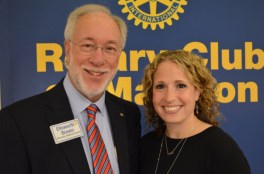 Dr. Katherine Schmitt who specializes in child and adolescent psychiatry highlighted the growing challenge of supporting children and their families through the challenge of illnesses such as ADD, ADHD, depression, bipolar disorder and schizophrenia.
 At our April 27 meeting, Dr. Noelle LoConte of the UW gave us some frightening, but also some hopeful information and a call to action during a presentation entitled Pancreatic Cancer Research: A Medical Oncology Perspective. As many know, often because of personal experience, pancreatic cancer is a particularly virulent disease, with a five year survival rate of less than 5%. With the exception of a rising incidence in the African American population, the incidence of this disease has remained relatively stable in our population. Nevertheless, pancreatic cancer is expected to be the second most common cause of cancer mortality by 2020. These numbers reflect the fact that there is no current method to screen for pancreatic cancer, and therefore, patients are typically diagnosed well into the disease process, when it is too late for effective surgical or drug intervention. In addition, the risk factors are not well established, although age is clearly the most important factor, with smoking, heavy alcohol consumption, and other contributors playing a role.


 The next round was a red wine presentation of Spanish Wines. Two were Rioja’s and the other a Priorat, and these regions represent the only regional DO’s with quality (i.e. DOCa) as classified by Spain. Both represent regional blends with Rioja’s having ~60% Tempranillo with additional Garnacha, Carignan, Cabernet Sauvignon, Merlot, and Syrah. The Priorat has more Garnacha but no Tempranillo but with the other wines also. We tried a 2009 Rioja Crianza (1 year in oak) at $20 and a 2009 Reserva (at least one year in oak and another year in oak or in the bottle) at $28. Incidentally there is a Gran Reserva with at least 2 years in oak and 3 years in bottle before release. The Priorat which is from the Catalonia region was a 2008 example at $30. These wines were very good and represent some of the best from Spain. All were very nice with no clear winner as I recall.
 Lastly we tried 3 very different red wines – a 2013 Catena Malbec from Argentina ($15), a 2010 Napa Watermark Cabernet Sauvignon of great quality, and a 2013 Unti Zinfandel from California (~$30). The most impressive was the Watermark with ~2/3 of the group preferring that wine. Unfortunately this is not available for purchase locally.




 Rotary Club of Madison, Wisconsin