Tag Archives: Rotary Club of Madison

All Ways Forward

–submitted by Ellie Schatz; photo by Will Anzenberger
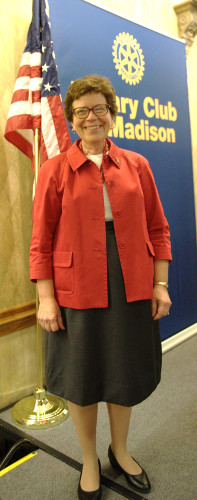
Rebecca Blank 11 4 2015The tone was set for Chancellor Rebecca Blank’s talk about moving the UW Forward by talented UW alumni. Soprano Emily Birsen sang “Quendo m’en vo” from La Bohème, accompanied by pianist Scott Gendel. Do we want to keep supporting and encouraging this kind of talent development in Wisconsin? Their standing ovation plus the response to Chancellor Blank’s opening questions (who in the audience works at, has a family member work at, or graduated from UW) signaled strong passion and commitment to our favorite education and research institution.

Chancellor Blank proceeded to give Renee Moe a run for her money as the fastest speaker we know. Filled with statistics, she demonstrated that we could feel the energy resulting from the tremendous investments to both education and research at UW since its founding in 1848. We can look forward to and support new approaches that will be both exciting and challenging as we move forward.

Trends at UW include a declining number of students from within the state, an increase in the number of out-of-state students, and an increase in the number of international students. There is a clear shift of students moving into STEM (science, technology, engineering, math) fields, which is a good thing, but with a caution: students should also understand the importance of writing, critical thinking, learning languages, and other skills taught in a broad liberal arts program.

Statistics supporting the good things happening at UW in education and research include: the student retention rate is 95.8! Graduation rates are up, and UW ranks as one of the top 25 research universities in the world. Given a changing research landscape, this means that to offset declining state and federal dollars we need to work differently, building research partnerships with industry. Chancellor Blank gave several examples of such partnerships, showing how we are growing in spite of the 250 million dollar cut in state funding, ongoing budget debates, and negative press.

All Ways Forward is a comprehensive Fundraising Campaign with the goal of raising 3.2 billion dollars by 2020. Recent gifts from John and Tasha Morgridge, Jerome and Simona Chazen, Albert and Nancy Nicolas, and the Grainger Foundation show how transformational gifts can help to move us forward. However, Blank warns, gift dollars are not substitutes for state dollars. $250 million in donor dollars does not equal that in state dollars for several reasons, i.e., gift dollars are tied to donor intent, gift dollars are in endowment, of which only 4 1/2% is accessible in a given year, and what we raise now in pledges may not be dollars in hand until many years out.

With continuing new programs and wonderful spaces, how can we not join the Chancellor in her enthusiasm and optimism. From the Villager Mall programs, a School of Education partnership with MMSD to build a pipeline of students of color and low income to help close the achievement gap, and excellent faculty, to awe-inspiring research, On Wisconsin.

 Did you miss  our meeting this week?  Our thanks to WisconsinEye for videotaping and providing this LINK.

Wine Fellowship Event on October 27

–submitted by Mike Wilson

From left: Mark Brant, Tracy Brant and Patty Wilson

From left: Mark Brant, Tracy Brant and Patty Wilson

The Wine Fellowship group met at Mike & Patty Wilson’s home on October 27 for the annual Mashambanzou Fundraiser.  This fundraiser has been held for the last 10 years and usually by the Wine Fellowship group, but once Dick and Noel Pearson held it at their place when the Wilson’s were not available.  In the past this has raised up to $1800/year for the Mashambanzou Care Trust (MCT), a Harare based organization in Zimbabwe.  The money is used for orphans and families in need, as a result of the AIDS epidemic. Initially the monies were used for uniforms (a requirement for elementary and high school attendance) and home assistance for these affected families and orphans, but this has graduated to continued education. The most recent monies were used to send several orphans to University/Technical Colleges.  This is a very worthy charity, a 501(c)3 registered group to which the UW Rotaract Club channels the donations that result in tax deductions for the Rotarian contributors.

wine oct 27MPictured at left, Annie Roensch (President of UW Rotaract) and Makenzi Tijerina (in charge of Rotaract fundraisers)  were present to help with the wine purchases, and started the event with a short presentation of the role of MCT and the monies previously raised by us for them to send to MCT.  These ladies will be important in the wine offering that will go to all the Madison Rotary Wine Fellowshippers – more to follow. Also, they will facilitate the IRS Tax deduction documentation/evidence for the entrance donations ($75) and donated portions of wines bought (15-25% of total cost).

Rachelle Richardson has been the driving force behind this fundraiser, and the 20 tasted wines were contributed by Purple Feet (now part of the Winebow group).  The sale of the selected wines will be through Steve’s of University Avenue, and facilitated by Wayne Crokus.  We required a retail outlet to get the sales tax registered, and they received a discount from Purple Feet, and discounted their sales price,to allow a significant portion of the wine price to be provided to the MCT.  Both the UW Rotaract Club and Steve’s liquor Store were vital to this fundraiser, and we, the Madison Rotary Wine Fellowship group, are indebted to them.

We tried Zardeto Proseco, Gruet Brut Methode Champenoise sparkling wine, and Ayala champagne (4 weeks before we tried Gruet Blanc de Noir) and all were excellent.

Next we tried three chardonnays, a Burgundy Bourgogne from Bichot, and a Melville Estates from the Santa Rita Hills CA, and Paul Hobbs from the Russian River Valley.  Again all very good.

Three wines from the 3/Three company proved the “Best Buy” wines with everyone raving about them, especially given their modest prices and their history of aging excellently.  Mike has old versions in his wine cellar.

wine oct 27B  wine oct 27D  wine oct 27E

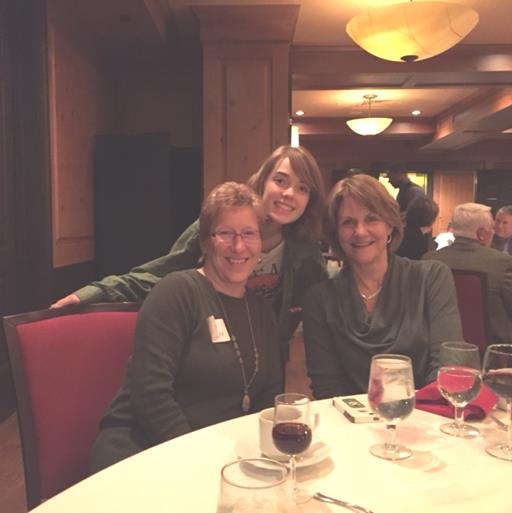
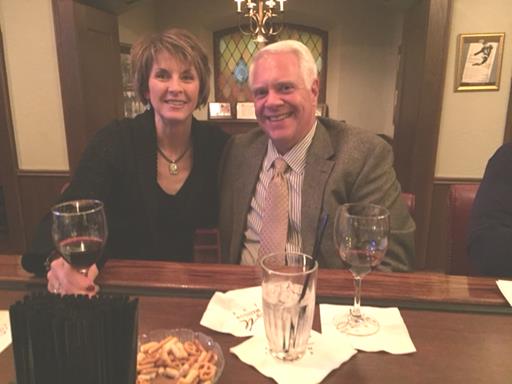
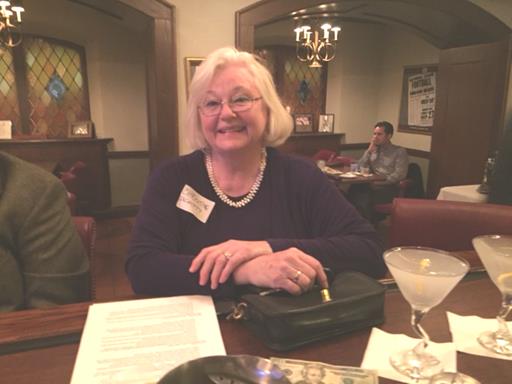
Photo 1: From left: Jane Wegenke, Meryl Mixtacki & Cheryl Wittke; Photo 2: Juli & Keith Baumgartner; Photo 3: Ken Yuska

We were reminded of the tasting a month before and four great red wines tasted then. Starting with an unbelievable Hey Mambo (a Sultry Red) from “The Other Guys” group in California, and a great Catena Malbec. These were two reasonably priced ($12 and $23 respectively) wines that scored the best reviews among the tasters at that event.  We also had a MollyDooker (left handed – in the land of OZ) Shiraz that continues a series of mind-boggling awards internationally for these wine growers, and a great but expensive Paul Hobbs Cabernet Sauvignon.

Meryl & Steve Mixtacki

Meryl & Steve Mixtacki

We also tried a Sardinian Cannonau (aka Grenache – Sardinia was once a Spanish colony hence the Grenacha plantings in Italy), followed by a Ripassa (a “repass” of Amarone grapes), and super Barbaresco (93 Pts).  A month ago at the Mashambanzou “pretasting” we had a very soft and beautiful Amarone (95 pts) that was loved, but the most expensive wine at these two tastings.

In all, between the event four weeks ago and last night’s event, we have tried 20 wines that are available. They all had scores between 89 and 95, with the Three 3/Three winery reds being unrated as far as I could find, but definitely “Crowd Pleaser” “Best Buys” in everyone’s opinions.

Of the tasters at last night’s event, $2200 worth of wine was purchased and this contributed between 15 and 25% of the purchase price to the MCT, and is tax deductible for the purchasers.  These were extraordinary wines that we are going to make available to all the Wine Fellowshippers for one week (more to follow soon).

wine oct 27I  wine oct 27H  wine oct 27K

The Wilson’s provided breads and crackers, cheeses (Brie, Maytag, and Dubliner), three Italian meats, and nuts, seeds, salted caramels, and of course Patty’s chocolate covered strawberries.

A good time was had by all, and Mike made some Aperol Spritzers for some to try, Patty and Mike having just got back from the Veneto where these originated, and are seriously consumed in Venice, Verona and Lake Garda by their observation.

David Maraniss on Detroit

–submitted by Carol Toussaint

You could tell by the number of people working their way around the Inn on the Park construction site that the speaker on this Wednesday had attracted a crowd.  Indeed, one of Madison’s favorite sons was there again to share insights captured in a new book, ONCE in a GREAT CITY, a Detroit StoryDavid Maraniss was back with another great story for Rotarians and their guests.

As his talk revealed, Maraniss was more interested in why things had happened in and to Detroit than to simply chronicle the events that brought down a great city. In the author’s note to his book he wrote that “the city itself is the main character in this urban biography, though the populace includes many larger-than-life figures.”   These individuals played key roles in the drama that was Detroit in 1962-64.  We met them Wednesday and learned some surprising things about the many ways each contributed to the vibrant city.

Whether it was the story of the launching of the Ford Mustang or the touching memories that talented performers shared about the creative side of the city, Maraniss researched through interviews as well as documents.  The migration of African Americans from the South to jobs in Detroit influenced the development of the Motown music and the stories of the prominent stars, many of whom rose from modest beginnings, are well represented in the book.

Reading Maraniss’ book is a bit like receiving a postcard from your favorite cousin who visited Detroit in 1963 and reported that “it had everything!”  Rotarians got a sense of what was behind the “everything” and enjoyed the inside view of it all.

Did you miss our meeting this week?  CLICK to watch the video.

Doug Moe Speaks to Madison Area Service Clubs on October 21

–submitted by Linda Maremont

Award-winning journalist and author Doug Moe was the keynote speaker featured at the 52nd Annual Madison Area Service Club’s Luncheon held at the Sheraton Hotel.  A lifelong Madisonian and graduate of UW-Madison, Moe has worked as a journalist and author for almost 40 years. As a daily newspaper columnist for The Capital Times and Wisconsin State Journal, he wrote some 4,000 columns. Prior to his newspaper career, he was a writer and editor of Madison Magazine.

Doug shared some of his more memorable experiences over the course of his journalistic career.  Contacted by a sports agent to write NFL defensive end Lyle Alzado’s biography, Moe’s book was aborted over a controversial chapter regarding Alzado’s anabolic steroid use.  He was invited to join a transplant team flying to central Illinois to harvest a liver, then returned to witness the transplant operation to the new recipient the following day.  Doug had the opportunity to interview the progeny of several notable figures including Lana Peters, the daughter of Joseph Stalin, and Reeve Lindbergh, daughter of Charles Lindbergh.

His wide-ranging experiences also included less well-known subjects such as Richard Trentlage, professional jingle writer responsible for the famed Oscar Mayer wiener jingle, and Don Featherstone, the artist most widely known for his creation of the pink plastic flamingo (Madison’s city bird).

Throughout his career, Doug has also “written books on the side,” two of which are currently being considered for movie or documentary production — “The World of Mike Royko” (a Chicago Tribune Choice Selection of the Year); and “Lords of the Ring: The Triumph and Tragedy of College Boxing’s Greatest Team,” runner-up for the Derleth Award for best non-fiction book of the year by a Wisconsin author. He is currently collaborating with former Wisconsin Gov. Tommy G. Thompson on Thompson’s autobiography.

¡estaba delicioso!

–submitted by Robyn Kitson; photos by Kris Ashe

Picture6

From Left: Robyn Kitson, Bev Mazur, Greg Mickells, and John Burgan

Spanish food was the theme as Rotarians of the Culinary Arts Fellowship Group gathered at the Madison Club Monday evening.

Picture8  Picture4  IMG_0065

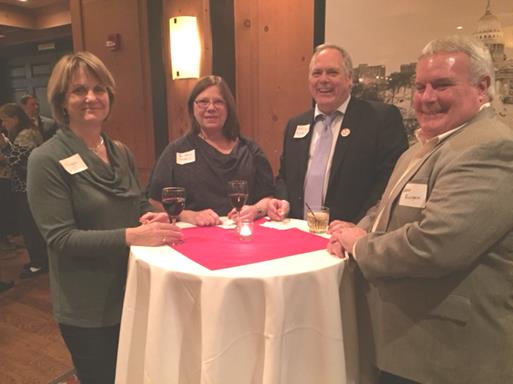
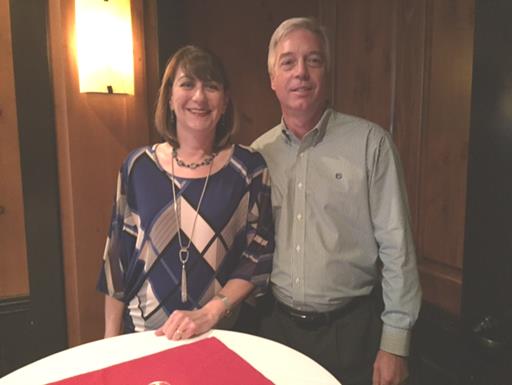
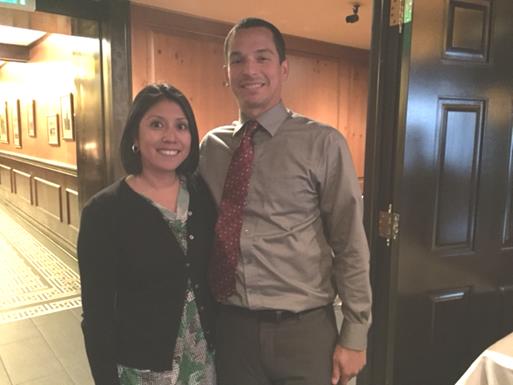
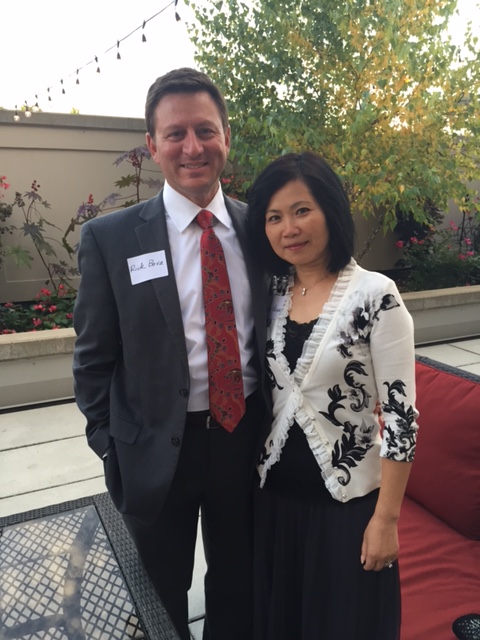
Photo 1: Mary & Robert Borland; Photo 2: Sandy & Theran Morales; Photo 3: Rick & Joanna Bova

The feast began while Rotarians socialized with Madison Club staff circulating the room offering hors d’oeuvres of croquettas de jamon, manchego, olive and chorizo pinxtos, and smoked rainbow trout bocadillos.

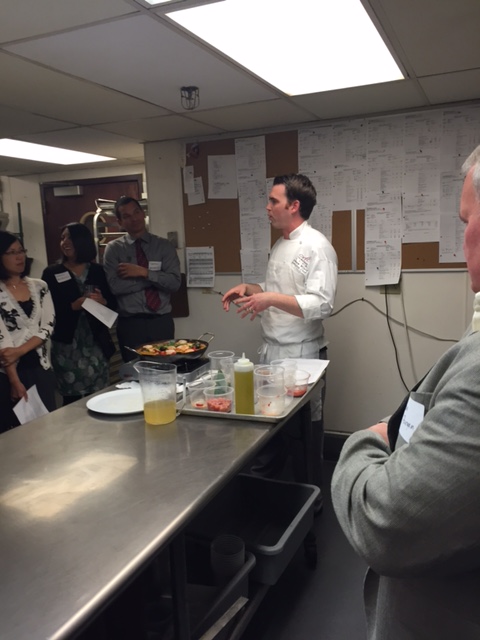
IMG_0083Chef Andrew Wilson invited us into the kitchen to witness his creation of classic paella. It was fascinating to see the master at work, adding the different ingredients – the chicken and the olive oil and the shrimp for just a little bit of coloring – peppers, basil, saffron, and then the mussels and shrimp and green beans…a bit of rabbit, too.

Rotarians filled four tables to partake in this artfully prepared Spanish spread.

First course: goat cheese stuffed piquillo, peppers, Serrano ham, oranges and parsley puree; wine pairing of Ulacia Txacolina- Basque Coast.
Second course: grilled octopus, roasted pearl onions, romesco sauce; wine pairing of Cune Rioja Crianza.
Third course: paella with saffron rice, rabbit, chicken, chorizo and shellfish; wine pairing of Pata Negra Ribero del Duero Reserva.
Fourth course: caramel flan with fresh figs and whipped cream.

Picture11  Picture2  Picture3

Photo 1: Becky Steinhoff, RYE Student Charlotte de Monceau; Photo 2: Juli & Keith Baumgartner; Photo 3: Christine Beatty

Jason Beren concluded the evening with a toast on behalf of the whole group to Valerie Kazamias for planning this popular, well-attended event.

Estaba delicioso!

World War II: When Did It End?

–submitted by Larry Larrabee; photo by Mike Engelberger

Stanley Payne 10 14 2015Professor Stanley Payne presented on the topic “WWII: When Did It End?” at our meeting on Wednesday October 14, 2015.  He is a professor emeritus of the University of Wisconsin Department of History and the author of several books on Europe and WWII, some of which have received national awards.

In this week’s presentation, Dr. Payne began by explaining Winston Churchill’s belief that the victory over Germany did not end the equally real threat of the Soviet Union, which controlled half of Europe, upsetting the balance of power that Britain and other democracies needed to survive.  In December 1944, Churchill launched “Operation Unthinkable” to push Russia out of Central Europe by force after the defeat of Germany.

The Polish Government in Exile, with its 200,000 troops, and even a sizable portion of German POWs were willing to enter armed conflict with the USSR after V-E Day but the idea received no support from the US leaders, with the exception of General George Patton.  And thus, a hot war turned into the Cold War.

Since 1945, it has been an age of civil wars in Eastern and Central Europe, the Middle East and Asia including America entering those in Korea and Viet Nam.  In fact, unusual for wars since the Middle Ages, there was no peace treaty in Potsdam following WWII.

Thus, Churchill was correct.  Victory over Germany did not really end the war.  Although the later fall of the Soviet Union decreased that country as a single threat, the civil wars have continued, particularly in the Middle East.

Did you miss our meeting this week?  CLICK to watch the video.