Tag Archives: Rotary Club of Madison

Soglin Sets Priorities in Tough Times

–submitted by Valerie Johnson; photo by Jeff Smith
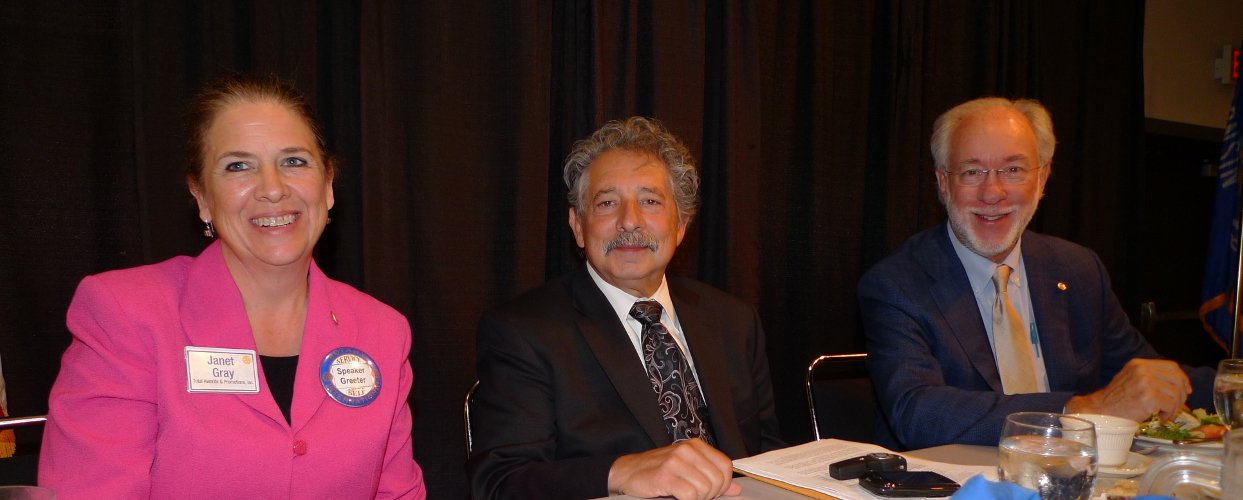
From left: Rotarian Janet Gray, Mayor Paul Soglin and Club President Ellsworth Brown

From left: Rotarian Janet Gray, Mayor Paul Soglin and Club President Ellsworth Brown

Mayor Paul Soglin began his annual fall review with our club by thanking Rotarians.  “The premise of government is that while we have elected representatives, what makes Madison function is active participation of citizens.”

“I’ve learned when you are trying to accomplish several economic goals, it makes a difference if the mayor makes the ask,” he said. He had two asks for Rotarians.

“My first ask is to support employment, both summer youth and adult employment.  We’ve made big advances in employment.  City employment has an expanded internship program. We provided 32 teens jobs this past summer. We have several partners: Operation Fresh Start, Simpson Street Free Press, Centro Hispano to name a few. These are real jobs with real pay.  We love it when at the end of the summer an employer calls and asks if they can keep on the student part-time for the rest of the year.”

Minnesota just released a study examining why there is a disparity on race in incarceration.  Mayor Soglin said we have an even bigger gap here.  Why the gap? “Poverty,” he said.  “Lack of participation in the workforce.  If we can change that, we can change a bevy of outcomes.”

Mayor Soglin’s second ask is about housing.  We are one of 100+ cities in the US that have signed a pledge to end veterans’ homelessness by the end of 2015 and end chronic homelessness by 2016.  We are doing poorly compared to other communities, he reported.

“There are reasons,” Mayor Soglin said, “particularly as it relates to the availability of housing and the cooperation of state government.  What is most upsetting is we have 31 veterans with VASH vouchers (for veterans only, pays for housing) who are still on the streets because they cannot find housing. So my second ask is for Rotarians to contact the Community Development office and figure out a way to make an apartment available for one of these 31 veterans.

The Mayor listed the city’s top three priorities:Affordable housing

  1. Affordable housing
  2. Improving equity and reducing poverty through job creation, training and employment, afterschool
  3. Food security

Three key financial facts:

  • City bonds rated AAA by Moody’s
  • Debt retires in 10 years typically
  • City goal is to stay under 15% of our budget going to debt. With significant cuts, we are still at 17%.

Where do our tax dollars come from?  Almost 75 percent comes from taxes; 13 percent from state aid, eight percent from fees.  This property tax burden is much higher than when he started in politics. The mayor reported he has made large cuts in CIP, the capital improvement plan.  This has lowered our borrowing to keep our good bond rating and allow us to retire debt.

“What is really crushing us,” he said, “is infrastructure replacement. We are replacing more pipes from the 60s than the 20s.”

CLICK to view the video.  Our Thanks to City Channel for taping our meeting this week.
Renewable Energy Buildings Coming Soon

–submitted by Kevin Hoffman; photo by Jeff Smith

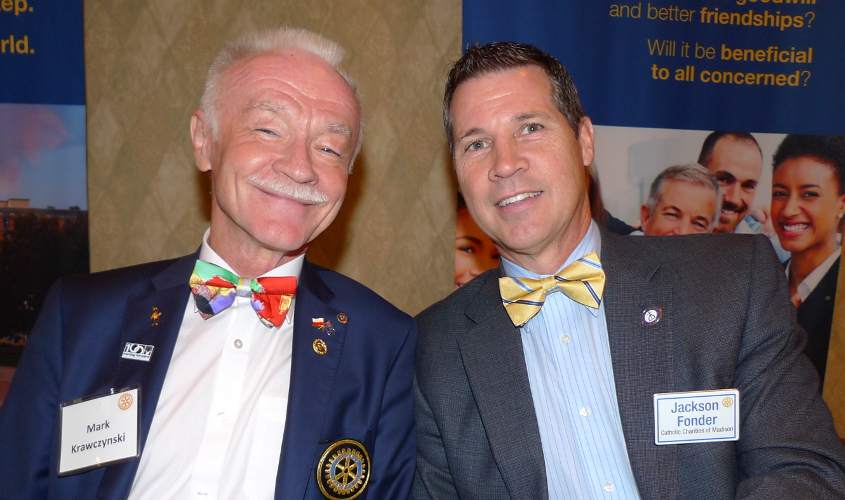
Mark Krawczynski (left) pictured here with our Rotary club member Jackson Fonder

Mark Krawczynski (left) pictured here with our Rotary club member Jackson Fonder

Fellow Rotarian Mark Krawczynski is originally from Warsaw, Poland, but has spent most of his life in Australia as a Chartered Architect working on many large scale public and private projects, including the reconstruction of the iconic Sydney Opera House.

He is now taking his nearly 50 years of experience as an architect to promote and advocate for using known renewable energy technologies to change the way buildings are thought of and constructed.  Thinking of future generations, Mark explained that the earth has reached the point where the use of traditional single-use energy technologies (oil, wood and coal), the growth of human population, and accelerating economic development have placed an unsustainable pollution load on the environment.  Fossil fuels, in particular, have caused many cities and regions to become polluted to the point where one can no longer see the sky, clean water is threatened and increasingly scarce, and pollution-induced illnesses have claimed more lives than polio.

From this gloomy premise he proceeded to propose that solutions are available but that the time to start is now and the transition will take a long time – probably 40 to 50 years.

Mark proposed that one of the first things to change would be how we view the purpose of buildings.  He described the construction of buildings in the past was from a “defensive” purpose.  That is, buildings were primarily to keep out natural elements such as water, wind and sun and, therefore, wasted.  Current buildings throw away these natural and renewable resources by repelling and sheltering us from them.

An updated consideration of buildings would look for ways to combine several clean, renewable energy technologies that would work in concert to provide for the energy needs of the building and spin off enough surplus energy to be used elsewhere in the community.  Mark envisioned that buildings built in this fashion would need to combine several technologies to be feasible but would work better than traditional energy methods.

Buildings designed using the harmony of several clean energy technologies would need to incorporate the technologies into their shape and structure, as well as the surrounding environment and natural resources of the site (wind, sun, geo-thermal, water, etc.).

Mark concluded by showing a short video that described a prototype building called an Elemental Flow Tower.  It was designed to use natural light, water, sun, geo-thermal, rain and wind to create a total system of self-contained energy production, as well as serve the functions of a building for shelter and comfort.

CLICK to view the video of this presentation on our club’s YouTube Channel.

A New View for Downtown Madison

–submitted by Bill Haight; photo by Jeff Smith

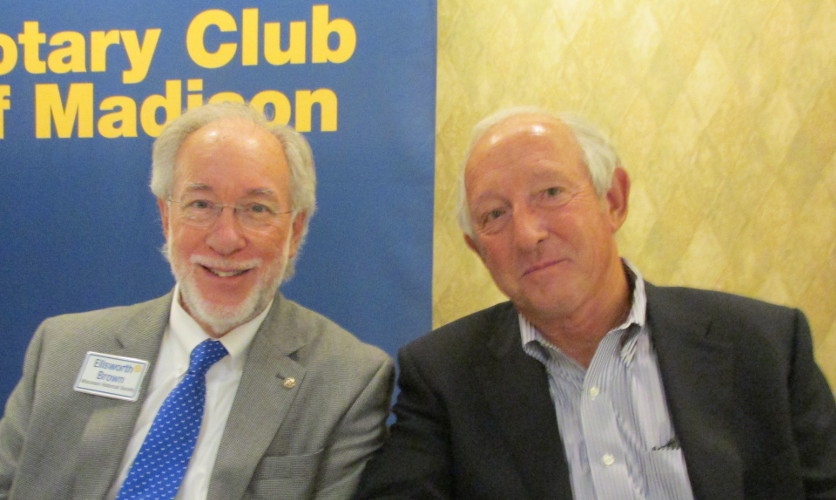
Brad Binkowski (right) seated here with Club President Ellsworth Brown

Brad Binkowski (right) seated here with Club President Ellsworth Brown

Brad Binkowski, who with Thomas Neujahr, is co-founder of Urban Land Interests, gave an overview of current developments on and around the Capitol Square.

ULI’s next project is a complete redevelopment of the Anchor Bank building, removing its dated precast panels, and adding a glass and stainless steel façade which will be “unlike anything you’ve seen in Madison,” said Binkowski.

In the Anchor project, as well as ULI’s Block 89 development, an essential component for success is replacing above grade parking with underground. Because of limited developable land and height restrictions, it’s impossible to create structures with street level energy and activity if above-ground parking is incorporated, said Binkowski. The Anchor project will have five levels of underground parking, extending under Carroll Street. Besides the Anchor property, there are only three more large sites downtown suitable for underground parking: the Judge Doyle Square development, The American Exchange Bank property, and the Braydon lot.

Epic is a significant driver of Madison’s growth, but it isn’t the only factor said Binkowski. Madison’s quality of life has attracted other firms, like office software company Zendesk, because it can find an ample workforce, without the extreme competition for talent and expense of cities like San Francisco. Among ULI’s residential tenants 56 percent came from outside Madison and their average age is 34. But just 26 percent work for Epic.

In 2011, 70 percent of ULI’s business tenants were from the legal, finance or government sectors. By 2015 that percentage has dropped to 64 percent, not because the traditional industries are shrinking, but because other sectors are growing much more rapidly. Restaurant tenants are up 29 percent and technology 143 percent. Those percentage changes, even from a smaller base, illustrate the shifting opportunity for growth, said Binkowski.

CLICK to view the video on our club’s YouTube Channel.

Moving the Needle Toward Better Education

submitted by Bob Dinndorf; photo by Mary O’Brien

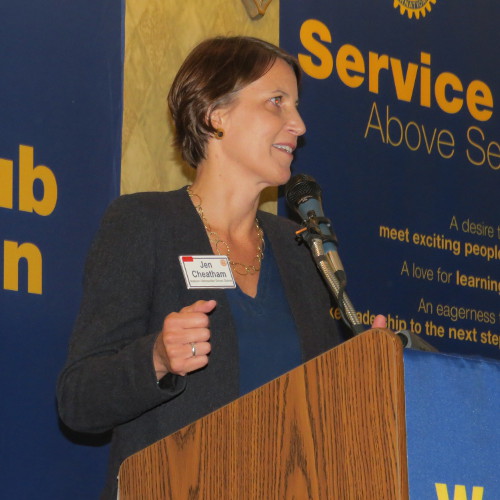
Jen Cheatham 8 26 15Dr. Jennifer Cheatham provided an “annual report” in her third Rotary presentation since becoming superintendent of the Madison Metropolitan School District in April 2013. Her 2015 appearance was special in that it was her first since becoming a member of the Rotary Club of Madison, she announced to generous applause. The Strategic Framework developed by the Madison Board of Education and staff, focuses on systemic improvement in our urban school district, the key to which lies in development, instructional alignment and coherence at every level of a school system aimed at achieving breakthrough results in student learning. Goal 1 of the plan includes milestones such as proficiency in reading and mathematics in grade 5. The lyrics, “reading and ‘riting and ‘rithmatic” from the 1907 song “School Days,” proclaimed by songleader Brad Hutter remain relevant today.

Though still early in the journey toward every school becoming a thriving school preparing every child for college, career and community, there is clear progress to report. Elementary schools continue to make major progress, with nearly 10 percentage point gains on all measures over two years and improvements for almost every student group, including Latino students and African American students, since work began on implementation of the strategic framework begun just two years ago.

High school graduation rates continue to move in the right direction, up for almost all student groups, and with pockets of accelerated results. At LaFollette High School, the four-year graduation rate for African American students increased to 75.3%. Memorial High School was also cited for dramatic improvement on critical measures. Our schools and the community will continue to progress by maintaining sustained focus on the day-to-day work of great teaching and learning. It is easy for educational institutions to become distracted by continually lengthening the list of innovations. The Strategic Framework and results can be found at www.madison.k12.wi.us/framework.

Our thanks also to WisconsinEye for videotaping our program this week.  You can view it HERE.

Hiking Group Learns More About John Muir’s Boyhood Home on Aug. 22

–text and photos submitted by Karl Gutknecht

Muir Hike 1

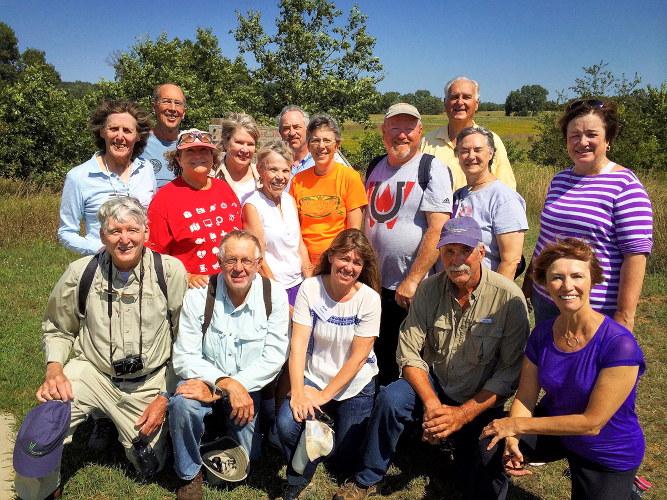
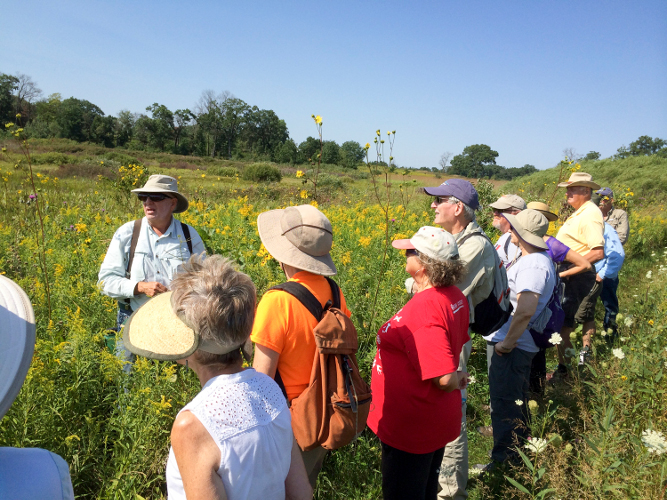
Downtown Rotarians and guests were hosted by The Wisconsin Friends of John Muir and Natural Heritage Land Trust while hiking Muir’s boyhood farm home terrain in Marquette County Saturday.

They learned that Muir’s conservation ethic was formed as a young man on the Muir Wisconsin homestead. These boyhood years in Wisconsin inspired his conservation ethic and love and appreciation of the natural world. Muir went on to espouse an intrinsic, spiritual value and beauty in nature and maintained that all living things are interconnected.

Muir Hike 2  Muir Hike 3  Muir Hike 4

Providing interpretations on the John Muir Memorial Park and nearby Observatory Hill hikes were Wisconsin Friends of John Muir Board of Directors Mark Martin and Fred Wollenburg as well as Heidi Habeger, Natural Heritage Land Trust. Hiking/Skiing Fellowship Group chair, Bob Graebner, was hike coordinator.

IMG_5918

The John Muir Memorial Park and Friends of John Muir celebrate the legacy of this great naturalist, a founder of The Sierra Club and often called the father of our country’s National Park System. The Natural Heritage Land Trust seeks to permanently protect local natural areas, rivers and streams, wildlife habitat, and working farms. It recently purchased part of the original John Muir family farm, bringing the total protected landscape to 1,400 acres, which includes the Muir Park and Fox River National Wildlife Refuge.

Further information on the John Muir Memorial Park can be found at Wisconsin Friends of John Muir, website www.johnmuir.org/wisconsin and for the Natural Heritage Land Trust, www.nhlt.org.

I Guess I Had to Do This

–submitted by Linda Baldwin; photo by John Bonsett-Veal

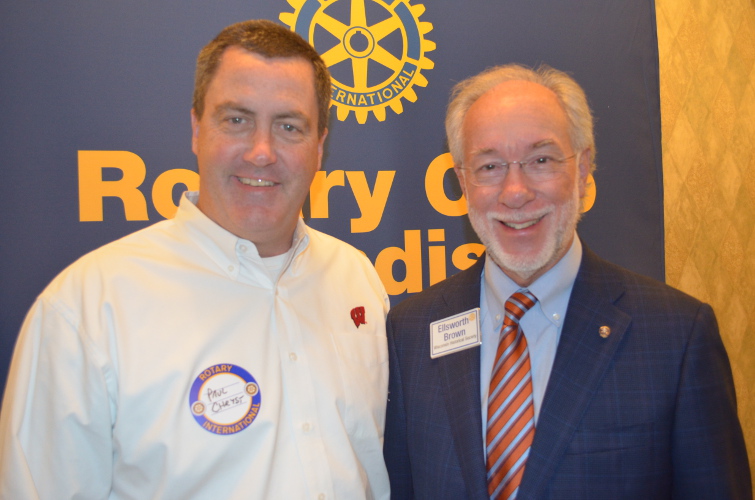
Coach Chryst (left) with Club President Ellsworth Brown

Coach Chryst (left) with Club President Ellsworth Brown

Paul Chryst, UW-Madison football coach, acknowledges he comes from a long line of Badgers and that he seemed destined to come here as head coach.

He’s proud to be here and represent the program every day.

Chyrst remarked that there’s something special about the UW team…it’s part of something bigger – the spirit of the state and the University.  “I’m a coach,” Chryst shrugged. “My dream job, well everyday I’ve coached, I loved it. I’ve been able to have a positive impact on young men.”

He says he’s at UW because of the body of work he’s done over time. “I’ve had a hand in helping those teams have success. But, so many people make for that success.”

The coach’s favorite job is to work with the players on the field. “None of us know how good players will be. But our job is to keep pushing them to be the best they can be. There’s no magic. You gotta work. Every season is a journey.”

“One challenge is to get to know your players as people, then you can coach them.” Chyrst moves on to recruiting. He says,  Recruiting is about finding the right fit. Guys who come here have to want to be a great player and get an education. We want high standards.”

Commenting on the cliché that there’s no “I” in team, Chryst disagreed. Individuals make up the team. They come from totally different backgrounds and come to work together bringing unique skills.

“Be you, but be the good you.”

When asked about the upcoming season, Chryst hopes for the team to come together. He has a group of experienced seniors, then the older guys who want their turn to lead and the younger players who will grow up. Chryst notes that the middle group is the key to our season success…can they make the jump?

Our thanks to WisconsinEye for videotaping our meeting today.  You can view the Coach’s presentation on this LINK to their website.

BONUS PHOTO:

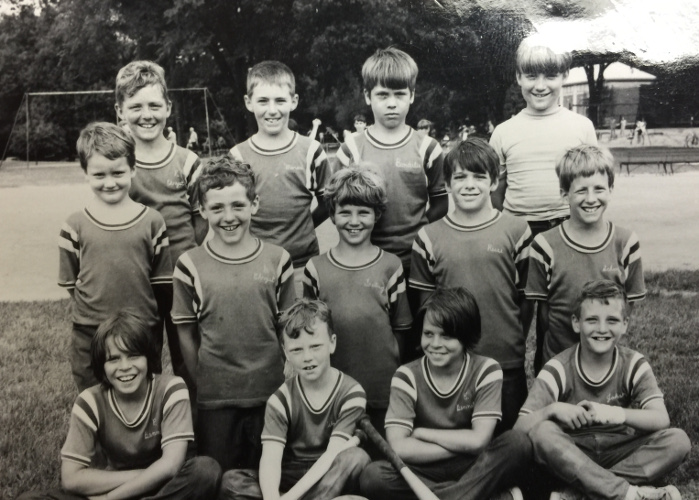
Paul Chryst (second row, left)

Paul Chryst (second row, left) served as bat boy for his neighborhood baseball team as a youngster. (1971)