Monthly Archives: August 2015

Moving the Needle Toward Better Education

submitted by Bob Dinndorf; photo by Mary O’Brien
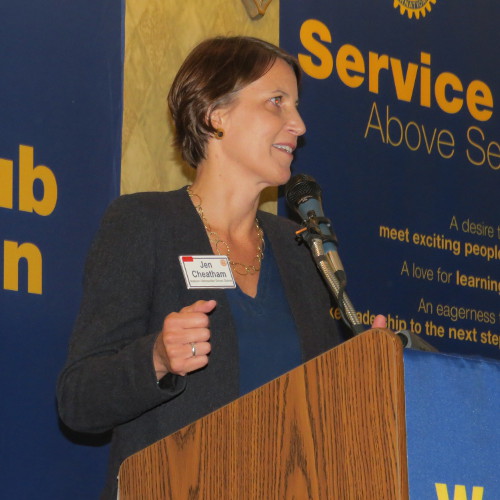
Jen Cheatham 8 26 15Dr. Jennifer Cheatham provided an “annual report” in her third Rotary presentation since becoming superintendent of the Madison Metropolitan School District in April 2013. Her 2015 appearance was special in that it was her first since becoming a member of the Rotary Club of Madison, she announced to generous applause. The Strategic Framework developed by the Madison Board of Education and staff, focuses on systemic improvement in our urban school district, the key to which lies in development, instructional alignment and coherence at every level of a school system aimed at achieving breakthrough results in student learning. Goal 1 of the plan includes milestones such as proficiency in reading and mathematics in grade 5. The lyrics, “reading and ‘riting and ‘rithmatic” from the 1907 song “School Days,” proclaimed by songleader Brad Hutter remain relevant today.

Though still early in the journey toward every school becoming a thriving school preparing every child for college, career and community, there is clear progress to report. Elementary schools continue to make major progress, with nearly 10 percentage point gains on all measures over two years and improvements for almost every student group, including Latino students and African American students, since work began on implementation of the strategic framework begun just two years ago.

High school graduation rates continue to move in the right direction, up for almost all student groups, and with pockets of accelerated results. At LaFollette High School, the four-year graduation rate for African American students increased to 75.3%. Memorial High School was also cited for dramatic improvement on critical measures. Our schools and the community will continue to progress by maintaining sustained focus on the day-to-day work of great teaching and learning. It is easy for educational institutions to become distracted by continually lengthening the list of innovations. The Strategic Framework and results can be found at www.madison.k12.wi.us/framework.

Our thanks also to WisconsinEye for videotaping our program this week.  You can view it HERE.
Hiking Group Learns More About John Muir’s Boyhood Home on Aug. 22

–text and photos submitted by Karl Gutknecht

Muir Hike 1

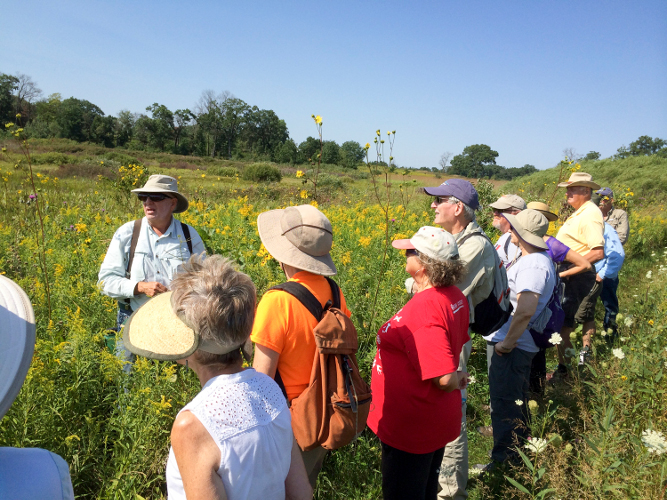
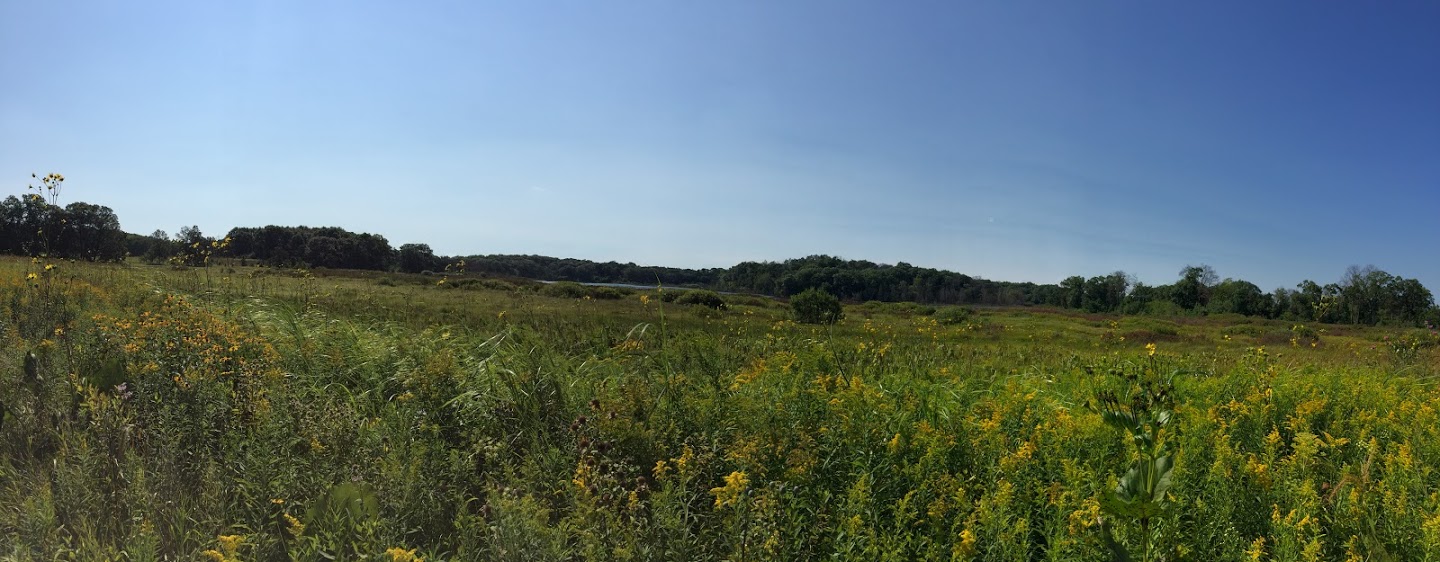
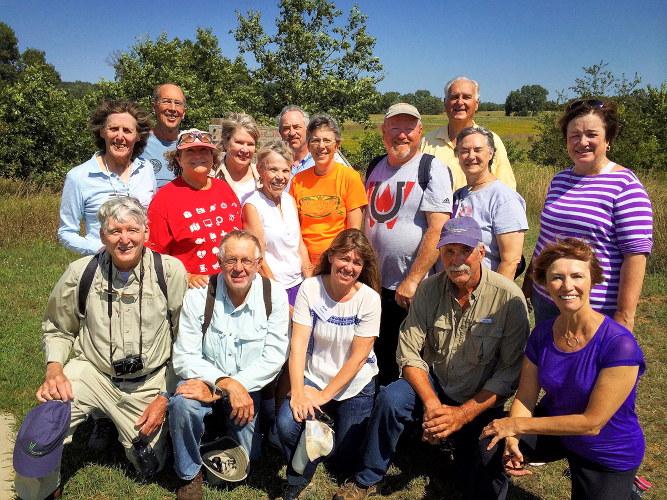
Downtown Rotarians and guests were hosted by The Wisconsin Friends of John Muir and Natural Heritage Land Trust while hiking Muir’s boyhood farm home terrain in Marquette County Saturday.

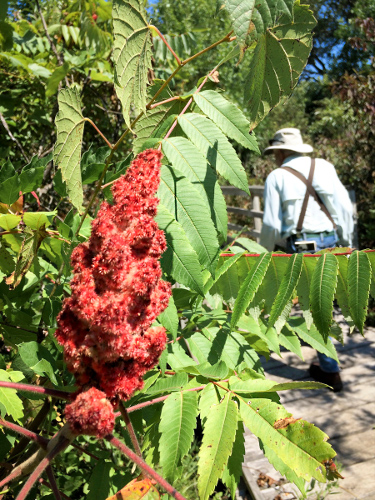
They learned that Muir’s conservation ethic was formed as a young man on the Muir Wisconsin homestead. These boyhood years in Wisconsin inspired his conservation ethic and love and appreciation of the natural world. Muir went on to espouse an intrinsic, spiritual value and beauty in nature and maintained that all living things are interconnected.

Muir Hike 2  Muir Hike 3  Muir Hike 4

Providing interpretations on the John Muir Memorial Park and nearby Observatory Hill hikes were Wisconsin Friends of John Muir Board of Directors Mark Martin and Fred Wollenburg as well as Heidi Habeger, Natural Heritage Land Trust. Hiking/Skiing Fellowship Group chair, Bob Graebner, was hike coordinator.

IMG_5918

The John Muir Memorial Park and Friends of John Muir celebrate the legacy of this great naturalist, a founder of The Sierra Club and often called the father of our country’s National Park System. The Natural Heritage Land Trust seeks to permanently protect local natural areas, rivers and streams, wildlife habitat, and working farms. It recently purchased part of the original John Muir family farm, bringing the total protected landscape to 1,400 acres, which includes the Muir Park and Fox River National Wildlife Refuge.

Further information on the John Muir Memorial Park can be found at Wisconsin Friends of John Muir, website www.johnmuir.org/wisconsin and for the Natural Heritage Land Trust, www.nhlt.org.

German POWs Working in Wisconsin

–submitted by Andrea Kaminski

Lucy SannaOne of the many benefits I appreciate about Rotary is the chance to learn new things about Wisconsin from our wonderful programs. Having moved here in 1977 – which made me a “newbie” at my table – I was unaware of the German prisoners of war who worked on our farms in World War II. Author Lucy Sanna filled us in on the history of German POWs in Wisconsin and read the opening of her newly released historical novel, The Cherry Harvest. Her presentation was enriched by historical photos of ships and trains that transported the POWs, camps where they lived and places where they worked.

Sanna acknowledged the aid of experts at the Door County Historical Society and public library, as well as the Wisconsin Historical Society, for her research. She and her daughter stayed with a farm family in the area, and she was put in touch with people who once worked with the POWs. She gained a lot of information from the staff at Fort McCoy.

In 1941 German POWs captured by the British were encamped in Europe. Because of a rumor that Hitler planned to drop bombs on the camps, the POWs were shipped to the United States on empty, returning Liberty Ships used to bring American troops to Europe. They traveled by train to military bases in many states, including Fort McCoy and other camps in Wisconsin. In 1945 there were some 425,000 German POWs in the U.S., according to Sanna.

At Fort McCoy, German and Japanese prisoners were retained in a separate camp within the Fort. The two groups were housed separately but used some shared facilities, leading to hostilities which needed to be managed by camp staff. The camp treated the prisoners well, offering such benefits as typing classes, a library with books in their own language and services provided by the YMCA. Yet officials publicly kept mum about the presence of the POWs in Wisconsin.

With the troops in Europe, Wisconsin residents who had once worked in orchards, canneries and dairies moved to more lucrative jobs in factories. This left farmers and food processing operators without the workforce they needed to make a living.

Sanna’s novel opens in 1944 with a moving scene about a Door County farm woman who is desperate to feed her family. She learns that there are German POWs who will pick cherries for 50 cents per hour (of which they keep 80 cents per day in the form of scrip which could be used in the camp commissary). The woman overcomes fear and conflict in her community to bring these workers to the peninsula for the harvest.

Circus World Museum — Not Just Clowning Around

–submitted by Mary Helen Becker; photo by Mary O’Brien

Scott O'Donnell 8 12 2015Rotarians and guests were enlightened and delighted with Scott O’Donnell’s (right) lively presentation about The Circus World Museum in Baraboo, Wisconsin, and his own lifelong fascination with the circus. Born in Canada, he claims to have moved to Wisconsin to escape  the harsh winters in Canada.

The program opened with President Ellsworth Brown wearing a clown nose while he introduced O’Donnell, Executive Director of the museum, which is a Wisconsin historical site. The music for the day was “The Man on the Flying Trapeze,” including a slide of the 19th  cemtury circus acrobat named Jules Leotard, whose name is used for the tights he developed.

O’Donnell did not have a circus background, as do many performers. Instead, he became interested in the circus as a child and turned into “the crazy kid at the back door of every circus.”  In college he studied Russian history but did his senior thesis on the animal rights movement in the circus.

He began his career as a clown, using dogs in his act. He refers to this period as having a “traveling dog pound,” relating how a woman left him “Tiny,” the largest great dane he ever saw.

Interested in show “business,” he owned his own circus for several years. He entertained the audience with circus history, including the origin of such terms as “making the nut,” or earning enough to pay the bills and get back the nuts which hold the wheels on the circus wagons. He also explained  the origin of pink lemonade, which sold much better at the circus than ordinary lemonade.

He described the daily programs at Circus World and other activities and features that await visitors. It seemed as if everyone in the audience wanted to head straight for Baraboo and the Circus World Museum. His presentation was about as much fun as a visit to the circus, but he left us all wanting more!

Highlights from Culinary Steak Fry August 4

–submitted by Mary Borland; photos by Juli Aulik and Donna Beestman

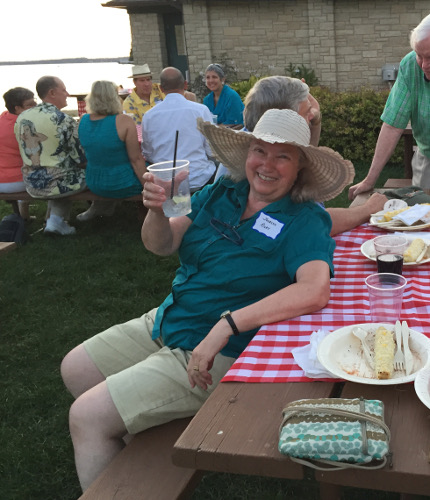
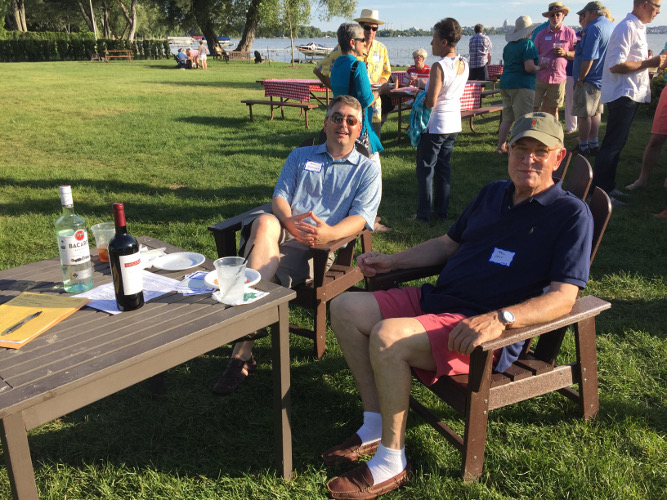
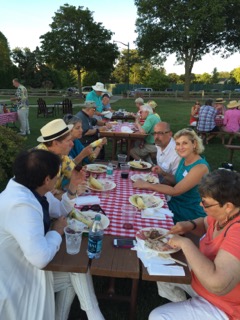
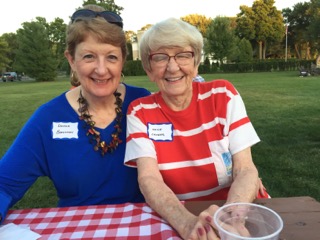
The Rotary Culinary Arts Fellowship Group met for a fun summer gathering on the sandy shore of Lake Mendota the evening of August 4. It was a perfect summer night in Madison! If someone looking to move to Madison was in town August 4, they would have immediately fallen in love with our city just due to the perfect weather.

From left: Dorothy Brown, Randy Banks, Donna Jurek, and Ellsworth Brown

From left: Dorothy Brown, Randy Banks, Donna Jurek, and Ellsworth Brown

Add a view of Lake Mendota and the Capitol, and it can’t be beat! The group enjoyed an Old-fashioned, delicious Lakeside Steak Fry, including appetizers and dessert, under the direction of celebrated Chef Steven Hahn (below) of the Maple Bluff Country Club.

IMG_6743AAA

Chef Steve demonstrated how to make the marinade used on the evening’s steaks and answered a multitude of questions from the group including how to test if a steak is done without piercing it with a meat thermometer and how long to marinate the steaks.

IMG_6810AAA  IMG_6814AAA  IMG_6706AAA

After enjoying the wonderful buffet, guests lingered on the shores of the Maple Bluff Beach House as the sun set and left thankful for the new friends they made and the wonderful food they enjoyed.

Photo2  Photo7  Photo8

If you’d like to join the Rotary Culinary Arts Fellowship Group, please contact the Rotary office – we’d love to have you!

I Guess I Had to Do This

–submitted by Linda Baldwin; photo by John Bonsett-Veal

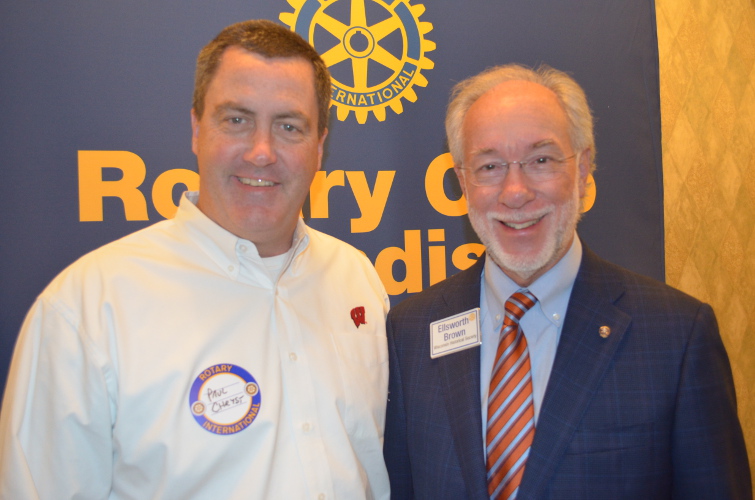
Coach Chryst (left) with Club President Ellsworth Brown

Coach Chryst (left) with Club President Ellsworth Brown

Paul Chryst, UW-Madison football coach, acknowledges he comes from a long line of Badgers and that he seemed destined to come here as head coach.

He’s proud to be here and represent the program every day.

Chyrst remarked that there’s something special about the UW team…it’s part of something bigger – the spirit of the state and the University.  “I’m a coach,” Chryst shrugged. “My dream job, well everyday I’ve coached, I loved it. I’ve been able to have a positive impact on young men.”

He says he’s at UW because of the body of work he’s done over time. “I’ve had a hand in helping those teams have success. But, so many people make for that success.”

The coach’s favorite job is to work with the players on the field. “None of us know how good players will be. But our job is to keep pushing them to be the best they can be. There’s no magic. You gotta work. Every season is a journey.”

“One challenge is to get to know your players as people, then you can coach them.” Chyrst moves on to recruiting. He says,  Recruiting is about finding the right fit. Guys who come here have to want to be a great player and get an education. We want high standards.”

Commenting on the cliché that there’s no “I” in team, Chryst disagreed. Individuals make up the team. They come from totally different backgrounds and come to work together bringing unique skills.

“Be you, but be the good you.”

When asked about the upcoming season, Chryst hopes for the team to come together. He has a group of experienced seniors, then the older guys who want their turn to lead and the younger players who will grow up. Chryst notes that the middle group is the key to our season success…can they make the jump?

Our thanks to WisconsinEye for videotaping our meeting today.  You can view the Coach’s presentation on this LINK to their website.

BONUS PHOTO:

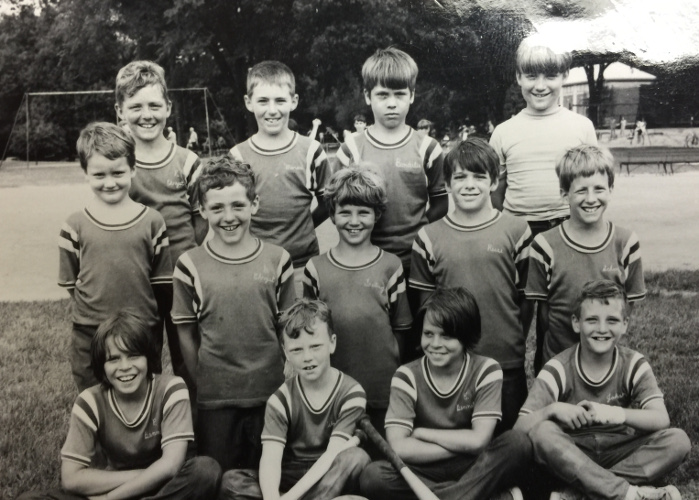
Paul Chryst (second row, left)

Paul Chryst (second row, left) served as bat boy for his neighborhood baseball team as a youngster. (1971)