
Submitted by Rich Leffler; photo by Valerie Johnson
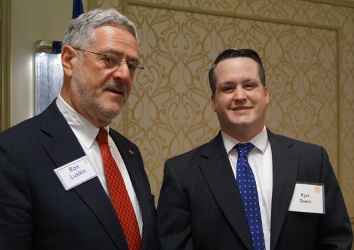 Professor Ryan Owens, a member of the UW Department of Political Science and an Affiliate Faculty of the Law School (and who is developing the Tommy Thompson Center on Public Leadership) spoke to the Club about “The Past, Present, and Future of the U.S. Supreme Court.” He began with an interesting “Thought Experiment.” With the addition of Neil Gorsuch to the Court, Justice Anthony Kennedy continues to be the middle or the median justice, often called the swing vote. But what happens if he retires, and if President Trump appoints a solid conservative such as Paul Clement, who is perhaps more conservative than Samuel Alito? In that case, the new median justice becomes Chief Justice John Roberts, who would then become the most powerful [influential?] Chief Justice since John Marshall. [Though he would be a very distant second.] If Ruth Bader Ginsburg were then to retire, Justice Alito would become the median justice. On the other hand, if Hillary Clinton had been elected, Justice Stephen Breyer might be the swing vote, etc. Very easily, a 6-3 conservative court under Trump might have been a 6-3 liberal court under Clinton. The presidential election of 2016 was, then, a very consequential election.
Professor Owens then wondered whether this was not a time for reforms to the Court. Two that he suggested were age limits on the justices, and perhaps requiring them to “ride the circuit,” as was once the case. The U.S. is the only common-law country without some limits on judicial tenure.
An age limit would remove the incentive for judges to retire “strategically,” so as to assure a like-minded jurist were appointed. It would also reduce the likelihood of justices serving while suffering from dementia. Attending circuit courts would let the justices see the consequences of their decisions and let the people see them in action close-up. It might also encourage the justices to retire earlier. [But would it also discourage people from taking an appointment?]
In answer to a question, Professor Owens said that he and a colleague were doing research on the age issue by studying oral arguments over the years to see if there is any evidence of dementia in sitting justices. He also questioned whether the Senate’s refusal to consider Merrick Garland’s nomination would not lead to further retaliation beyond the recent filibuster. He expects the Trinity Lutheran case, probably Justice Gorsuch’s first major opinion, to be an important decision.
If you missed our meeting this week, you can watch the video here.
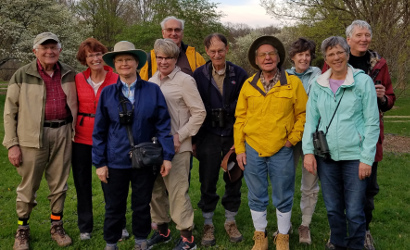 A group of nine Rotarians and guests met at the UW Arboretum Visitor Center for a hike on April 24 for an evening bird sighting. The goal was to observe the courting behavior of the male woodcock. Guide Levi Wood provided information about the rich conservation history of the UW Arboretum and a tour of the Longenecker Gardens which showcases a collection of trees and shrubs. The Magnolia collection was in full bloom and the early lilacs were opening.
 We were pleased to see the Oak planted by Paul Harris and saw turkeys and a red-tail hawk nearby. The hike included a walk through Gallistel and a brief stop at Teal Pond. Curtis Prairie provided the zen-like experience of hearing the courting sounds of the male woodcock who becomes active at dusk. Although the bird was never seen, its presence was clear by the loud, nasal peent calls made on the ground, the twittering sounds made by the wings as the woodcock rises up 100’ or more in an aerial display, the call made at the ‘top’ of the flight, and steep dive back down to the prairie. The Audubon website refers to this behavior as a ‘sky dance’. Female woodcocks are attracted by the ‘lek’ of males performing their rituals and have an opportunity to select the fittest mate.

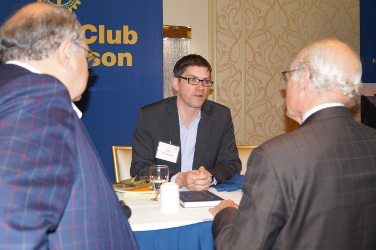 Jon Pevehouse, UW Political Science Professor, asked and answered the question, “How should the Trump administration balance power with constraint to maximize our legitimacy and prosperity?” at the April 5 Rotary meeting.
 Rotary Club of Madison, Wisconsin