
Category Archives: 2. Meetings

WI Supreme Court Candidate Judge Brian Hagedorn

submitted by Andrea Kaminski; photo by Mark Moody
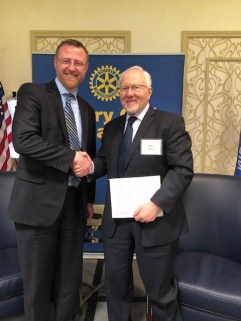
Hagedorn 3 27 2019

Judge Brian Hagedorn with Steve Walters

On Wednesday, March 27, Steve Walters, Senior Producer at WisconsinEye, moderated a Question and Answer session with Wisconsin Supreme Court candidate Brian Hagedorn, a Court of Appeals judge who serves in the court’s Waukesha-based District II. While both Supreme Court candidates were invited to speak, Judge Lisa Neubauer had another commitment and declined Rotary’s invitation. Per our policy on inviting candidates to speak (see our March 8 newsletter for the policy), a person from Neubauer’s campaign was invited to attend and distribute campaign materials in the back of the room.

Rotary members were invited prior to the program to submit questions for Judge Hagedorn, and these were passed on to Walters for consideration. In addition to providing an opening and closing statement, Hagedorn responded to the following questions, including some that referred to his comments at a recent Milwaukee Press Club forum:

  1. You quoted Alexander Hamilton who said the judiciary should be the “least dangerous” branch of government, and then you said, “That’s not really where we are at nowadays.” Please explain what you meant by that.
  2. In several forums you have asked Judge Neubauer to cite specific examples where your personal beliefs influenced an opinion you wrote. At one event she said you “acted on your beliefs” by starting a school with a code or mission statement that discriminates. You have said there has been a “lot of misreporting” on the school, so please set the record straight.
  3. Given your blog statements on same-sex marriage and bestiality when you were a law school student, how you would convince members of the LGBTQ community and their supporters to vote for you?
  4. Wisconsin Supreme Court Rule 60.03 governs the behavior of all Wisconsin judges and requires a judge to avoid the appearance of impropriety at all times, whether on the bench or off, as well as the appearance of impropriety as judged from the standpoint of a reasonable person. Given your previous statements about marriage equality and Planned Parenthood, can those appearing before you on any case involving either of those groups see you as impartial?
  5. You have said of your opponent, “I don’t have a problem with people having any kind of political background coming onto the court [but] she (Neubauer) has far more political background than I do.” Please explain what you meant by that.
  6. About your time working for Governor Walker, you have said, “I didn’t do politics. I did law. I was his lawyer. I didn’t make any decisions.” But you participated in the drafting of Act 10, restricting the role of public unions, as well as Act 2, making it more difficult to sue nursing homes for negligence or malpractice. If matters related to either of these or other laws you had a part in drafting were to come before the court, would you recuse yourself?
  7. Do you consider these cases to be settled law: Roe v. Wade, the 2015 U.S. Supreme Court decision allowing same sex marriage, and the Washington, DC, case affirming individual gun ownership as a 2nd Amendment right?
  8. How would you approach the constitutional question of “first impression”?
  9. If ethical complaints are filed against a Supreme Court justice, and all or most of the justices recuse themselves from the matter, what should happen to that complaint?
  10. You have said that one of the biggest challenges for the courts is fighting the opioid crisis. Explain how the Supreme Court can address that problem.

To hear Hagedorn’s answers in his own words, and to find other candidate interviews, go to Wisconsin Eye’s coverage on the Wisconsin Supreme Court.

If you missed our meeting this week, you can watch the video here.
Stories About Pioneers Who Settled in Wisconsin

submitted by Kevin Hoffman; photo by Mike Engelberger

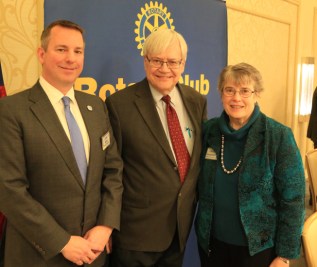
Michael Stevens 3 6 2019

From left: Club President Jason Beren, Michael Stevens and Rotarian Loretta Himmelsbach serving as our club’s speaker greeter this week

Instead of writing about Wisconsin history in the pioneer era (1830-1850) from the perspective of the famous or leaders of that time, Dr. Michael Stevens chose to document the practical and emotional side of everyday existence for ordinary people.  What did it feel like to those who lived in a new situation from the land to weather to language to food to culture?

While there were many things to be negative about such as Wisconsin weather extremes, an imbalance in the male to female ratio (8 men to 5 women), poor food and hardship on the journey, having to learn a new language (English), loss of cultural affiliation, unfamiliar surroundings, and loneliness; the overall impression was that the pioneer had a positive outlook and balanced the difficulties against the opportunities, diversity, freedom and future prosperity they envisioned.

The trade-offs from having to learn English, live in rough conditions and with rough people, and missing their home country are the freedom they enjoyed to map their future, work hard for income and wealth, and the natural beauty of Wisconsin.

One essay of the time expressed the following about the Wisconsin Character:  There is a freedom and independence of mind – people think for themselves; an awakening spirit of enterprise – people are open to new ways of doing things; people work hard – they invest their sweat equity; and a public spiritedness about Wisconsinites – people support roads, schools, churches and a friendly interest in the welfare of all.

Dr. Stevens drew insights into the attitudes, humor and outlook of the early pioneer and the similarities to today’s Wisconsin Character.  The essay writer above said of his time:  “The settler here finds, within the limits of his acquaintance, people from all the states and many foreign countries, and those too have been formerly been engaged with a variety of occupations different from his own, so he acquires a great variety of new ideas and becomes much more liberal in all his opinions and life.”  Even through the hardships and inconveniences of the time, the pioneer’s outlook is not so different from our present-day Wisconsin outlook.

If you missed our meeting this week, you can watch the video here.
Rotary’s General Secretary: “We Are All Peacemakers”

submitted by Dave Mollenhoff; photo by Pete Christianson

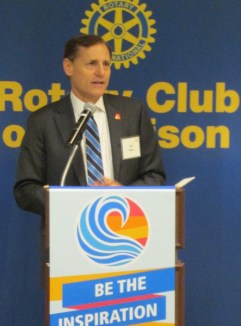
John Hewko 10 3 2018Rotarians were privileged to hear John Hewko, Rotary International’s General Secretary, talk about three global issues facing Rotary in the 21st century.

First, we must finish PolioPlus, even though we have been supporting this cause for 30 years.  Today, with the help of international partners including UNICEF, WHO, and Gates Foundation, the end is in sight.  Yes, Hewko admitted, we are experiencing donor fatigue, but we cannot move on to the next big project until we are successful with this one.  PolioPlus, he continued, has really put Rotary on the international map.  The remarkable infrastructure that we developed to deliver PolioPlus can be used for the next big campaign, he noted, but admitted that no decision had been made on what this would be.

Second, Rotary’s international membership has been stagnant at 1.2 million members for the last 20 years.  This is because membership in the U.S. has been declining, but membership in Asia and Africa has been increasing.  Faced with stagnant growth, Rotary must develop new products for today’s changing marketplace including experimenting with formats that depart from the club model.  Hewko also urged Rotarians to find ways to increase our impact on the world.   For example, our club could join forces with other Wisconsin clubs to do larger scale projects.

Third, Hewko urged us to recognize that “peace is at the center of everything we do.”  We do this by providing potable water, teaching better health practices, and eradicating disease.  Rotary International has recently joined forces with the Institute for Economics and Peace to focus grant programs on those that create the most enduring peace.

Hewko directs a staff of 800 employees at the RI headquarters in Evanston, Illinois and seven other international offices, and has served as general secretary since 2010.

Members from many Rotary Clubs in Southern Wisconsin also attended the talk.

If you missed our meeting this week, you can watch the video here.

Wisconsin Obesity Prevention Initiative Targets Neighborhoods

submitted by Jocelyn Riley; photo by Margaret Murphy

Vicent Cryns 9 12 2018

“Virtually every organ in the body is adversely affected by obesity,” Dr. Vincent Cryns, the Marian A. and Rodney P. Burgenske Chair and Chief, Division of Endocrinology, Diabetes & Metabolism at the University of Wisconsin School of Medicine and Public Health, told Rotarians on September 12.

Not only are people’s individual bodies affected negatively by obesity, according to Dr. Cryns, but obesity also has a negative effect on society as a whole.  The cost of the obesity epidemic to American society is equal to 4 to 8 percent of our Gross Domestic Product, with disadvantaged communities affected disproportionately.  The even more discouraging news is that there have been three-fold increases of obesity and overweight in the past forty years.  Dr. Cryns cited several causes, including less physical activity due to factors like increasing screen time and the marketing of “tasty inexpensive calorie-dense foods.”

Dr. Cryns is involved with the Wisconsin Obesity Prevention Initiative (OPI), which is compiling and analyzing “zip-code-level data” to design positive interventions and coaching to help deal with this crisis.  OPI is currently working with two community partners, the Menominee Nation and Marathon County, to come up with place-based solutions to the problems posed by widespread obesity.  Possible solutions include incorporating nutritious foods like wild rice into traditional activities like community feasts and improving pedestrian and bike access so that people who would like to walk and bike more can do so safely.  Dr. Cryns encouraged his audience to find out their individual Body Mass Index (BMI; weight divided by height squared) and modify eating and exercise until it reaches healthy levels.

If you missed our meeting this week, you can watch the video here.

Madison to Launch Professional Soccer Team

submitted by Bill Haight; photo by Karl Wellensiek

DSC_8192

Peter Wilt, managing director of Madison’s newly forming professional soccer team told Rotarians why Madison is ready for its own pro team.

Soccer is popular with young people and approximately 50% of Madison’s population is under the age of 30. Soccer has become the second most popular sport among the 12-24 age range and 4th among all ages. The Madison area has 40 youth soccer clubs and 20,000 registered participants.

People who began playing soccer in the 1980’s when youth soccer began to take off in the U.S. are now among community leaders and decision makers. A sustainable pro team will need passionate fans, a tribal culture, and community pride, said Wilt. Madison is ready.

The team’s name and head coach will be named very shortly and the team’s first of 14 regular home games is planned for April, 2019. The new team will be part of a Tier III division, with teams from mid-sized cities such as Tucson and Toronto.

The team is owned by Big Top Events, which operates the Madison Mallards baseball team and concerts at Breese Stevens Field, also the home of the new soccer team.

Investment in Breese Stevens by the City of Madison and Big Top Events will eventually bring capacity to 5,000 and add suites, upgraded restrooms, club seating, a rooftop deck and enhanced food and beverage options. A season ticket will be in the neighborhood of $274, with game tickets comparable to movie prices, noted Wilt.

Players are being recruited internationally and will also feature local and state players, said Wilt. The new team’s players will be mostly in the 21-25 age range and will be full-time Madison residents, unlike Mallard players who stay with local housing hosts during the season.

The sizable and growing Madison soccer fan base is finally getting a hometown team of its own.

If you missed our meeting this week, you can watch the video here.

TR Loon Brings Fun & Games to Rotary

submitted by Ben Hebebrand; photo by Mike Engelberger

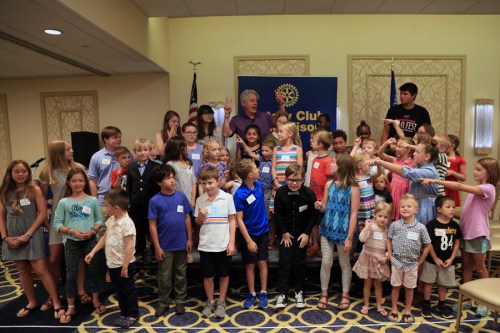
HO7A6660The Rotary Club of Madison treated its membership at its August 15 Club meeting to fun and games – highly appropriate in that the day represented the Club’s annual Bring-Your-Child or Grandchild to Rotary Day.
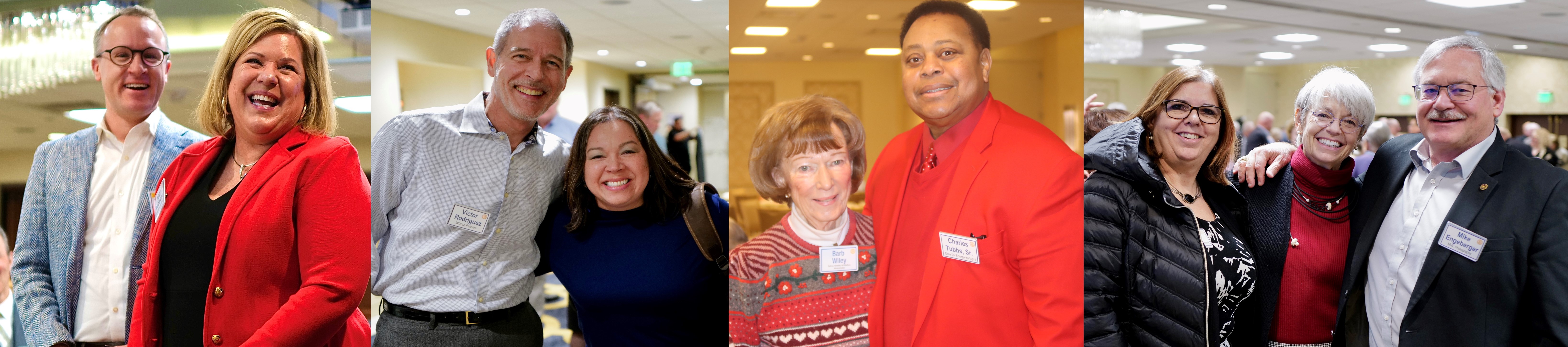
Sitting up front and center, about 50 Rotary children were treated to the wacky magic of TR Loon – The Truly Remarkable Loon, also known as the “Juggler from Madison.”

In a highly engaging performance, TR Loon held kids captive and adults entertained by completing the incredible feat of spinning ten plates or as TR Loon reminded the audience “simultaneously at the same time.”

In inviting the kids to help him count the number of plates spinning, he reminded the audience that “there are three kinds of jugglers – those who can count and those who cannot.”

Humor aside, TR Loon indeed had ten plates spinning simultaneously, all the while receiving help from the kids, who alerted him when any one of the plates appeared to be at the brink of no longer spinning and thus crashing. The absolute highlight, however, was when TR Loon invited the kids in the audience and a few fun-loving adults to launch flying monkeys to bring the ten spinning plates down. The image of spinning plates being brought down by flying monkeys represented to this fun-loving news reporter our Club’s finest moment, and elicited a comment from a Club member that the scene was not much unlike what happens at the State Capitol.

At the end of TR Loon’s presentation, Stephanie Richards, CEO of the Madison Circus Space, informed members that her organization is in the midst of a capital campaign to build a new center in Madison. Circus Space promotes the circus arts as an important art form by teaching interested children and adults on various circus arts such as juggling or aerial stunts.