
–submitted by Carol Toussaint; photo by Valerie Johnson
 The Rotary audience learned today just how lucky we are that our speaker, Brenda DeVita, was not pursuaded by her brother who argued against her choice of an acting major. He wanted her to know that her intelligence and people skills along with obvious loquaciousness were better suited for a respectable career as a lawyer.
Brenda DeVita knew then, and we now know, that it would have been a big mistake for her not to follow her heart. As she began and kept acting, she said she “came to understand its power – that in the safety of a dark theater, people (the audience ) can be moved.” Actors, she added, help people to connect with people they would most likely never know.
Moving to Spring Green, Wisconsin, and American Players Theatre in 1995 when her husband, actor James DeVita, was hired to play Romeo, set a lot of things in motion. Brenda was hired as an assistant to work along side Artistic Director David Frank. “Over the years” she noted, “it became clear that our job of matching great people with APT was similar to finding a needle in a haystack.” Finding those “rare, selfless, hard working, humble, classically trained, kind, collaborative storytellers who like mosquitoes and didn’t want to be rich” would be how they built the core of the company.
In 2014 Brenda DeVita took over as Artistic Director and in her first season, 2015, box office records were set. Rather than talk about the 2016 season, of which she is justly proud, she directed everyone to pick us a brochure and seriously consider attending this summer. In response to her question, nearly everyone in the audience raised a hand indicating an experience with attending an APT production.
She shared that financial stability is something APT is proud of and that “tenacity in our budgeting has allowed us to get to what we are calling the Next Great Stage.” Immediately after the last show on the Hill closes in October, construction will begin and be finished for the following season. Stay tuned for more news of these developments as they work to rebuild the stage, making it more flexible and exciting, for actors and audience.
Did you miss our meeting this week? CLICK to watch the video.
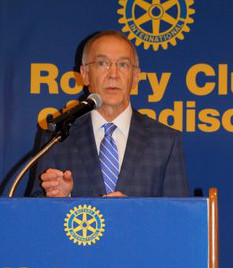 Dr. Edward Coffey, President & CEO of the Menninger Clinic, as well as Professor of Psychiatry, Behavioral Sciences & Neurology at Baylor College of Medicine, was in Madison June 7-8 for a collaborative meeting of 150 health and other community organizations to discuss treatment of depression and the goal of zero suicide. He spoke at our meeting of June 8th about his work in this field.
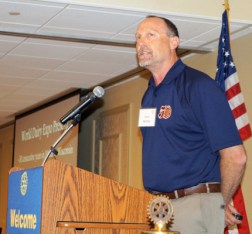 If you consider Wisconsin’s $44 billion dairy business to be all about big business, you might be surprised to find out that 96 percent of all of Wisconsin’s dairy farms are actually family-owned.
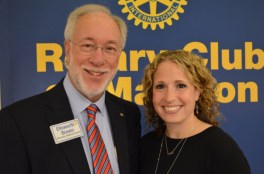 Dr. Katherine Schmitt who specializes in child and adolescent psychiatry highlighted the growing challenge of supporting children and their families through the challenge of illnesses such as ADD, ADHD, depression, bipolar disorder and schizophrenia.
 At our April 27 meeting, Dr. Noelle LoConte of the UW gave us some frightening, but also some hopeful information and a call to action during a presentation entitled Pancreatic Cancer Research: A Medical Oncology Perspective. As many know, often because of personal experience, pancreatic cancer is a particularly virulent disease, with a five year survival rate of less than 5%. With the exception of a rising incidence in the African American population, the incidence of this disease has remained relatively stable in our population. Nevertheless, pancreatic cancer is expected to be the second most common cause of cancer mortality by 2020. These numbers reflect the fact that there is no current method to screen for pancreatic cancer, and therefore, patients are typically diagnosed well into the disease process, when it is too late for effective surgical or drug intervention. In addition, the risk factors are not well established, although age is clearly the most important factor, with smoking, heavy alcohol consumption, and other contributors playing a role.

 Rotary Club of Madison, Wisconsin