Category Archives: Rotary Club of Madison Guest Speaker

All Ways Forward

–submitted by Ellie Schatz; photo by Will Anzenberger
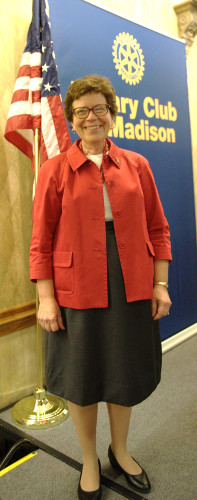
Rebecca Blank 11 4 2015The tone was set for Chancellor Rebecca Blank’s talk about moving the UW Forward by talented UW alumni. Soprano Emily Birsen sang “Quendo m’en vo” from La Bohème, accompanied by pianist Scott Gendel. Do we want to keep supporting and encouraging this kind of talent development in Wisconsin? Their standing ovation plus the response to Chancellor Blank’s opening questions (who in the audience works at, has a family member work at, or graduated from UW) signaled strong passion and commitment to our favorite education and research institution.

Chancellor Blank proceeded to give Renee Moe a run for her money as the fastest speaker we know. Filled with statistics, she demonstrated that we could feel the energy resulting from the tremendous investments to both education and research at UW since its founding in 1848. We can look forward to and support new approaches that will be both exciting and challenging as we move forward.

Trends at UW include a declining number of students from within the state, an increase in the number of out-of-state students, and an increase in the number of international students. There is a clear shift of students moving into STEM (science, technology, engineering, math) fields, which is a good thing, but with a caution: students should also understand the importance of writing, critical thinking, learning languages, and other skills taught in a broad liberal arts program.

Statistics supporting the good things happening at UW in education and research include: the student retention rate is 95.8! Graduation rates are up, and UW ranks as one of the top 25 research universities in the world. Given a changing research landscape, this means that to offset declining state and federal dollars we need to work differently, building research partnerships with industry. Chancellor Blank gave several examples of such partnerships, showing how we are growing in spite of the 250 million dollar cut in state funding, ongoing budget debates, and negative press.

All Ways Forward is a comprehensive Fundraising Campaign with the goal of raising 3.2 billion dollars by 2020. Recent gifts from John and Tasha Morgridge, Jerome and Simona Chazen, Albert and Nancy Nicolas, and the Grainger Foundation show how transformational gifts can help to move us forward. However, Blank warns, gift dollars are not substitutes for state dollars. $250 million in donor dollars does not equal that in state dollars for several reasons, i.e., gift dollars are tied to donor intent, gift dollars are in endowment, of which only 4 1/2% is accessible in a given year, and what we raise now in pledges may not be dollars in hand until many years out.

With continuing new programs and wonderful spaces, how can we not join the Chancellor in her enthusiasm and optimism. From the Villager Mall programs, a School of Education partnership with MMSD to build a pipeline of students of color and low income to help close the achievement gap, and excellent faculty, to awe-inspiring research, On Wisconsin.

 Did you miss  our meeting this week?  Our thanks to WisconsinEye for videotaping and providing this LINK.

David Maraniss on Detroit

–submitted by Carol Toussaint

You could tell by the number of people working their way around the Inn on the Park construction site that the speaker on this Wednesday had attracted a crowd.  Indeed, one of Madison’s favorite sons was there again to share insights captured in a new book, ONCE in a GREAT CITY, a Detroit StoryDavid Maraniss was back with another great story for Rotarians and their guests.

As his talk revealed, Maraniss was more interested in why things had happened in and to Detroit than to simply chronicle the events that brought down a great city. In the author’s note to his book he wrote that “the city itself is the main character in this urban biography, though the populace includes many larger-than-life figures.”   These individuals played key roles in the drama that was Detroit in 1962-64.  We met them Wednesday and learned some surprising things about the many ways each contributed to the vibrant city.

Whether it was the story of the launching of the Ford Mustang or the touching memories that talented performers shared about the creative side of the city, Maraniss researched through interviews as well as documents.  The migration of African Americans from the South to jobs in Detroit influenced the development of the Motown music and the stories of the prominent stars, many of whom rose from modest beginnings, are well represented in the book.

Reading Maraniss’ book is a bit like receiving a postcard from your favorite cousin who visited Detroit in 1963 and reported that “it had everything!”  Rotarians got a sense of what was behind the “everything” and enjoyed the inside view of it all.

Did you miss our meeting this week?  CLICK to watch the video.

Doug Moe Speaks to Madison Area Service Clubs on October 21

–submitted by Linda Maremont

Award-winning journalist and author Doug Moe was the keynote speaker featured at the 52nd Annual Madison Area Service Club’s Luncheon held at the Sheraton Hotel.  A lifelong Madisonian and graduate of UW-Madison, Moe has worked as a journalist and author for almost 40 years. As a daily newspaper columnist for The Capital Times and Wisconsin State Journal, he wrote some 4,000 columns. Prior to his newspaper career, he was a writer and editor of Madison Magazine.

Doug shared some of his more memorable experiences over the course of his journalistic career.  Contacted by a sports agent to write NFL defensive end Lyle Alzado’s biography, Moe’s book was aborted over a controversial chapter regarding Alzado’s anabolic steroid use.  He was invited to join a transplant team flying to central Illinois to harvest a liver, then returned to witness the transplant operation to the new recipient the following day.  Doug had the opportunity to interview the progeny of several notable figures including Lana Peters, the daughter of Joseph Stalin, and Reeve Lindbergh, daughter of Charles Lindbergh.

His wide-ranging experiences also included less well-known subjects such as Richard Trentlage, professional jingle writer responsible for the famed Oscar Mayer wiener jingle, and Don Featherstone, the artist most widely known for his creation of the pink plastic flamingo (Madison’s city bird).

Throughout his career, Doug has also “written books on the side,” two of which are currently being considered for movie or documentary production — “The World of Mike Royko” (a Chicago Tribune Choice Selection of the Year); and “Lords of the Ring: The Triumph and Tragedy of College Boxing’s Greatest Team,” runner-up for the Derleth Award for best non-fiction book of the year by a Wisconsin author. He is currently collaborating with former Wisconsin Gov. Tommy G. Thompson on Thompson’s autobiography.

World War II: When Did It End?

–submitted by Larry Larrabee; photo by Mike Engelberger

Stanley Payne 10 14 2015Professor Stanley Payne presented on the topic “WWII: When Did It End?” at our meeting on Wednesday October 14, 2015.  He is a professor emeritus of the University of Wisconsin Department of History and the author of several books on Europe and WWII, some of which have received national awards.

In this week’s presentation, Dr. Payne began by explaining Winston Churchill’s belief that the victory over Germany did not end the equally real threat of the Soviet Union, which controlled half of Europe, upsetting the balance of power that Britain and other democracies needed to survive.  In December 1944, Churchill launched “Operation Unthinkable” to push Russia out of Central Europe by force after the defeat of Germany.

The Polish Government in Exile, with its 200,000 troops, and even a sizable portion of German POWs were willing to enter armed conflict with the USSR after V-E Day but the idea received no support from the US leaders, with the exception of General George Patton.  And thus, a hot war turned into the Cold War.

Since 1945, it has been an age of civil wars in Eastern and Central Europe, the Middle East and Asia including America entering those in Korea and Viet Nam.  In fact, unusual for wars since the Middle Ages, there was no peace treaty in Potsdam following WWII.

Thus, Churchill was correct.  Victory over Germany did not really end the war.  Although the later fall of the Soviet Union decreased that country as a single threat, the civil wars have continued, particularly in the Middle East.

Did you miss our meeting this week?  CLICK to watch the video.

How Are We Doing? Where Are We Going? What Have I Learned?

–submitted by Donna Hurd; photo by Jeff Burkhart

Leslie Howard 10 7 2015

As the end of an era approaches, Leslie Ann Howard, CEO of the United Way of Dane County and fellow Rotarian, delivered a heart-felt and impassioned overview of how the social condition of the Madison community has evolved since taking the helm 34 years ago.  As the first female to lead the organization in its 93-year history, Ms. Howard has seen the community’s narrative change from you “can’t get things done in Madison” to “We can and we will.”

Reflecting on life lessons, Leslie Ann recounted the first twenty years of her life as the child of an alcoholic father.  She experienced all of the emotion and pain that such a relationship carries with it.  However, at the age of 44 her father became sober through the balance of his life and taught her, “It’s never too late to change”, a lesson that has shaped her into the inspiring leader she has become.  It is this lesson that has directed her leadership of the United Way and guided her in her mission to help right some of the most pervasive social wrongs in our community.

As the first female manager in the nation of a collegiate football team, she learned “there are no limitations due to gender,” an experience that would equip her with the necessary acumen and confidence to interact with men in the locker room or the Boardroom.

These life lessons, while not all-inclusive, were pivotally instrumental in propelling Leslie Ann into a life focused on social and organizational change, leaving us a gift we should all cherish for many years to come.

In response to donor’s expectations that the needle move in a positive direction as a result of continued asks and gifts of financial support, the organization accepted the charge to embark on a mission of changing the “human condition,” once felt an improbable goal.  With this transformation, the organization embarked on a quest, aptly referred to as the “Agenda for Change,” focusing on Education, Income, and Health; and has moved the needle in the right direction, evidenced by the decreases in recidivism rates, decreases in homeless families and improved outcome because of partnerships with parents.  Successes abound, but the work must continue.

With a strong belief that people, circumstances, and conditions can change, our community can, and will continue change, with the hope that Madison will become one of the Best Places to Live and Work for all its citizens.

Thank you, Leslie Ann, for your leadership, insight, and unrelenting quest for change.  If we all believe in the possibility of change, it will become our reality!

Did you miss out meeting this week?  CLICK to watch the video.

Prescription Pain Killer Abuse in Wisconsin; Sharing a Dose of Reality

–submitted by Mary Borland; photo by John Bonsett-Veal

Attorney General Brad Schimel (right) pictured here with Club President Ellsworth Brown

Attorney General Brad Schimel (right) pictured here with Club President Ellsworth Brown

Wisconsin Attorney General Brad Schimel spoke with Rotarians on September 30 about why the Wisconsin Department of Justice, in conjunction with the Wisconsin Department of Health Services and partners across the State, have launched a $1.7 million campaign titled A DOSE OF REALITY, which is working to prevent prescription painkiller abuse in Wisconsin.

Brad explained, when prescribed and used properly, prescription opioid painkillers can offer relief; however, anyone is at risk of becoming addicted, especially our young people ages 12-25. Deaths and hospitalizations from overdoses are increasing, and four out of five heroin addicts start by abusing prescription painkillers.

Brad went on to share that this problem is impacting tens of thousands of families in Wisconsin and it is now declared a public health crisis.

  • The fear of death is not strong enough to stop people from using these drugs.
  • Opiate overdoses have more than doubled in less than a decade and now exceed motor vehicle deaths!
  • Many myths on this topic, most notably the myth that only “bad” kids and only “other” families or neighborhoods are affected. The fact is, all walks of life and communities are affected by this problem.  If not for prescription opiate abuse, we may not have a heroin problem at all.
  • Most people abusing opiate drugs obtain the drugs from a family member or friend – this presents a great opportunity!
  • Addictions to opiate drugs are driving spikes in most other crimes.
  • Wisconsin is number 2 in America for pharmacy robberies, with Indiana being number 1. Brad stressed that legal enforcement alone will not solve this problem.
  • Treatment is a critical piece to the solution. 163,000 people in Wisconsin are abuins opiates.

The three key messages of the campaign to address abuse of prescription medications are:

  1. Use medications only as prescribed to you and as directed
  2. Store medications safely and securely
  3. Dispose of medications properly by dropping them off at a designated site

What can you do in addition to the three key messages above?  Check out the website http://doseofrealitywi.gov/ and

  • Take the Pledge to Save Lives
  • Spread the word
  • Talk to your kids/grandkids about the dangers of opiate abuse
  • Ask your health care providers if there are alternative therapies available instead of taking an opiate drug. In the United States, we readily reimburse for drugs but are not good at covering addictions.  Advocate for changing this.
  • Keep track of the number of pills in your bottles
  • Dispose of unused meds promptly and safely. October 17 is Drug Take Back Day.  Last Take Back Day yielded over 20 tons of medications.  Find a medication return unit close to you to use anytime by visiting:   http://doseofrealitywi.gov/get-the-facts/safe-storage/

Our thanks to WisconsinEye for videotaping our meeting this week.  CLICK to view the video.