Category Archives: Rotary Club of Madison

Reducing Madison’s Recidivism Rate

–submitted by Stan Inhorn; photo by Jeff Burkhart

ketcham-linda-10-19-16

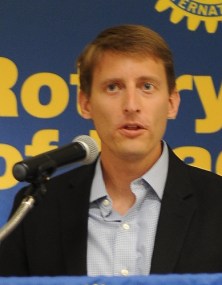
Linda Ketcham, Executive Director of Madison-area Urban Ministry (MUM), told Rotarians about the many ways that her organization, in conjunction with many other agencies and non-profits, is working to increase prisoners successful return to community life. MUM has a long history of promoting social justice and studying issues such as transitional housing that bring partners to the table.

Incarceration is a major problem in the U.S. and in Wisconsin and Madison. More than 90% of prisoners return home after serving their terms, and they face daunting problems that often lead to serving additional time. Furthermore, the system is flawed so that people of color represent a large segment of the jail population. Children and other family members experience collateral damage from the incarceration of a mother or father.

MUM has a long history of helping returning prisoners. Circles of Support is a program that links volunteers with persons released from jail. Extensive research has produced a body of literature that identified 8 principles that lead to effective strategies. These include the need to assess the risk of a person committing new crimes. It is more productive to focus on the medium to high risk individuals rather than on the low risk ones. Create a needs assessment on each individual to determine if specific issues, such as addiction, should be addressed first. Target interventions to their learning styles. Provide skill training and provide positive interactions and ongoing support.

With all their efforts, in conjunction with United Way, MUM has helped to reduce the recidivism rate from 66% to 12% in Madison. MUM continues to work with other nonprofits to provide mental health programs, housing, building of credit scores, and employment. Even though these programs are expensive, they are far cheaper than keeping people in jail at a cost of $29,000 each year.

If you missed our meeting this week, you can watch the video here.

Wine Fellowship Enjoys Taste of “Italifornia”

–submitted by Mike Wilson, Wine Fellowship Co-chair

Rotary “Italifornia” and “Cal-Ital” Wine fellowship tasting at the Madison Club, Tuesday 11th, October 2016.

Michael Pare of the L’Eft Bank wine company representative who has a thing for efts and newts, presented a rousing tasting of California wines with Italian emphases, explaining the Cal-Ital and “Italifornia” tasting slants, and within this tasting some very old vines by USA standards.

mad-club-wine-2  mad-club-wine-3

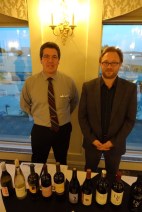
This tasting was had at the Madison Club, with Juli and Keith Baumgartner having arranged for the event. The Madison Club beverage manager, Dave Ginocchio arranged the facility and assisted with the tasting process by pouring the wine. He also prepared marvelous table mats with the 10 wine labels printed with a glass sitting atop each label.  He also provided descriptions of each wine and a list of the wines and the member prices which he made available to all attendees.  These wines were very reasonably priced and ranged from $11-$26.
mad-club-wine-5When thinking of these Cal-Ital wines one can concentrate the early wineries founded by first and second generation Italian-American families and the examples are many: Gallo, Robert Mondavi, Louis Martini, Sebastiani, Simi, Seghesio, Foppiano, Trinchero, Rochioli, Martinelli and Rafanelli and who among us have not tasted some great wine from these folks.  This was addressed by Michael Pare at the start, and Dave Ginocchio added to this idea with three appropriate old “Italifornia” photographs at the top of the price list/ordering sheet provided.

While the Italians were very important in the early California wine industry, there was also that Wisconson transient, Count Haraszthy.  Haraszthy was the pioneer Wisconsin wine guy (albiet unsuccessful, in what is now Wollersheim Winery), but also founder of the oldest incorporated village in Wisconsin (initially Szeptaj – beautiful place in Hungarian), subsequently named after himself, and now Sauk City.  He was a very successful businessman, had brickyards that built many of Sauk City’s old homes, a river shipping company, and a politician to boot.  He then headed for Sonoma California and subsequently developed the Buena Vista Winery that has since been restored, and functions to this day.  His sons inter-married with Mariano Vallejo’s daughters, the very general who surrendered to the California “Bears” when they revolted against Spanish rule. Vallejo then bought the nearby Mission vineyard, with an adjacent city named after him, and so these famous families where united. Haraszthy went on to become the “Father of Zinfandel” as claimed by his sons, but who was a very important facilitator of the Californian wine industry.

mad-club-wine-4

There were three white wines we tried, a 2014 Tocai Fruilano from Madonna Winery, a 2014 Malvia Bianca from Onward, and a 2010 Jacuzzi Family Arneis (THE white wine of Piedmonte), and yes the Jacuzzi family invented the jacuzzi we all know.  I loved the Arneis, and read that Jacuzzi make some of the best Cal-Itals produced according to a book on the very topic.
 

mad-club-wine-13  mad-club-wine-14

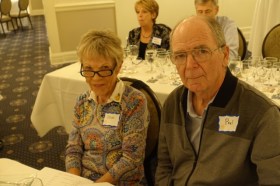
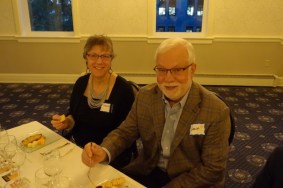
Photo 1: Sandy & Dana Corbett; Photo 2: Ellie and Paul Schatz

We then moved to the Red wines.  We tried a very soft 2012 Duxoup Sangiovese, then a wonderful 2014 Cline ancient vines Mouvedre made from 80+ year old vines (this means pre-prohibition vines as the Vollstad act required the bottles be broken, barrels smashed, and vines pulled out except for the production of altar wine for church and the 50 gallon per person homemade wine allowance.  This kept about 10% of wineries in business, albiet not a great business, but for us in the 20th century we do now benefit from old vines available to us.

mad-club-wine-8  mad-club-wine-11

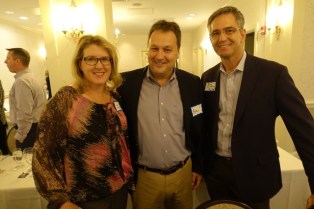
Photo 1: Leslie & Peter Overton; Photo 2: Joy Dawson, Ben Hebebrand & Bob Winding

We next tried a very good 2013 Folk Machine Charbono that my wife Patty loved. A Marietta Christo Lot #3 Rhone Blend of Syrah, some Petitie Sirah, Grenache and Viognier in a wine rated 91 by Robert Parker was available for $15.75.

We next had a stunning Ridge 2014 Benito Dusi Ranch Zinfandel.  These vines date back to 1922 and 25 acres worth goes to Ridge from the Dusi Family wine operation of now 202 acres (only 100 acres are from 1922 – 94 years old).  The Dusi family sells grapes to Tobin James, Turley, Meridian, Four Vine Winery and several other wineries if you remember having this vineyard from other winemakers.  We followed this wine with Donati Family Winery Claret and their Ezio Cabernet Sauvignon. These were well liked.

mad-club-wine-10

Joy Gander & Becky Steinhoff

David then brought out a special wine for us to sample: the “2012” Continuum (“96 rating”). This 100% estate wine using Cabernet Sauvignon, Cabernet Franc “, Merlot”, and Petit Verdot represents the last project of Robert Mondavi (remember he did OPUS with Baroness Rothschild) – to produce a First Growth wine of his own. The “2012” vintage we tasted is historically important to the Mondavi family, as the vintage marks the first Continuum to come from the Pritchard estate grapes only.  “The available 2013 vintage  is also important as it represents the first Continuum from the new winery building, the 40th vintage made by Tim Mondavi and marks the 100 anniversary of Robert Mondavi’s birth – the 1-40-100 wine in their parlance.”

You can see that several of the wines, the Claret and Cabernet Sauvignon above, the Ancient Vine Mouvedre and Christo Rhone blend weren’t Italian wines, but they are wines and stories that are classically Californian – fulfilling the Cal-Ital/Italifornia tasting formula.  A good time was had by all and there was a brisk sale of these wines to the attending Wine “Fellowshipper” Rotarians.

mad-club-wine-6

From left: Keith Baumgartner, Rich Cushman, Lori Cushman & Juli Baumgartner

Living with Epilepsy

–submitted by Donna Hurd; photo by John Bonsett-Veal

seaborg-kristin-10-5-16

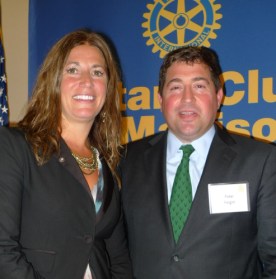
Dr. Kristin Seaborg (left) with Club President Michelle McGrath

If asked, “What illness affects 1 in 26 people, 50 million people worldwide; greater than 100,000 soldiers coming from Iraq and Afghanistan; attributed to 1/3 of all sudden deaths in children?” Would your answer be: cancer, heart disease or diabetes? What if you were told that this illness contributes to $15.5 in indirect medical costs per year; more than 7 times higher than any other chronic disease, including diabetes and heart disease? The mystery is not in the disease, but in what is known about the disease and the number of individuals affected by it.

With 200,000 new diagnoses per year, Epilepsy is a neurological disease that affects individuals more than muscular dystrophy, multiple sclerosis, cerebral palsy and Parkinson’s Disease combined. It accounts for 50,000 deaths per year, but only accounts for one-fourth of research funding of all other neurological disorders.

So why don’t we talk about? The stigmas associated with this disorder would make the most confident person keep the secret to themselves. While the discussion has advanced beyond medieval thoughts of divine punishment for sinners and identification as witches, vexed with evil spirits (I hope), many continue to remain silent about this malady as a sense of shame continues to be invoked.

Our guest, Dr. Kristin Seaborg, presented a compelling argument for disclosure and discussion about this condition as it will encourage an open dialogue, dispel the sense of shame, and create a climate of discovery, not disdain.  Dr. Seaborg decided that she would not let Epilepsy rob her of her dreams and through her book: The Sacred Disease: My Life with Epilepsy, discloses her experiences with the disease and why this is a conversation we must have.

For more information about Epilepsy go to www.efa.org.

If you missed our meeting this week, watch the video here.

The Political Demographics of Wisconsin

–submitted by Kevin Hoffman; photo by Jeff Smith

craig-gilbert-9-28-16

Washington Bureau Chief Craig Gilbert (pictured here at left with Rotarian Stan Kitson) of the Milwaukee Journal Sentinel presented the political climate for the 2016 election.  In a word, the Presidential and Congressional elections are more polarized than any in recent history.

With the two major-party candidates suffering high disapproval ratings, there are divisions both between the parties but also within each party as supporters struggle to reconcile party affiliation with distaste for their respective candidate.  For example, Republican nominee Donald Trump should enjoy a significant advantage in Waukesha County. Traditionally, Republican nominees have enjoyed well over 50% support in polls but Trump is only at 41% with 15% undecided.  Democratic nominee Hillary Clinton is doing well in solidly Democratic Dane County but she struggles to attract the same level of support as President Obama did in 2012.

Also, in Wisconsin there is a significant urban-rural divide that has implications for the general election.  Trump enjoys support in the rural northwest of the state but in population centers such as the southeast, with more reliable and higher voter turnout, he is below the level of support Romney captured in 2012.  Urban Republicans have been slower to coalesce around their nominee resulting in a large number of undecideds.

So, the election will come down to how effectively each candidate can mobilize their “base” areas of support in spite of voter misgivings.  Trump will need to convince the undecideds in traditionally Republican strongholds to vote for him rather than a third-party candidate, cross over and vote for Clinton, or not vote.  Clinton has stronger support within Democratic areas but also needs to convince Sanders supporters, the Obama coalition from 2012, and Republicans turned off by Trump to vote for her.

If you missed our meeting this week, watch the video here.

Milwaukee Bucks Remake

–submitted by Ben Hebebrand; photo by Jeff Smith

feigin-peter-9-21-16

A complete transformation of our state’s professional basketball team, the Milwaukee Bucks, should lead not only to an eventual NBA championship but also a turnaround for a significant portion of the downtown Milwaukee area.

At the September 21 Rotary Club of Madison meeting, Milwaukee Bucks Team President Peter Feigin characterized the Buck’s current development and construction project as one that is “30 percent about the Bucks, and 70% about getting people to be in downtown Milwaukee.”

Feigin outlined construction projects of a 30-acre neglected downtown Milwaukee area to include a new 16,500-seat arena (to replace the old Bradley arena that eventually will be demolished), a practice facility, a health center, parking areas, and an entertainment block featuring a plaza, a potential hotel, and restaurants. The arena will also double as a venue to attract big-name concerts that have eluded the state in recent years.

Matching the NBA’s global reach as is evident in over 100 international athletes playing for NBA teams and games being broadcast in 215 different nations, Feigin announced the Bucks’ “mission to be the most successful and respected sports and entertainment company in the world.” This new mission originates in a new ownership group “that just purchased a 50-year-old team that we are treating as a start-up venture.” As concerns a specific vision for the competitive prospects within the N.B.A., Feigin boldly proclaimed the goal to win a world championship rather than just “being a winning team.”

The mentality of a start-up, according to Feigin, is needed because “we have lost a generation of fans….we have been a bit dormant.” He added that Wisconsin, based on UW’s recent basketball successes and otherwise long-standing traditions, “has a basketball culture we need to nurture.”

When reminded by Club members of significant incentives offered by the state, city, and county, Feigin anticipates four-fold returns on such public investments in the forms of new jobs and associated income tax revenue as well as increases in property values and associated increases in property tax revenues.

When asked by Club members of the team’s social responsibilities and obligations, Feigin referred to Milwaukee as “one of the most racist and segregated cities I have seen,” citing a need for better practices in inclusion, diversity, and leadership. “We are determined to get involved.”

Did you miss our meeting this week?  Watch the video here.

The Forward Festival

–submitted by Mary Helen Becker; photo by Will Anzenberger

Younkle Matt 8 17 16.Matt Younkle, the inventor of Turbo Tap, a device which enables craft beers to be poured quicker and more efficiently, described this year’s Forward Fest, which will take place from Aug. 18 to Aug. 25 in various venues around Madison, including the Madison Children’s Museum, MMOCA, the Madison Central Library, and the Wisconsin Institutes for Discovery. In 2010 he co-founded the Forward Technology Conference. In a few short years it has grown to the 44 events available this year.
Open to the public, the Forward Fest emphasizes cross-connection, promotion, and opportunities to interact with others. The goal is to make Madison the best place possible to start a business. Several companies are sponsors, and the event is produced by many volunteers.

They support coworking, a way for a new business to have an address and a place to work. Young companies are the primary sources of new jobs. Rotarians were given a schedule of events which undoubtedly features something of interest to everyone!

Did you miss our meeting this week?  Watch it online HERE.