Category Archives: Rotary Club of Madison

The UW in the 1960s

–submitted by Rich Leffler; photo by Will Anzenberger

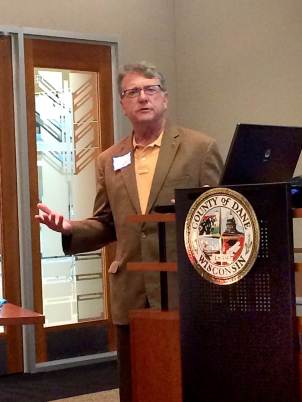
Stu Levitan (2)Stu Levitan offered an impressionistic, kaleidescopic, sprightly, and, most importantly, insightful history of the UW in the tumultuous 1960s. He began with an aerial photo of the campus in 1962. No Humanities Building, no Elvehjem Museum, no Vilas Hall, Helen C. White, Sellery, Ogg, and Witte halls. All were added during the 1960s as the campus burgeoned.

He mentioned people who were students at the time: Dick Cheney, Tommy Thompson, Jim Doyle, Ed Garvey, Shirley Abrahamson, David Prosser, Barbara Crabb, Paul Soglin, David Maraniss, Andrew Goodman (for one semester), Steve Ambrose, Dave Zweifel, Ben Sidran, Pat Richter]and Joyce Carol Oates. They became leaders in their professions and some still are. Stu also spoke of the people who shaped the decade (and Stu holds a minority view among historians that it is individuals who make history): the aforementioned Soglin, the great Fred Harvey Harrington (who as president “super-sized” the UW), Robben Fleming, William Sewell, Ed Young, Milt Bruhn, Richter, Ron VanderKellen and Crazy Legs Hirsch.

But the sixties are remembered for one big thing: the student anti-war activism. The origins of that activism were, said Stu, in the civil rights movement of the late 1950s and early 1960s, when students went down South at considerable risk to fight against racial segregation. They demonstrated a deep “level of commitment and fearlessness.” Students who challenged the Klan were not intimidated by university administrators. Antiwar activism was, “to a considerable extent shaped” by the civil rights movement. When the first sit-in took place to oppose the draft, it was to protest student deferments that increased the exposure of non-students–the poor and minorities. Resistance to the war, though it had an element of self-interest, was also driven by principle. Peaceful resistance yielded to the Dow “riot” in fall 1967, which Stu called “the single most important political event of the decade. It marked the end of the summer of love and the start of the days of rage.” There was a cost to all this: the Regents, once defenders of the university, “took the lead in attacking” students, faculty, and administrators. The UW lost support among the people of Wisconsin, support that is still not recovered. When Stu asked an activist if the demonstrations were worth it, he answered that the more important question is were the demonstrations necessary? Stu is still working on the answer to that question. Watch for his conclusion in his book to be published next year by the Wisconsin Historical Society Press.

Did you miss our meeting this week?  Watch the video HERE.

Wine Fellowship Event July 24

–submitted by Mike Wilson

Winephoto1

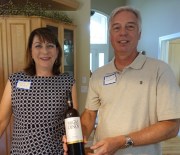
Twelve Madison Rotary Wine Fellowshippers met at Steve and Meryl Mixtacki’s home on Sunday, July 24, to taste summer wines each couple had brought for the group to try. Steve and Mike Wilson had additional wines so that “pairings” could be arranged with the wines brought along.

We tried two Methode Champenoise – a Gruet brut made in Albuquerque from grapes grown near Truth and Consequences in New Mexico, and a champagne -Taittinger.  Both were excellent, but the Gruet for its price (less than half of the Champagne) was the winner.

Winephoto5Winephoto4Winephoto7

Photo 1: John & Jane Wegenke; Photo 2: Mary & Robert Borland; Photo 3: Meryl & Steve Mixtacki

Next we tried 3 whites.  A 2014 Pine Ridge Chenin Blanc and Viognier blend, a 2012 Adam Alsation Auxerrois (Pinot Gris/Pinot Grigio equivalent), and a 2014 Artesa limited release Chardonnay.  This was the flight that was most loved.  The first two wines were inexpensive, but the Artesa has only just been released by the winery and is not listed on the website but expect it to be about $40 (given the 2013 price).

The next flight was cooled Premier Cru Beaujolais, two of the lighter versions – a Chiroubles and a Regnie. After that we had an Artesa Pinot Noir and a Skouras (2012 Megas Oenas) – a Greek blend of Aghiorghitiko and Cabernet Sauvignon – and I rated them both as excellent.

We ended the evening with a Moscato (Piedmonte) that was cold, and sweet, with the typical low alcohol content (5-6% only).

A great time was had by all, and the best loved wines were the Gruet sparkler, Artesa Chardonnay, Pine Ridge (Chenin Blanc and Viognier), and Alsation Auxerrois (Pinot Gris).

“When you’re alone and life is making you lonely you can always go DOWNTOWN”

–submitted by Bob Dinndorf; photo by Mary O’Brien

Susaan Schmitz 7 20 16A musical introduction of the Rotary Club’s program was announced as guest presenter Susan Schmitz joined Bob Dinndorf as songleader for Petula Clark’s Downtown, accompanied by keyboard artist Lynn Phelps.
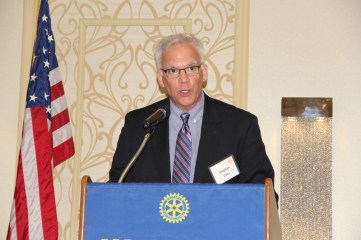
Downtown Madison Inc (DMI) started over forty years ago as urban sprawl to the east and west began to intensify. Three of DMI’s four founders were Rotarians and members of the Greater Madison Chamber board. As DMI grew it separated from the Chamber to become a self-sustaining entity. Two of its signature initiatives have successfully entered new generations: Frostiball is in the care of Overture and Paddle n’ Portage is carried on by Isthumus.

Today DMI boasts 500 members and administers assessed funds generated by the Central Business Improvement District which includes businesses around Capitol Square and along State Street. DMI continually advocates for a vital, healthy Downtown among city staff, alders, the mayor, county exec, UW Madison, Edgewood College, Madison College, Madison Police, Greater Madison Chamber and the Convention & Visitors Bureau, Madison Regional Economic Partnership, churches, neighborhood associations and many other individuals and organizations concerned about downtown Madison.

Bounded on the east by the Yahara River and on the west by Camp Randall, the originally platted in July 1836 for the City of Madison is used today as bounds for Downtown Madison, Inc. (DMI). The University of Wisconsin and the State Capitol Building, connected by State Street, (along of course, with the Rotary Club of Madison) were and continue to be anchors for Downtown.

Susan Schmitz, Executive Director of DMI, underscored the importance of downtown when she said there are more people living in urban areas than rural areas for the first time in history. She then painted by number a picture of the current “State of the Downtown.” A sampling:

  • Since 2000, downtown population has increased from 22,165 to more than 25,000
  • 3.56% apartment vacancy rate drives rental rates and construction
  • 93.9% of downtown residents are renters
  • 52.7% of Madison residents as a whole are renters
  • 40,000 meals were served to homeless people in 2014 by downtown churches
  • 560 places for day care are available downtown at Red Caboose and Creative Learning. More is needed
  • 44% of downtown employees work in public administration, 12% in hospitality, 8.2% in professional/technical occupations
  • 10.8% office vacancy is declining and needs to be in the 7-8% range
  • 40% of downtown businesses are classified as food and beverage businesses; a consistent number since 1998. Bars are not taking over!
  • 11.7% is the increase in Metro Bus ridership since 1010.
  • 149,385 bicyclists have been counted by the Eco-totem counters on Madison trails; an increase from 48,537

Much more can be added. Susan urged Rotarians to contact their alders to let them know our priorities and concerns so that they continue to make wise policy to govern the city.

Did you miss our meeting this week?  Watch the video here.

“Everything He Knew, He Learned in 1721”

–submitted by Linda Baldwin; photo by Mary O’Brien


Stephen Coss 7 13 16

It was a pivotal year for the American colonies, for modern medicine and for Benjamin Franklin, then an apprentice in his brother’s Boston print shop. Professor Stephen Coss discussed his book, “The Fever of 1721.”

According to Coss, in 1721, Massachusetts colonists participated in the first successful rebellion in the colonies against England, the first independent newspaper, The New England Courant, was published, western medicine’s first inoculation experiment was conducted on smallpox victims, and Franklin arrived on the scene as his brother’s printer’s apprentice.

Quite a year. Read the book.

In Boston, the first political challenge to English authority was led by Boston businessman Elisha Cooke Jr. The Boston Caucus, led by Cooke, convinced locals to oust the very unpopular English governor, thus accomplishing the first overthrow of a royal appointee.

While newspapers had been published in Boston and in the colonies under the authority of the crown, James Franklin started the New England Courant with his 12 year old brother Ben as an independent voice, the first in the colonies.

Not a successful business venture, James decided to exploit the inoculation of smallpox controversy to raise readership. Thus began a tradition of independent voices in the press discussing social, philosophical and political issues…social issues poked fun at by Silence DoGood, the pen name of teenager, Ben Franklin. Professor Coss tells us that James didn’t know that Ben was writing the DoGood articles and was outraged when he found out.  This “freedom” of the press was later enshrined in the 1st amendment of the US Constitution.

As small pox raged through the population, New Englander Cotton Mather began promoting inoculation as a way to combat the disease. Together with Dr. Boyleston, through much criticism, small pox inoculation was attempted and thus began vaccination as a successful tool against diseases like small pox.

For Ben Franklin, this was a time of intense education in politics, journalism and public medicine.  He was greatly influenced by Mather in promoting that community service, trying to do good, was a more valuable effort by men in our society than the accumulation of wealth and power. Later, Franklin formed the “Junta” in Philadelphia; a do-gooder group which was a model for Rotary to come.

Did you miss our meeting this week?  Watch the video on our YouTube Channel here.

July 6 Fellowship Luncheon Highlights

On July 6, members and guests participated in our club’s 24th Annual Vocational Fellowship Luncheon Day.  Instead of our regular meeting at the Inn on the Park, members enjoyed this opportunity to get to know one another better in a small group setting as they learned more about various area businesses.  Here are some photo highlights from this year’s locations:

IMG_4614

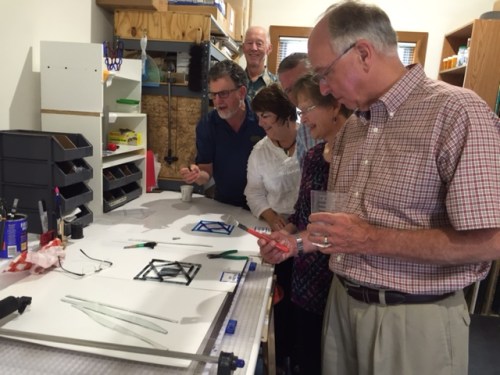
Member and guests gathered at the home of Denny Carey for a presentation on how fused glass is accomplished in a live glass studio.  Each guest built a unique decorative piece of glass.

IMG_4832

Terry Anderson hosted members and guests with an overview of this year’s Legislative Council special study committees and the workings of the Council.  The luncheon concluded with an optional climb to the top of the capitol dome for a bird’s eye view of Dane County.

20160706_125136

Jed Engeler arranged for members and guests to hear the stories of Wisconsin citizen-soliders from the Civil War to the present day at the Wisconsin Veterans Museum.


IMG_0921

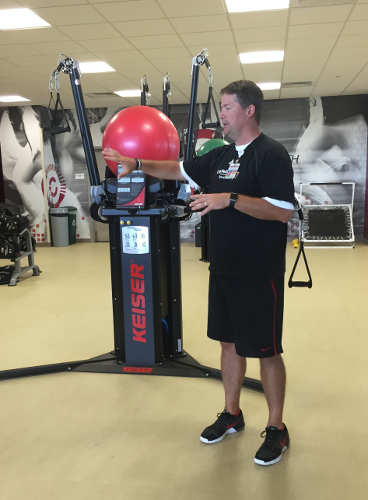
John Sheehan of The American Center hosted members and guests and provided a program and tour the Sports Performance and Rehab Center.

Dane Co Airport 4

Bill White, former airport commissioner, provided an overview of the history, operations and  growth for the Dane County Airport which included a short behind-the-scenes tour of terminal, baggage and facilities operations.

20160706_122024

Exact Sciences Corporation included Valerie Johnson as host were members and guests received an interactive presentation highlighting the challenge of colon cancer and guided tours of the lab.

Today in History: Saying Farewell to “Brownie”


–submitted by Rick Kiley; photos by Valerie Johnson

DSC00484   DSC00488  DSC00496  DSC00500

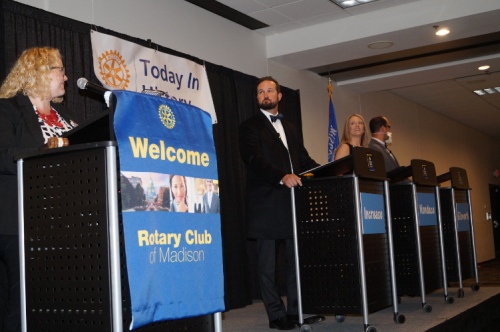
June 29 was the annual Changing of the Guard “Roast” of outgoing Club President Ellsworth Brown hosted by Club members who have joined during the past year, a.k.a. the Roast Committee.  All agreed it was very creatively staged and “hit all the right notes.” Several veteran members said it was among the best they’d seen.

President Ellsworth Brown began the program thanking the Rotary Office staff and those who supported him during the past year: his wife Dorothy, Assistant Julie Schultz and members of the club.  He thanked the Club for it’s commitment, action, willingness to say “yes” and volunteerism, ending with a quote from Yogi Berra, “It isn’t the heat that gets you, it’s the humility.”

DSC00502  DSC00501

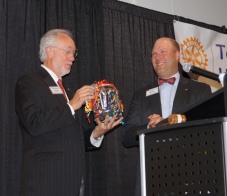
President Ellsworth then ceremonially passed the President’s pin to incoming President Michelle McGrath, and she passed the Vice President’s pin to Donna Hurd.  Past President Tim Stadelman welcomed Ellsworth to the Past President’s Club; Renee Moe presented him the Past President’s plaque and Wes Sparkman presented him a Paul Harris Fellow pin.

DSC00510

The Roast was a Jeopardy-style TV game-show theme.  Of course, one of the contestants was 50-week reigning champion Ellsworth “Brownie” Brown.  The show kicked off with a video from Reno, Nevada, of a trauma helicopter pilot, Ellsworth and Dorothy’s son, Lincoln, and his wife Tia.  Lincoln then made a surprise entrance in his flight suit.

The game show’s categories of Jeopardy-style answers included Early Ellsworth, Hysterical Society, Rotary Rites of Passage, 50 Shades of Brown and Word of the Day.  Of course, the winner was Ellsworth Brown.

DSC00523  DSC00526  DSC00530

Winner’s prizes included a collection of pens donated by Club members (to enhance Ellsworth’s own collection), a historical pen from a sycamore tree at the place President Lincoln and General Grant once met, and a special edition of the Isthmus with Ellsworth’s caricature on the cover.

Finally, a parting video featured new President Michelle McGrath donating a unique “artifact”, Ellsworth himself, to the Wisconsin Historical Society.

DSC00514