Category Archives: Rotary Club of Madison

Be a Gift to the World

–submitted by Stan Inhorn; photo by Will Anzenberger
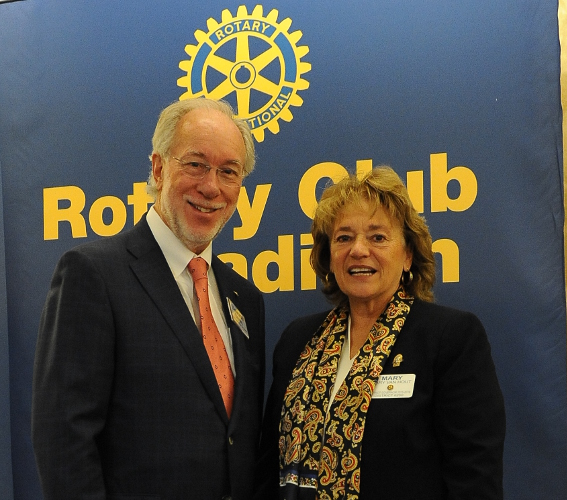
Club President Ellsworth Brown pictured here with District Governor Mary Van Hout

Club President Ellsworth Brown pictured here with District Governor Mary Van Hout

On September 23, Rotary District Governor Mary Van Hout described her personal relationship to Rotary and the many ways it has affected her life. She said that one word “Give” defines how her Rotary membership has affected her civic involvement.    Many people are wary of becoming involved or giving of their time and money to philanthropic organizations but they underestimate the benefits that accrue.

This year’s Rotary International motto is “Be a Gift to the World.” This motto emphasizes the five core values of Rotary:

  1. Friendship – You have many friends throughout the community.
  2. Leadership – There is an opportunity for personal development.
  3. Integrity – This is based on the 4-way test of Rotary.
  4. Service – You place service above self.
  5. Diversity – You understand the value of acceptance of other political views, religions, ethnicity, social and economic status.

Mary learned many of these values growing up in a small rural area in Wisconsin where she observed how neighbors helped each other by working in teams to carry out their chores. When she was 10, her mother died, and neighbors displayed random acts of kindness to Mary and her several siblings. In 2000, Mary learned about the Rotary Orphan Train Project, and she took her first international trip to Guatemala. The Rotarians’ intent was to institute a computer program, but the Catholic sister in charge of the orphanage insisted that the money could be better used to build a poultry barn. The girls would then learn how to grow their own food as well as developing business skills. Since this trip, Mary has pursued many other international service projects. She implores Rotarians to balance the “Giving” word with “Getting” as you consider the many benefits of Rotary membership.

Did you miss our meeting this week?  CLICK to watch the video.

Get to Know Rotary! New Member Event on September 17 at Madison Club

–submitted by Sandy Morales; photos by Donna Beestman

From left: Mpoli Simwanza-Johnson, Club President Ellsworth Brown, Zack Robbins, Brett Topham and Jenny Sanders

Last Thursday 25+ new and experienced Rotarians came together to network and learn about the opportunities that come with being a Rotarian.

NME 9 17 2015 EJason Beren from the Member Development Committee welcomed the group and everyone had a chance to introduce themselves. A presentation followed and started with the work that is supported internationally and locally with both The Rotary Foundation of Rotary International and our club’s Madison Rotary Foundation. Rotarians are encouraged to participate in both and Paul Harris recognition is given to those that contribute at least $1,000 to The Rotary International Foundation which can be a cumulative gift over time.

There are many ways to participate in Rotary outside of the regular scheduled weekly luncheon and is highly encouraged and also a way to do make-ups.  One member explained that fellowship groups are a great way to engage a spouse, partner or family. Rotarians can also attend other Rotary clubs locally or anywhere else in the world, since we have 34,000 clubs internationally.  Rob Stroud also encouraged members to consider becoming involved at the district level and meet other Rotarians from the region.

From left: Kris Ashe and Sandy Morales

From left: Kris Ashe and Sandy Morales

There was a one-question quiz at the end – What is the maximum number of make-ups you can garner on one Wednesday? Can you guess? Answer is four. 1) New Member Coffee 2) Committee Meeting before Rotary 3) Committee Meeting after Rotary 4) Evening Fellowship.

Soglin Sets Priorities in Tough Times

–submitted by Valerie Johnson; photo by Jeff Smith

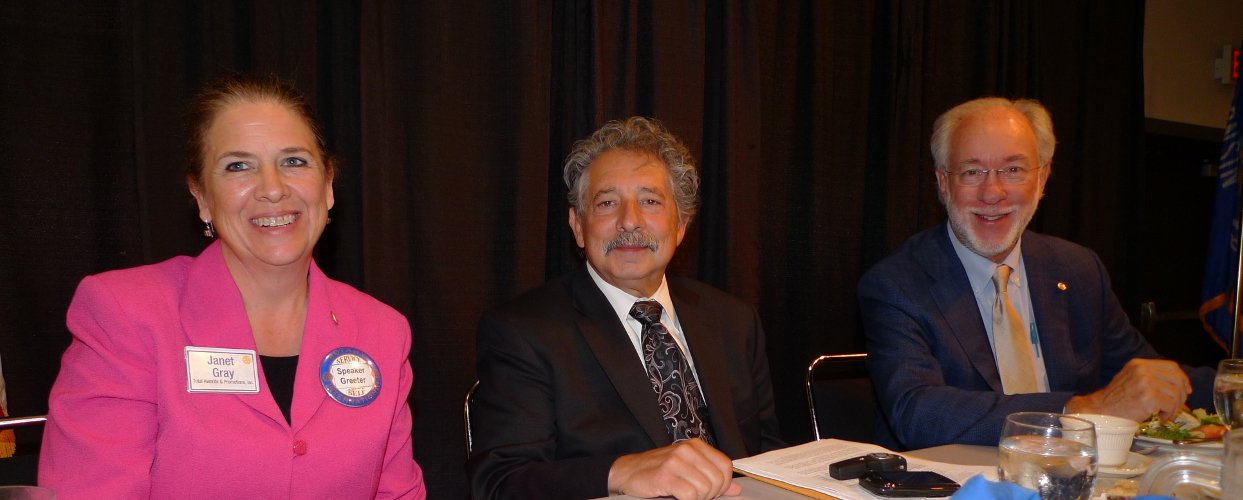
From left: Rotarian Janet Gray, Mayor Paul Soglin and Club President Ellsworth Brown

From left: Rotarian Janet Gray, Mayor Paul Soglin and Club President Ellsworth Brown

Mayor Paul Soglin began his annual fall review with our club by thanking Rotarians.  “The premise of government is that while we have elected representatives, what makes Madison function is active participation of citizens.”

“I’ve learned when you are trying to accomplish several economic goals, it makes a difference if the mayor makes the ask,” he said. He had two asks for Rotarians.

“My first ask is to support employment, both summer youth and adult employment.  We’ve made big advances in employment.  City employment has an expanded internship program. We provided 32 teens jobs this past summer. We have several partners: Operation Fresh Start, Simpson Street Free Press, Centro Hispano to name a few. These are real jobs with real pay.  We love it when at the end of the summer an employer calls and asks if they can keep on the student part-time for the rest of the year.”

Minnesota just released a study examining why there is a disparity on race in incarceration.  Mayor Soglin said we have an even bigger gap here.  Why the gap? “Poverty,” he said.  “Lack of participation in the workforce.  If we can change that, we can change a bevy of outcomes.”

Mayor Soglin’s second ask is about housing.  We are one of 100+ cities in the US that have signed a pledge to end veterans’ homelessness by the end of 2015 and end chronic homelessness by 2016.  We are doing poorly compared to other communities, he reported.

“There are reasons,” Mayor Soglin said, “particularly as it relates to the availability of housing and the cooperation of state government.  What is most upsetting is we have 31 veterans with VASH vouchers (for veterans only, pays for housing) who are still on the streets because they cannot find housing. So my second ask is for Rotarians to contact the Community Development office and figure out a way to make an apartment available for one of these 31 veterans.

The Mayor listed the city’s top three priorities:Affordable housing

  1. Affordable housing
  2. Improving equity and reducing poverty through job creation, training and employment, afterschool
  3. Food security

Three key financial facts:

  • City bonds rated AAA by Moody’s
  • Debt retires in 10 years typically
  • City goal is to stay under 15% of our budget going to debt. With significant cuts, we are still at 17%.

Where do our tax dollars come from?  Almost 75 percent comes from taxes; 13 percent from state aid, eight percent from fees.  This property tax burden is much higher than when he started in politics. The mayor reported he has made large cuts in CIP, the capital improvement plan.  This has lowered our borrowing to keep our good bond rating and allow us to retire debt.

“What is really crushing us,” he said, “is infrastructure replacement. We are replacing more pipes from the 60s than the 20s.”

CLICK to view the video.  Our Thanks to City Channel for taping our meeting this week.

Renewable Energy Buildings Coming Soon

–submitted by Kevin Hoffman; photo by Jeff Smith

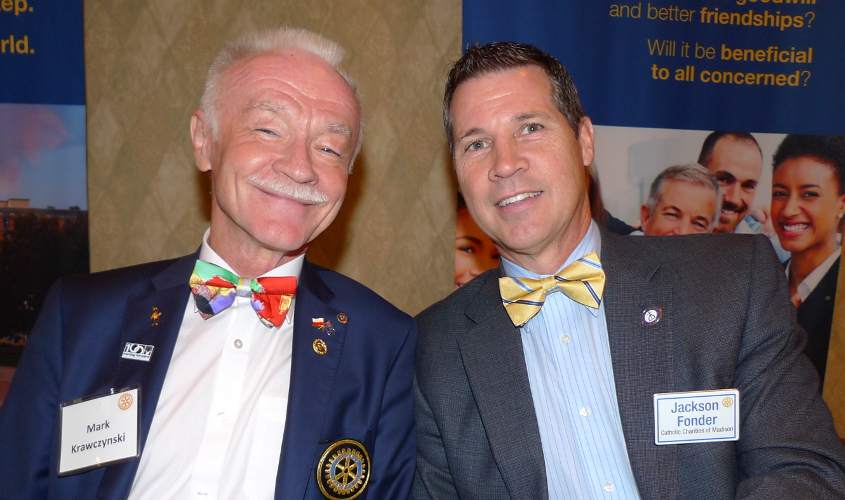
Mark Krawczynski (left) pictured here with our Rotary club member Jackson Fonder

Mark Krawczynski (left) pictured here with our Rotary club member Jackson Fonder

Fellow Rotarian Mark Krawczynski is originally from Warsaw, Poland, but has spent most of his life in Australia as a Chartered Architect working on many large scale public and private projects, including the reconstruction of the iconic Sydney Opera House.

He is now taking his nearly 50 years of experience as an architect to promote and advocate for using known renewable energy technologies to change the way buildings are thought of and constructed.  Thinking of future generations, Mark explained that the earth has reached the point where the use of traditional single-use energy technologies (oil, wood and coal), the growth of human population, and accelerating economic development have placed an unsustainable pollution load on the environment.  Fossil fuels, in particular, have caused many cities and regions to become polluted to the point where one can no longer see the sky, clean water is threatened and increasingly scarce, and pollution-induced illnesses have claimed more lives than polio.

From this gloomy premise he proceeded to propose that solutions are available but that the time to start is now and the transition will take a long time – probably 40 to 50 years.

Mark proposed that one of the first things to change would be how we view the purpose of buildings.  He described the construction of buildings in the past was from a “defensive” purpose.  That is, buildings were primarily to keep out natural elements such as water, wind and sun and, therefore, wasted.  Current buildings throw away these natural and renewable resources by repelling and sheltering us from them.

An updated consideration of buildings would look for ways to combine several clean, renewable energy technologies that would work in concert to provide for the energy needs of the building and spin off enough surplus energy to be used elsewhere in the community.  Mark envisioned that buildings built in this fashion would need to combine several technologies to be feasible but would work better than traditional energy methods.

Buildings designed using the harmony of several clean energy technologies would need to incorporate the technologies into their shape and structure, as well as the surrounding environment and natural resources of the site (wind, sun, geo-thermal, water, etc.).

Mark concluded by showing a short video that described a prototype building called an Elemental Flow Tower.  It was designed to use natural light, water, sun, geo-thermal, rain and wind to create a total system of self-contained energy production, as well as serve the functions of a building for shelter and comfort.

CLICK to view the video of this presentation on our club’s YouTube Channel.

A New View for Downtown Madison

–submitted by Bill Haight; photo by Jeff Smith

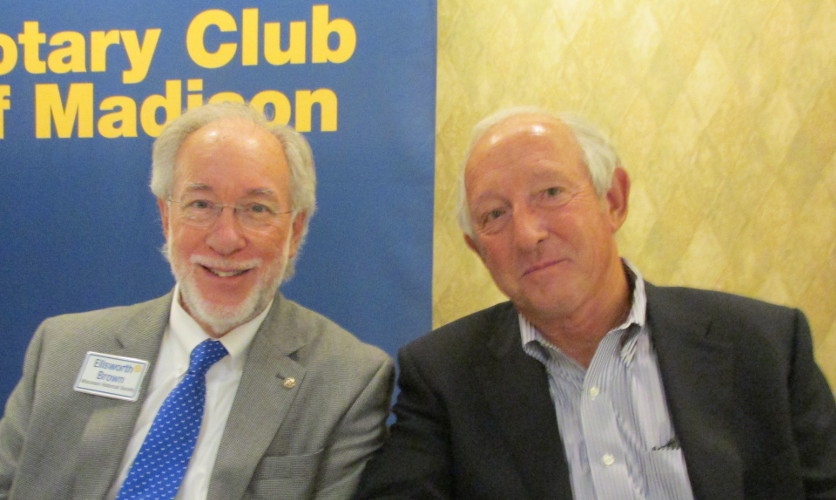
Brad Binkowski (right) seated here with Club President Ellsworth Brown

Brad Binkowski (right) seated here with Club President Ellsworth Brown

Brad Binkowski, who with Thomas Neujahr, is co-founder of Urban Land Interests, gave an overview of current developments on and around the Capitol Square.

ULI’s next project is a complete redevelopment of the Anchor Bank building, removing its dated precast panels, and adding a glass and stainless steel façade which will be “unlike anything you’ve seen in Madison,” said Binkowski.

In the Anchor project, as well as ULI’s Block 89 development, an essential component for success is replacing above grade parking with underground. Because of limited developable land and height restrictions, it’s impossible to create structures with street level energy and activity if above-ground parking is incorporated, said Binkowski. The Anchor project will have five levels of underground parking, extending under Carroll Street. Besides the Anchor property, there are only three more large sites downtown suitable for underground parking: the Judge Doyle Square development, The American Exchange Bank property, and the Braydon lot.

Epic is a significant driver of Madison’s growth, but it isn’t the only factor said Binkowski. Madison’s quality of life has attracted other firms, like office software company Zendesk, because it can find an ample workforce, without the extreme competition for talent and expense of cities like San Francisco. Among ULI’s residential tenants 56 percent came from outside Madison and their average age is 34. But just 26 percent work for Epic.

In 2011, 70 percent of ULI’s business tenants were from the legal, finance or government sectors. By 2015 that percentage has dropped to 64 percent, not because the traditional industries are shrinking, but because other sectors are growing much more rapidly. Restaurant tenants are up 29 percent and technology 143 percent. Those percentage changes, even from a smaller base, illustrate the shifting opportunity for growth, said Binkowski.

CLICK to view the video on our club’s YouTube Channel.

Moving the Needle Toward Better Education

submitted by Bob Dinndorf; photo by Mary O’Brien

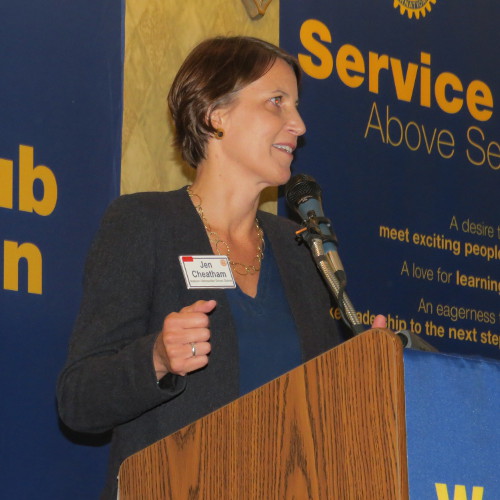
Jen Cheatham 8 26 15Dr. Jennifer Cheatham provided an “annual report” in her third Rotary presentation since becoming superintendent of the Madison Metropolitan School District in April 2013. Her 2015 appearance was special in that it was her first since becoming a member of the Rotary Club of Madison, she announced to generous applause. The Strategic Framework developed by the Madison Board of Education and staff, focuses on systemic improvement in our urban school district, the key to which lies in development, instructional alignment and coherence at every level of a school system aimed at achieving breakthrough results in student learning. Goal 1 of the plan includes milestones such as proficiency in reading and mathematics in grade 5. The lyrics, “reading and ‘riting and ‘rithmatic” from the 1907 song “School Days,” proclaimed by songleader Brad Hutter remain relevant today.

Though still early in the journey toward every school becoming a thriving school preparing every child for college, career and community, there is clear progress to report. Elementary schools continue to make major progress, with nearly 10 percentage point gains on all measures over two years and improvements for almost every student group, including Latino students and African American students, since work began on implementation of the strategic framework begun just two years ago.

High school graduation rates continue to move in the right direction, up for almost all student groups, and with pockets of accelerated results. At LaFollette High School, the four-year graduation rate for African American students increased to 75.3%. Memorial High School was also cited for dramatic improvement on critical measures. Our schools and the community will continue to progress by maintaining sustained focus on the day-to-day work of great teaching and learning. It is easy for educational institutions to become distracted by continually lengthening the list of innovations. The Strategic Framework and results can be found at www.madison.k12.wi.us/framework.

Our thanks also to WisconsinEye for videotaping our program this week.  You can view it HERE.