Category Archives: Rotary Weekly Guest Speaker

Q&A Forum with AG Candidate Josh Kaul

submitted by Ben Hebebrand; photo by Pete Christianson

Josh Kaul 10 24 2018

From left: Lester Pines, Josh Kaul and Greg Everts

At the October 24 meeting of the Rotary Club of Madison, Democratic candidate Josh Kaul for the office of Wisconsin attorney general summed up his vision for the state’s highest judicial office by asserting that he would operate as an independent force “standing up for the rights of Wisconsinites” and working to make Wisconsin “stronger and safer.”

Citing his Wisconsin roots of growing up in Oshkosh and Fond du Lac and highlighting his Stanford law degree along with his experience as a federal prosecutor serving in Baltimore, Kaul made the case to be the right person for the job. He outlined various positions related to voting rights, the opioid epidemic, the Affordable Care Act, high incarceration rates of African-American citizens, school safety and the recent appointment of Brett Kavanaugh as US Supreme Court Justice.

In discussing voting rights, Kaul painted himself a champion based on his record of actively challenging any attempts to restrict voting including in Wisconsin. He also addressed the gerrymandering issue in Wisconsin that reached the U.S. Supreme Court by supporting the idea of a non-partisan redistricting model.

On the topic of the opioid crisis, Kaul pledged to follow a four-point agenda, encompassing enforcement of laws with large-scale traffickers, expanding access to substance abuse treatment, holding pharmaceutical companies accountable, and expanding Medicaid to afford greater treatment options under Badger Care. Asked whether he had accepted any campaign donations from the pharmaceutical industry, Kaul answered that he had not and also had made the pledge not to accept any funds from the National Rifle Association.

Kaul pledged to withdraw Wisconsin from current and future lawsuits seeking to repeal or invalidate the Affordable Care Act, and he especially stressed the need to grant medical coverage to those with pre-existing medical conditions.

Kaul addressed the high incarceration rate of the African-American population by advocating for community policing and community prosecution, pointing to such successful efforts in Milwaukee.

In terms of school safety, Kaul emphatically declared that more common sense is needed than is evident in his opponent’s ideas to arm teachers with guns. He singled out his opponent for “criticizing gun-free school zones.”

In drawing yet another distinction between him and his opponent, Kaul said he had opposed Kavanaugh’s confirmation even prior to the sexual harassment charges against him became public. “The Court is going too far to the right,” he said. “The process was not a good one.” He was especially critical of his opponent’s statement that the allegation of sexual harassment 36 years ago should not disqualify Kavanaugh.

The greatest criticism of his opponent has been the massive backlog of rape kits not being tested in an effort to bring justice to victims and lock up potential sex offenders representing further danger to public safety. Kaul said the “delay in getting justice” was a blatant example of his opponent’s misplaced priorities.

While Attorney General Brad Schimel was invited to appear jointly or on a separate date, his campaign office declined our invitation.  Per our board policy, we offered Schimel’s office to have his campaign materials at our meeting on October 24th, and our thanks to Nancy Bartlett for attending and staffing the table. 

Our thanks also to WisEye for videotaping our meeting this week.  Watch the video here.
Rotary’s General Secretary: “We Are All Peacemakers”

submitted by Dave Mollenhoff; photo by Pete Christianson

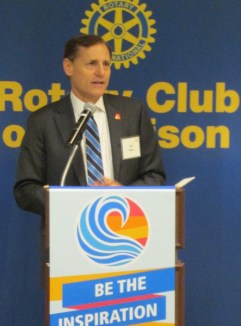
John Hewko 10 3 2018Rotarians were privileged to hear John Hewko, Rotary International’s General Secretary, talk about three global issues facing Rotary in the 21st century.
First, we must finish PolioPlus, even though we have been supporting this cause for 30 years.  Today, with the help of international partners including UNICEF, WHO, and Gates Foundation, the end is in sight.  Yes, Hewko admitted, we are experiencing donor fatigue, but we cannot move on to the next big project until we are successful with this one.  PolioPlus, he continued, has really put Rotary on the international map.  The remarkable infrastructure that we developed to deliver PolioPlus can be used for the next big campaign, he noted, but admitted that no decision had been made on what this would be.

Second, Rotary’s international membership has been stagnant at 1.2 million members for the last 20 years.  This is because membership in the U.S. has been declining, but membership in Asia and Africa has been increasing.  Faced with stagnant growth, Rotary must develop new products for today’s changing marketplace including experimenting with formats that depart from the club model.  Hewko also urged Rotarians to find ways to increase our impact on the world.   For example, our club could join forces with other Wisconsin clubs to do larger scale projects.

Third, Hewko urged us to recognize that “peace is at the center of everything we do.”  We do this by providing potable water, teaching better health practices, and eradicating disease.  Rotary International has recently joined forces with the Institute for Economics and Peace to focus grant programs on those that create the most enduring peace.

Hewko directs a staff of 800 employees at the RI headquarters in Evanston, Illinois and seven other international offices, and has served as general secretary since 2010.

Members from many Rotary Clubs in Southern Wisconsin also attended the talk.

If you missed our meeting this week, you can watch the video here.

MSO Celebrates 25 Years

submitted by Rich Leffler; photo by Margaret Murphy

John DeMain 9 19 18

From left: Club President Jason Beren, club member Perry Henderson and John DeMain

Madison Symphony Orchestra conductor John DeMain joined us in his first event to celebrate the 25th year of his leadership here in Madison. Twenty-five years is an extraordinary time for a modern conductor to stay with an orchestra. We have been lucky to have him here for a quarter century.

John began by very generously crediting his predecessor, Roland Johnson, for his long service to the MSO and as creator of the Madison Opera as part of the MSO. He credited Mr. Johnson with making the orchestra professional and with recruiting the services of UW faculty and students. John also explained the changes that he has brought. At one time, the orchestra performed eight single concerts a year. When Roland Johnson passed the baton to John, he urged him to build on his work developing an audience. John has tripled the audience during his tenure. Today, the season consists of a series of eight concerts, each performed three times, on Friday and Saturday evening and on Sunday afternoon. The MSO has done more than increase its audience and its string section (now full-sized). In his first year, John initiated blind auditions for prospective musicians. UW faculty joined the orchestra, which encouraged their students to participate as well. The result was fine musicianship. [Anyone who has heard the MSO will agree that it is shockingly good. Its string section is vibrant and its sound has a sheen.]

John also thanked Pleasant and Jerry Frautschi for their astounding gift of the Overture Center, including Overture Hall, which has a splendid acoustic that allows us to hear how beautifully the MSO plays. John also spoke of the several associated organizations and programs affiliated with the MSO.

John concluded on a somewhat somber note. Former UW Chancellor John Wiley was in attendance. He upgraded the School of Music during his tenure. Some of his work is being undone because of funding woes: many of the faculty are no longer tenure-track. They and their students are less likely to join the MSO. However, fine musicians from elsewhere are maintaining the orchestra’s excellence.

The Maestro made one last point: Madisonians should include the MSO in their entertainment options. This reviewer agrees. As an old ad in New York once proclaimed: “Try It, You’ll Like It.”

We express a special thanks to the MSO: The Rhapsodie Quartet: Susanne Beia, Laura Burns, Chris Dozoryst and Karl Lavine.  The quartet performed a movement from the American String Quartet written by Antonin Dvořák.  If you missed our meeting this week, you can watch the video here.

“Show Your Rotary Pride”

submitted by Stan Inhorn; photo by Karl Wellensiek

DG Bill Hoel 8 29 2018

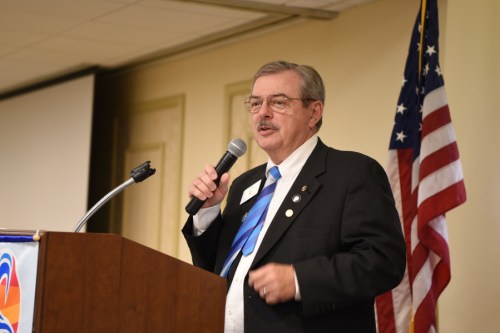
Bill Hoel, Rotary District 6250 Governor, inspired Rotary Club of Madison members to show their Rotary pride. Hoel suggested that Rotary is recognized worldwide for the success of its many programs carried out by its more than 35,000 clubs and 1.2 million members in over 200 countries. He further explained that the clubs are grouped into 529 districts and 34 zones. Rotary continues to grow in numbers, more in other continents than in North America. The  Rotary International website showcases projects that have been completed around the world.

The biggest project ever undertaken by Rotary is the Polio Eradication program that has a goal of total eradication of the polio virus.  No other major project will be undertaken until no more cases are reported and until no virus can be identified in samples of wastewater for at least three years. Although isolated cases are still being found in a few countries in Asia and Africa, occasional cases are reported in the U.S. One such case was recently reported in Minnesota from a boy who had visited a Canadian Amish settlement that had not received the polio vaccine.

Hoel also emphasized that cooperation between Rotary clubs and other organizations is important. Rotary has permanent representatives in the United Nations and indirectly with its subsidiaries such as the World Health Organization and the World Food Program. He described two efforts that involved Wisconsin clubs, one in 1986 and one in 1989. The first involved a period of starvation in Ethiopia, in which a concerted effort enabled tons of dried whole milk to be sent by planeload and cargo ship.  The second, called Hands Across the Heartland, sent food to Moscow during a period of famine.

Hoel suggested that Rotary Pride for all its accomplishments should inspire others to think of becoming a Rotarian. Because of its manpower, Rotary Club of Madison has many accomplishments to be proud of, but it may be able to do even more by collaborating with other clubs in the district.  He invited members to attend the 2019 District Conference, June 7-8, at the La Crosse Center.

If you missed our meeting this week, you can watch the video here.


Closing the Achievement Gap in Madison Schools

submitted by Valerie Renk; photo by Karl Wellensiek

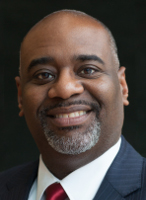
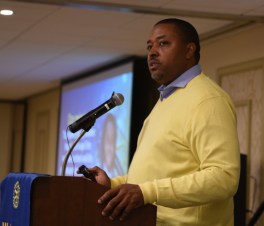
Kaleem Caire 8 8 2018Rotarians heard that over nine months of deliberations, surveys and thought, one project was chosen to receive a major grant of $100,000 from our Madison Rotary Foundation, One City Schools.  The school is led by Kaleem Caire, School Founder and CEO, and a member of our club.  He shared the school’s formula for success at the August 8 club meeting.
Caire shared a video illustrating the goals of the school: equalizing advantages.  The school is designed to be a place where young students can feel school was a home, and where other families can experience diversity.

“Our goal is to decrease the achievement gap while meeting the needs of our community,” Caire says.

Ages one through five, with a total of 97 children, are served at the school.  The school has been open three years and offers breakfast, lunch and afternoon snack with their own in-house chef.  They offer learning, not just education.

They address the health of the family, their financial situation, and are a resource center for the families.  “If we can decrease stress, we can increase opportunities and the student is happier,” Caire says.

They have many partners, the first of which was the Madison Children’s Museum. They are supported by 1,216 individuals and 63 institutional donors. This fall, the school splits into two schools with a 4k and 5k charter school addition.  This will also provide new funding through charter school funding.

Why is it called One City?  “People kept telling me they don’t know what to do to help,” Caire says.  “Yes, you do. Invest in early childhood with deep, student driven-learning for success.  “You are going to hire young people one day, and we need them to be innovators in life and in work.”  Caire says.

Our thanks to WisEye for videotaping our meeting this week.  You can watch the video here.

Saving and Improving Lives: One Drop at a Time

submitted by Linda Baldwin; photo by Pete Christianson

Ben Merens 7 25 2018

From left: Program Committee Chair Sara DeTienne; Ben Merens & Marcia Whittington

This week’s Rotary presentation by Ben Merens, a “storyteller” for the Blood Center of WI Blood Research Center, was one where I left having learned amazing information about a subject of which I knew nothing.

Merens did indeed tell stories…

The young man at Verizon who had had a double lung transplant, survived, married his nurse and had a family.  Ricky owes his life to doctors like those at the BRI because blood research found a way to get the body to accept transplants.

Chaos, Merens describes, is what the blood system looks like and scientists determine what patterns do exist, how they are supposed to work and then find out how to fix things when they don’t.

BRI scientists patented a test to determine whether the regularly used blood thinners would work for a specific patient and if not, doctors could substitute a more effective blood thinner.

We watched with Merens as he described a heart being harvested and then rushed down the hall to transplant into a waiting patient.  The heart was successfully inserted…then the action stopped, and they waited. The heart, still in the open chest, began to beat.

Merens described a WI Donor event when a mother spoke about the joy and sadness when she realized her son is living because another person’s child has died.  Then she said, he’s an active two year old being held by the mother of the donor who heard her child’s heart beat in the chest of my son.

We think about research being a scientific activity with words and practices that most of us don’t understand.  Merens brought the results of research into our hearts and minds at Rotary today.  And we do understand.

If you missed our meeting this week, you can watch the video here.