Category Archives: Rotary Weekly Guest Speaker

“It’s Nice to Be Relevant Again”

–submitted by Andrea Kaminski; photo by Stacy Nemeth

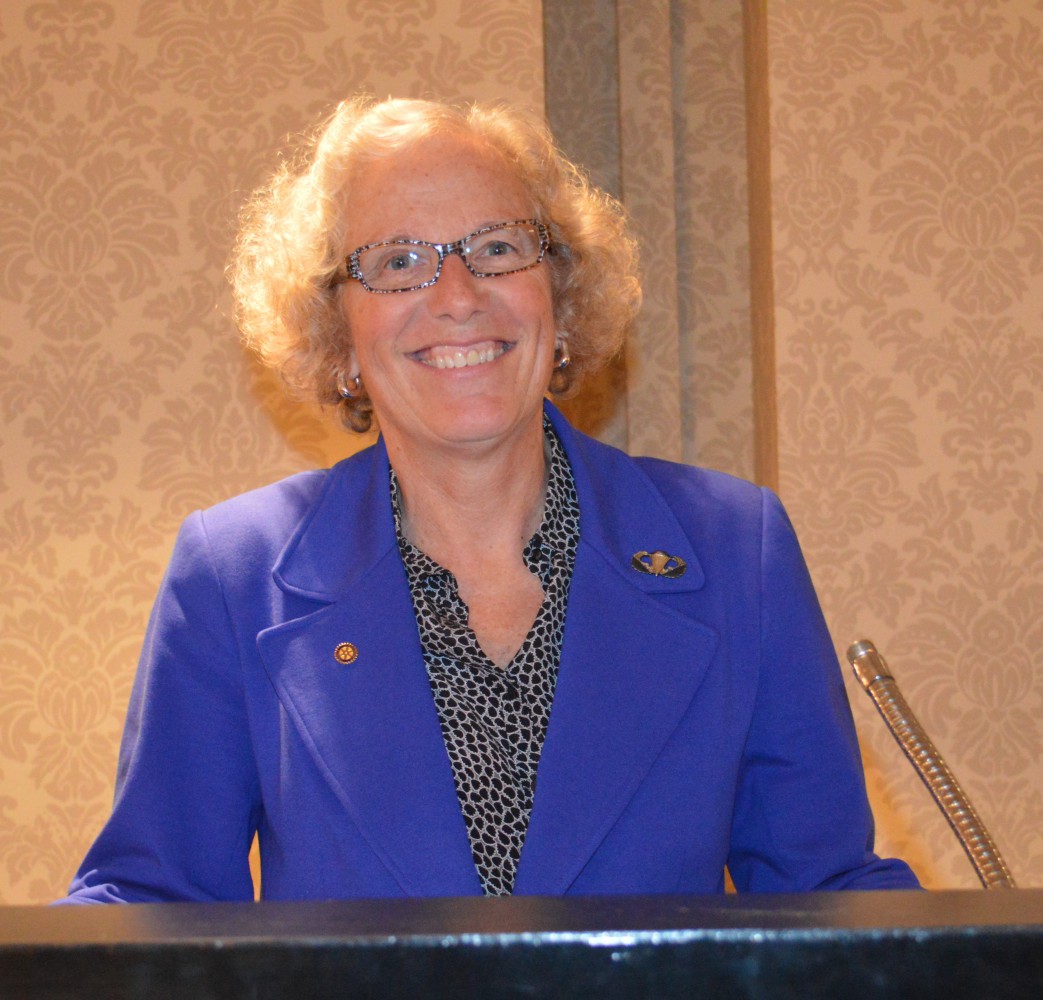
David McDonald 12 3 2014…began David McDonald, UW-Madison Professor of History, in his presentation called Russia Resurgent: Vladimir Putin’s Quest for Russia’s “Place at the Table.”  An expert on the history of imperial Russia and the politics of contemporary Russia, McDonald went on to explain that in the 1990s Russia was considered a “spent force” but that it is once again a world power.

He commended UW-Madison for having maintained its focus on Russia for many decades. He noted that such investments by universities are a “long–term bet against unseen issues” for which our country needs to be prepared.

McDonald said that President Putin’s rise is not surprising when you think about the lives of average Russian citizens when the U.S.S.R. was dissolved in 1991. They had housing, schools, healthcare and likely some savings. They had enough money to travel on holiday. Then suddenly they were in a position where they might have to purchase the apartment they were living in and pay for utilities. They saw the collapse of their armed forces. They were dismayed by the disgrace of their sports programs, especially hockey. (As a Canadian, McDonald could relate!) Matters got even worse in the economic downfall of 1998.

Most of all, Russians were distressed because they no longer lived in a nation that was feared and respected worldwide. They wished to regain Russia’s place at the table.

The triumph of Putin, McDonald said, was the product of a scheme that was many years in the making. Former Communist Party officials and KGB operatives took advantage of a weak civil society and a high level of disengagement by citizens. It didn’t help that the United States did not invest a major effort in helping to rebuild Russian government after the dissolution of the U.S.S.R., as it did in Japan and Germany following World War II.

As the economy eventually improved, Putin was able to convince people that the money that was coming into Russia was his doing. More importantly, he gave people hope that Russia could again be a respected world power. He discovered the power of nationalism, appealing to Russians’ pride in their nation’s history of imperialism and its resurgence after World War II.  These were examples of how Russian values helped their society overcome privation.

As a result Putin enjoys great support in Russian society, McDonald said. Most citizens are “delighted and impressed” by what he has done to reclaim what they believe is Russia’s proper place in the world.

McDonald noted that what Putin can accomplish will be limited by the struggling economy and “brain drain.” He explained that entrepreneurs and academics are leaving Russia as a result of Putin’s demonization of educated society. McDonald finished his remarks by noting that Putin is “running out of room to maneuver” as he attempts to preside over disparate forces in his own country and on the world stage.
 

Where the Peace Corps and Rotary Meet

–submitted by Valerie Johnson; photo by Mike Engelberger

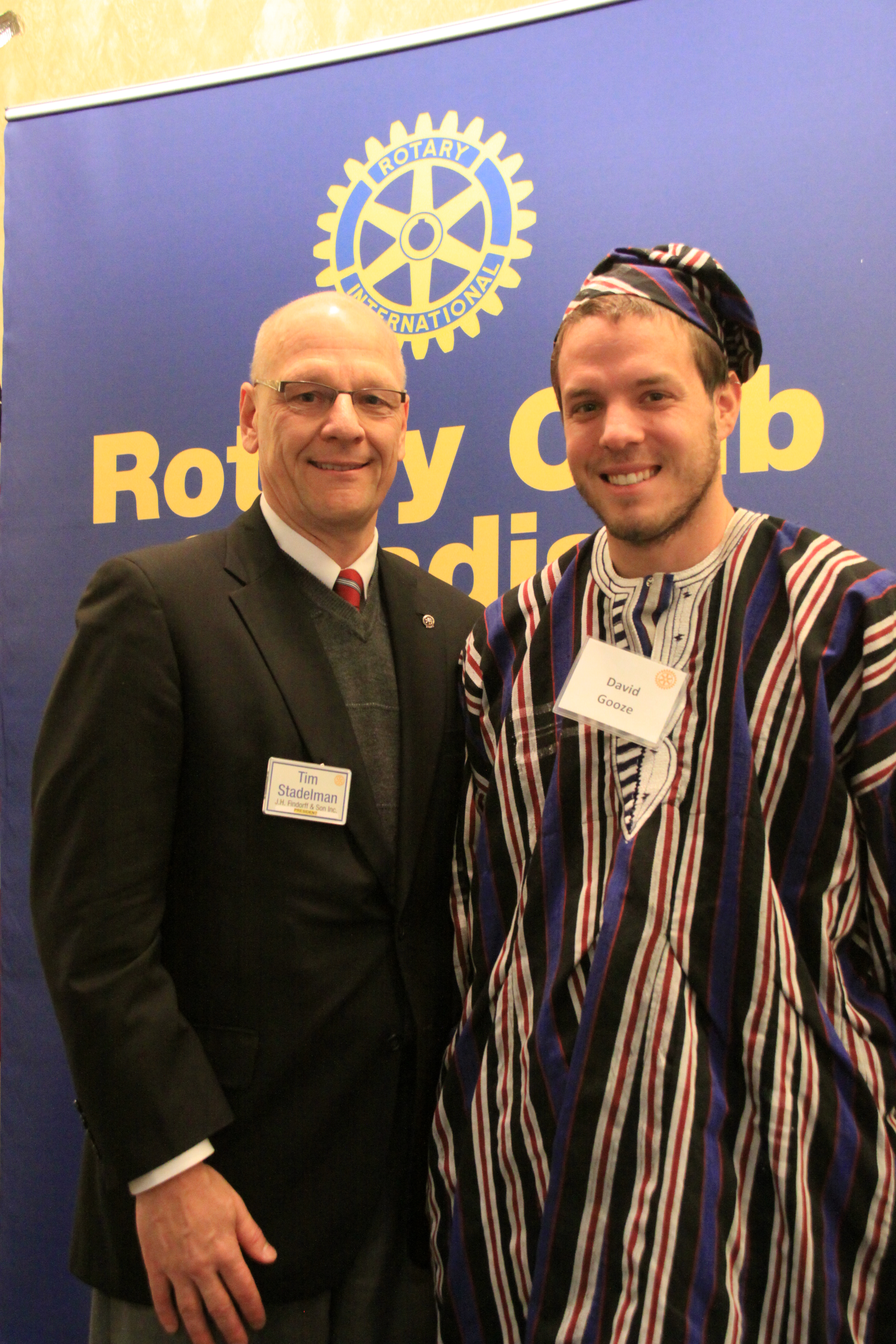
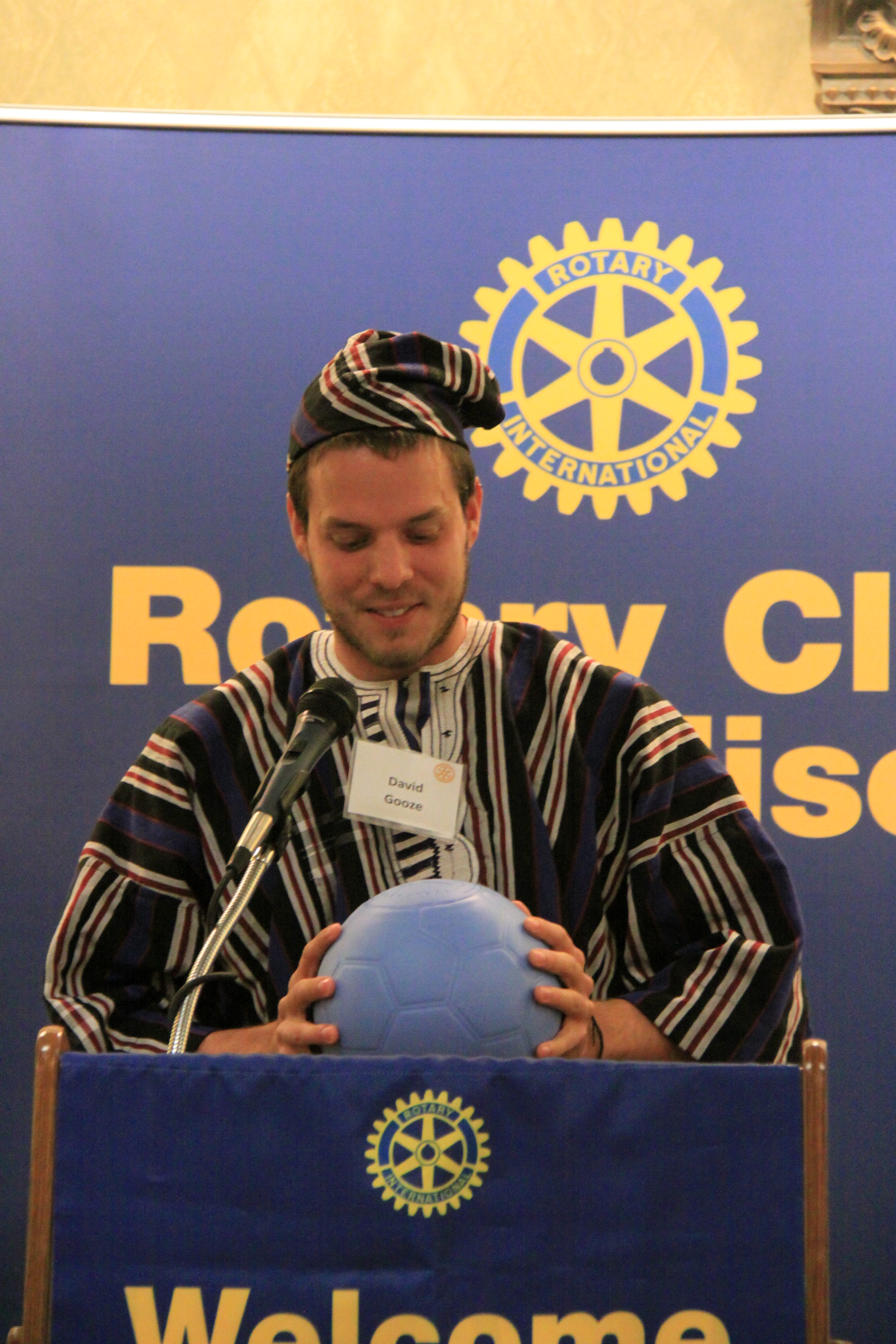
David GoozeAs Rotarians listened to David Gooze [pictured here (right) with Club President Tim Stadelman] at the November 26 meeting entertain them with stories of his Peace Corps experience in Togo– everything from sacrificing goats to navigating 40 languages or being startlingly awoken by calls to prayer from the mosque at 5:45AM – his real story quietly unfolded.

The real story was one of vision and collaboration as Peace Corps officials, with David’s involvement, and Rotary International leaders, with David’s parent’s involvement, finalized a four-year work in progress started by Peace Corps alumni in Denver.

To promote global development and volunteerism, Rotary and Peace Corps signed a letter of collaboration, agreeing to participate in pilot programs in the Philippines, Thailand and Togo.  Under the May 2014 agreement, Rotary clubs and Peace Corps volunteers are encouraged to share resources and knowledge to boost the impact of development projects. Opportunities for collaboration include supporting community projects, training, networking and community education.

IMG_3527One of David’s major programs in Togo was to distribute more than 5,000 soccer balls to disadvantaged youth. He organized ‘More Than Just a Game’ sessions, which use soccer to teach children about malaria prevention. Before he brought these non-deflatable balls, children were using rolled up bags for soccer balls.  He also helped teach modern honey-production methods.

One of his greatest rewards was having a local leader, a woman Rotarian, tell him, “I want to learn how to be more worldly, work with my own people.  I can’t depend on Americans and others to do projects for my community in the future.”

While David said the word stewardship doesn’t translate well into their local language, that is exactly what she was referring to and what she was learning.  Gooze is a 2006 Oregon High School graduate and a 2010 Graduate of the University of Oregon.

An Epidemic of Prescription Drug Overdose

–submitted by Stan Inhorn; photo by Mike Engelberger

Teater Donald 11 19 2014On November 19, Dr. Donald Teater, Medical Adviser to the National Safety Council, provided insight into the magnitude of the drug overdose problem in the U.S. In the past 10 years, there have been 125,000 overdose deaths, especially from opioids. Every day, about 45 productive people die as a result of more morphine being prescribed. Since 2010, there have been more overdose deaths than from car crashes, and more deaths than caused by breast or prostate cancer.

As more drug prescriptions are being written, the number of patients seeking treatment for overdose is overwhelming doctors handling such cases. The primary culprit is the extract from the seed-pod of the poppy plant that yields morphine and codeine and their derivatives. Used primarily for alleviating pain, opioids are also prescribed for anxiety and depression. Although they relieve anxiety and depression, they should not be prescribed because they can become addictive.

Opioid addiction is a disease model, like diabetes or COPD. It has a genetic disposition, and it causes biological changes in the brain that damages brain chemistry. Its effects can be mediated by medication to get over an addiction. However, like other chronic diseases, it can be controlled but not cured. Unfortunately, disease flare-ups are often treated by jail, not by medical intervention.

Addiction carries the stigma of moral weakness rather than being viewed as a real disease. Narcotic addiction often results in traffic accidents, falls, and mental confusion. Furthermore, addiction often delays recovery from some medical conditions such as back pain. Opioids can even increase sensitivity to pain in these cases. For relief, other pain medications such as acetaminophen are often better.

Dr. Tester applauded several Dane County programs, including the Medical Drug Program that disposes unused pills. Others are the Safe Community Parent Addiction Network and the Health Care Task force for Safe Opioid Prescribing. The battle to control opioid misuse must be ramped up considering that the societal cost of this disease totals over $55.7 billion dollars a year.

Rabbi Manfred E. Swarsensky Humanitarian Service Award Program on November 12, 2014

–submitted by Donna Hurd; photos by Mike Engelberger

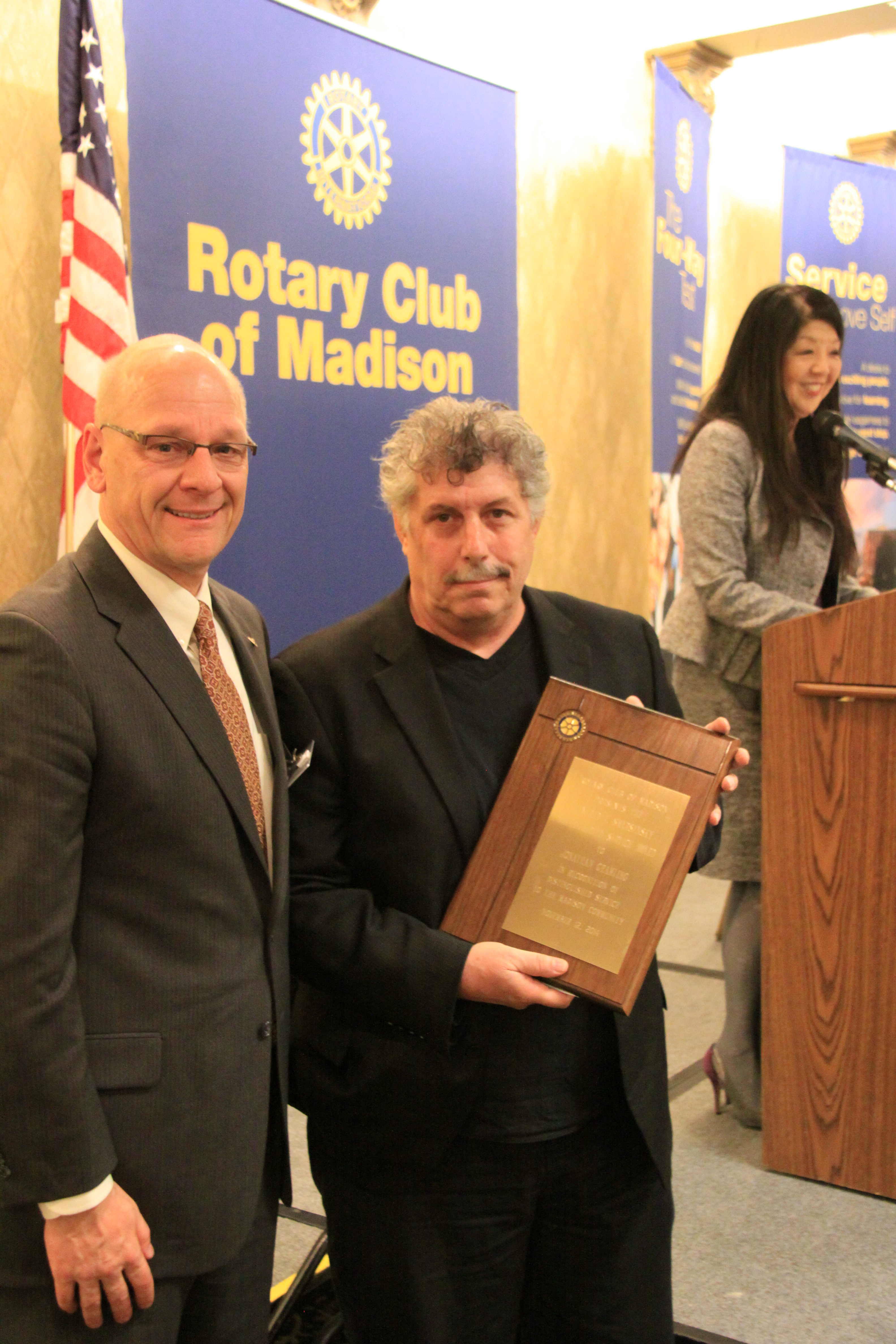
Club President Tim Stadelman (left) presenting award to Jonathan Gramling

Club President Tim Stadelman (left) presenting award to Jonathan Gramling

Jonathan Gramling was awarded the 2014 Manfred E. Swarsensky Humanitarian Service Award, 32 years since its inception in 1982.

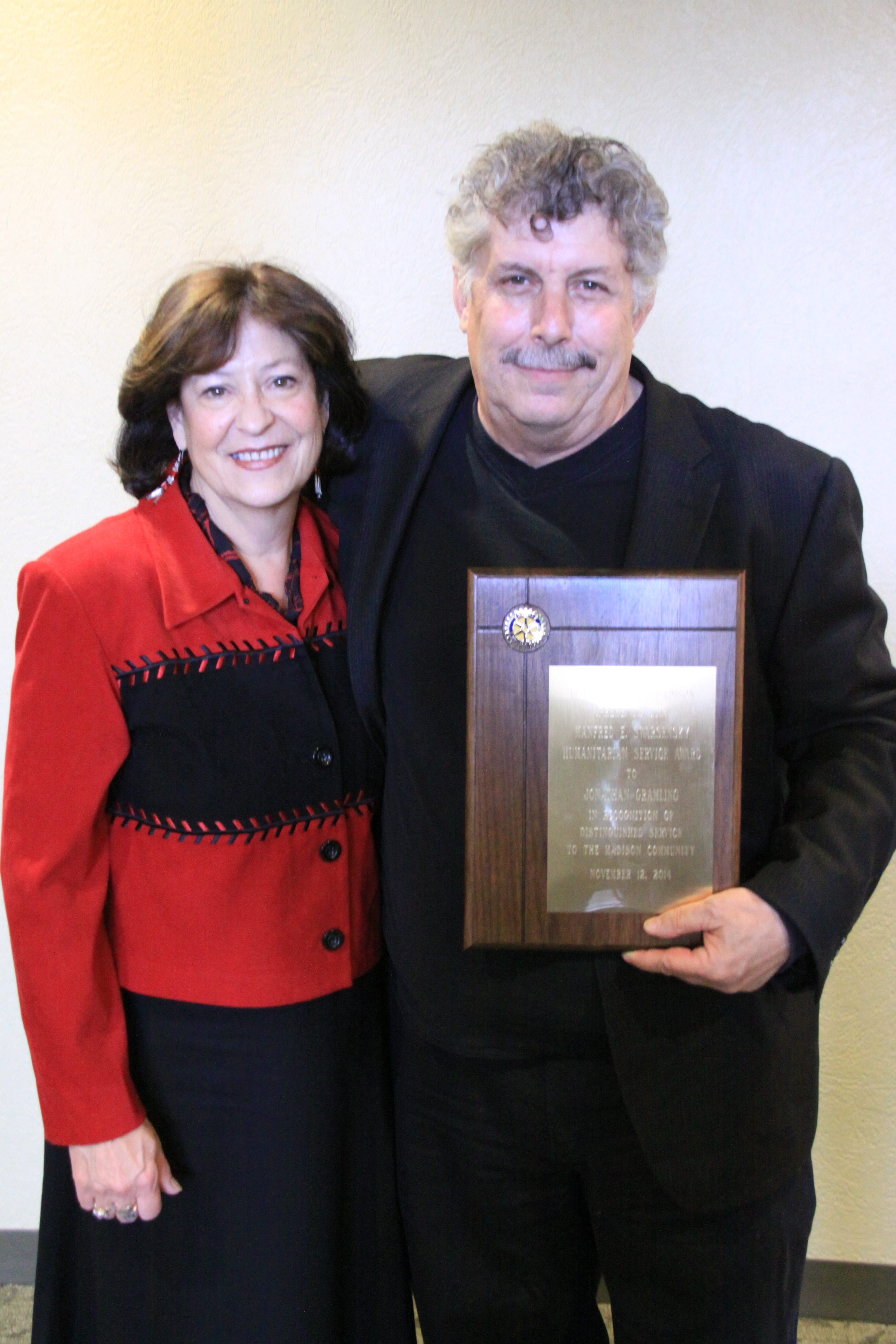
IMG_3317Patty Loew (pictured at left with Jonathan Gramling), a past recipient of the award and Mr. Gramling’s nominator, says of him “Jonathan Gramling has devoted his life to civil rights and promoting racial equity.  From volunteering on self-help projects benefitting African-Americans in the South, to fundraising for United Farm Workers in Madison to supporting Native people on environmental threats associated with mining.  Gramling’s service has been inspirational and exemplary.”


IMG_3248In remembrance of Rabbi Swarsensky, Rotarians and guests viewed the 2000 award-winning video production chronicling his life.  In addition, Rotarian Mario Mendoza (pictured at right) provided the club with excerpts of the November 22, 1967, address to the Rotary Club of Madison, entitled “Thanksgiving – Holiday or Holy Day.”  The address, by all accounts, is as relevant today as it was in 1967.  Paralleling the first Thanksgiving to that of 1967, Rabbi Swarsensky penned, “The work of the Pilgrims is no longer our world.  We could not go back to it, even if we wanted to.  But the recollection of the first Thanksgiving of 1621 can have meaning for us in 1967 [and 2014], if we learned again to be grateful for the simple things in life, which are the most priceless blessings: life and health, home and love and friendship, the privilege to give of ourselves and the determination to make our country and the work a better place so that our children and our children’s children may be proud of us, as we are proud of and grateful to those who have gone before us.”

IMG_3298

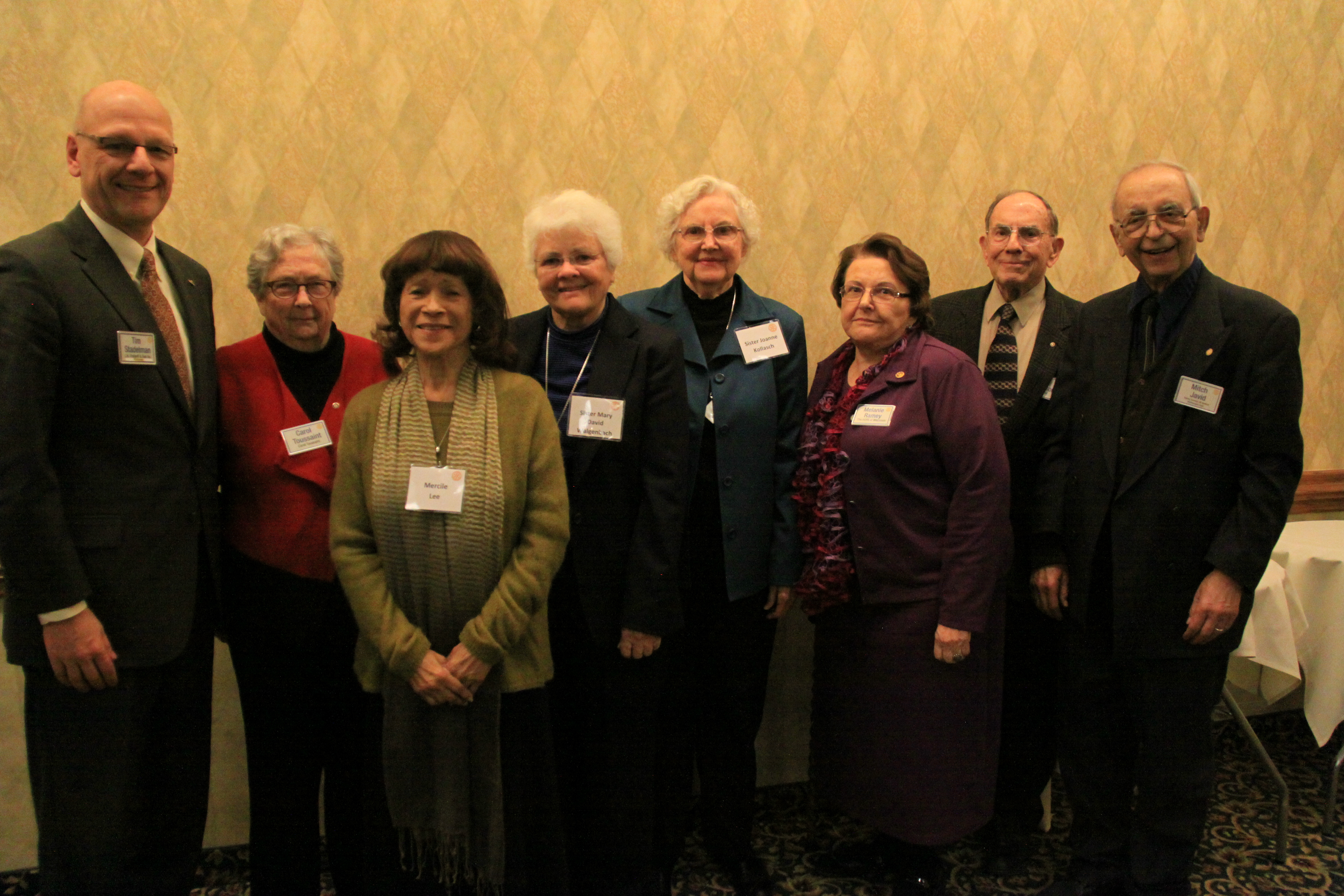
Pictured above from left: Club President Tim Stadelman, Carol Toussaint, Mercile Lee, Sr. Mary David Walgebach, Sr. Joanne Kollasch, Melanie Ramey, Andy Davison and Mitch Javid

The Club was privileged to host 11 past recipients of the award: Sr. Mary David Walgenbach & Sr. Joanne Kollasch, Patty Loew, Richard Davis, Mitch Javid, Rotarian Carol Toussaint, Rotarian Bill Rock, Rotarian Andy Davison, Norval Bernhardt, Rotarian Melanie Ramey and Mercile Lee.

IMG_3372

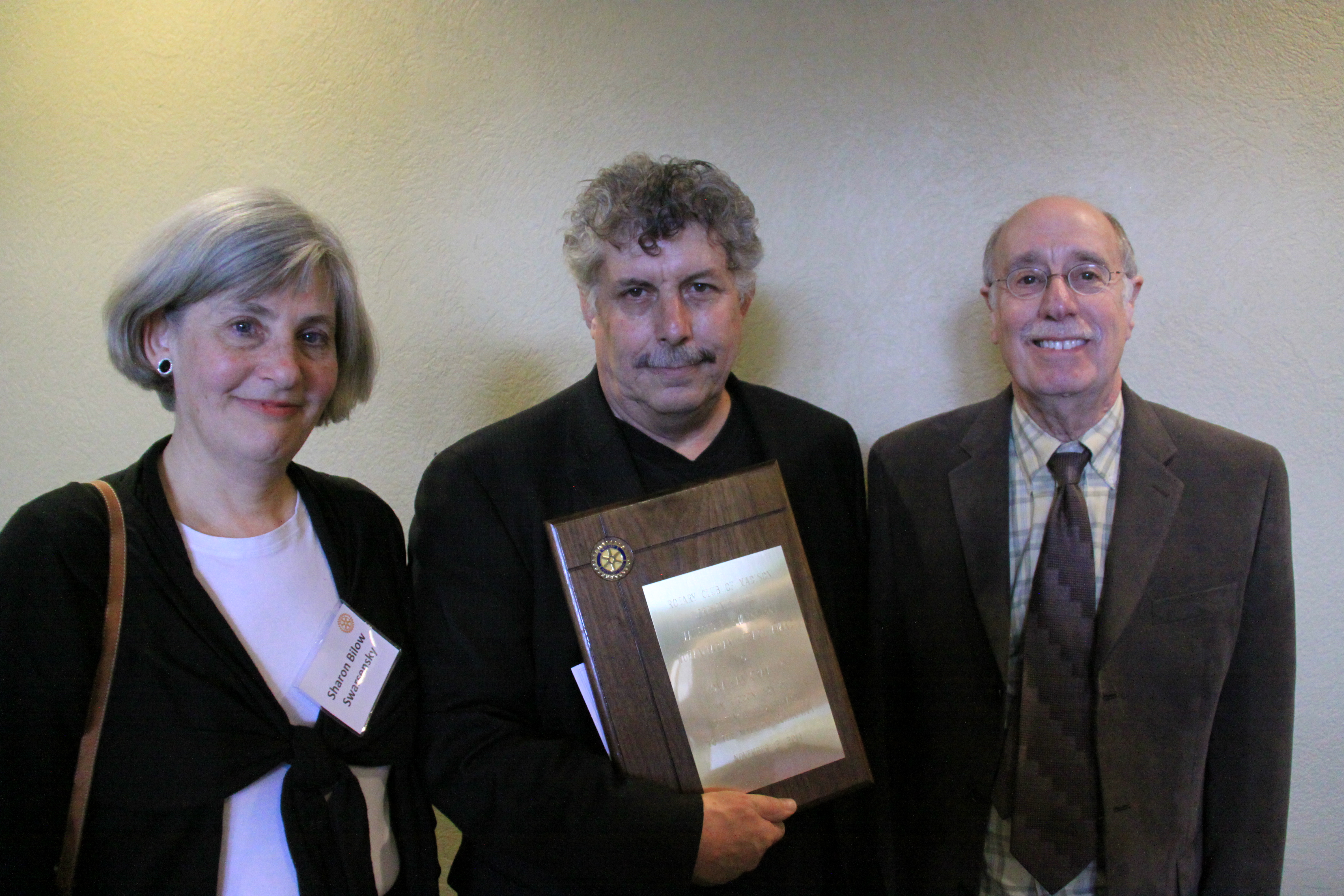
In addition, we were honored that Rabbi Swarsensky’s daughter, Sharon Swarsensky Bilow and her husband, Paul Bilow, were able to join us for this celebration.  They are pictured above with Jonathan Gramling.

The Manfred E. Swarsensky Humanitarian Service Award was established in 1982 and identifies individuals who have, through their voluntary efforts, made a particularly outstanding contribution to the humanitarian service in the greater Madison community, in the tradition so well exemplified by the life of Rabbi Swarsensky.   The award-winning documentary video, “A Portrait:  Rabbi Manfred Swarsensky,” that was created and produced by Rotarian Dick Goldberg with assistance by Wisconsin Public Television, provides background on Manfred Swarsensky and can be viewed on YouTube, and the Rotary office also has a copy of the video for any member wishing to view it.

The Face of Edgewood College is…

–submitted by Linda Baldwin; photo by John Bonsett-Veal

photo

From left: President-Elect Ellsworth Brown with Scott Flanagan

Everyone!

Scott Flanagan is the 7th President of Edgewood College, after spending 16 years at the college as a teacher and administrator.  Today he gave us an overview of the college.  Begun in 1949 under the leadership of the Dominican sisters, Edgewood College has grown to more than 3000 students in many undergraduate, graduate and non-traditional programs.

President Flanagan recalled that in 1970 the college went co ed and announced this change through a road sign “Now Co ed.”  He surmised this change was not met with enthusiasm as the sign was quickly stolen.

Today the sisters’ legacy is carried out through the good work of all associated with Edgewood; students, faculty and staff, the board of trustees and even the presidents, past and present.

Edgewood College was one of the first in the country to offer the “yellow ribbon” program, an opportunity for veterans to attend college on scholarships.  Today more than 150 vets are attending Edgewood.

Edgewood primarily educates students from the greater Madison area, and they stay in the area after graduation.  Flanagan proudly pointed to the fact that only 3% of 2013 grads were still looking for work; 97% were working, in the military or doing graduate work.

He also talked about the programs for returning students seeking professional advancement through Edgewood programs, serving traditional and non-traditional students and invited everyone to the “Stream,” Edgewood’s new arts complex.

It’s Wisconsin, so Flanagan mentioned the 15 sports programs at the college, the robust study abroad program, the community internships which take students out into the community for service and civic engagement, offering more than 200,000 hours in service.

In closing, he touched on the partnerships with area businesses that provide additional scholarship money for students; the emphasis on inclusivity, noting that 15-20% of Edgewood students are minorities with retention rates almost as high as the student body in general and affordability, noting that 94% of Edgewood students receive some sort of financial aid.

President Flanagan closed by asking Rotarians to get involved with Edgewood to help meet our society needs for qualified workers, engaged citizens, servant leaders and scholarly problem solvers.


“It’s Never Too Late to Change”

–submitted by Mark Stover; photo by Pete Christianson

Leslie HowardKeynote speaker Leslie Ann Howard, President and CEO of United Way of Dane County, delivered this message to a full house at the 51st Annual Madison Area Service Clubs luncheon on Wednesday, October 15, at the Sheraton.

Evidence that Howard’s message of changing the human condition is not only possible but happening today in our community echoed throughout the program.

Bill Battista, winner of this year’s Ruth Gordon Service Award changed the human condition for children in the West Madison Little League.  During his involvement, the Little League has grown to encompass participation of over 700 boys and girls in baseball and softball.  Giving kids positive encouragement makes a big difference in their lives and the lives of people around them.

Christine Hodge, winner of this year’s Community Youth Volunteer Award is helping to change the human condition by her focus on children’s education.  She is founder and Director of the Mt. Zion Academic Learning Center which provides after-school tutorial support for all children in the church community and throughout the Madison Metropolitan School District.

Howard noted that “making change at scale” is often less expensive and creates greater measurable improvements in real people’s lives than many of the traditional ways of addressing social needs.  Howard cited data in three areas of the United Way’s recent work.

The initiative called Housing First seeks to insure that homelessness is addressed at its root: keep people in their homes in the first place.  Research shows that once a person enters a shelter they only have a 37% chance of leaving it – that is, getting out of a support situation.  Instead, a smaller investment providing short term support to keep people in their homes results in an 80% chance of long-term independence.

Similarly with people reintroduced to their neighborhoods from prison there is a 67% recidivism rate without intervention.  Journey Home, another United Way initiative, cuts that to less than 5% with an annual investment of $500 per program participant.  By comparison it costs $38,000 a year to keep an offender in prison.

Finally, parenting skills are critical to getting children off to a healthy start in life.  Low income participants in the Parent Child Home Program with only two years of involvement find their kids graduate from high school at that same rate as middle income kids do.

There’s a lot to be proud of among the service providers and service clubs of the Madison area.  CLICK to view Neil Heinen’s recent editorial, “Service Clubs Continue to Thrive in Madison.”

Our thanks to Leslie Howard for her presentation and to Brad Hutter and Kristine Mirelle for providing special music.