Governor Tony Evers — At the Heart of It

submitted by Ellie Schatz; photo by Mike Engelberger

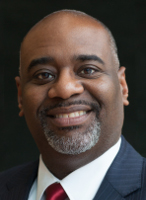
Gov Tony Evers 5 1 19Being a past Rotarian when he was a private citizen, Governor Tony Evers opened with some personal observations. First, he applauded the audience for their civic mindedness and stressed the importance we play as role models for our young people. Second, he talked about the small private liabilities of being in a major public position. For instance, he asked how do you sell a car? It took him and his wife over a month to figure that out. In summary of his private life, he said, “I try to figure it out; not worry; keep steady.”

The Governor focused on questions of the budget in his formal presentation. His budget/funding goals include:

  1. The Transportation System. Wisconsin ranks low, somewhere between #48 and #50. Transportation issues include biking, walking, and mass transit.


  1. Health Care. He has a plan to infuse 1.6 million dollars to invest in, among other things, good baby and mom care, opioid treatment, and the health of children suffering from lead poisoning. As an aside he mentioned that frustrations include answering questions such as, “why spend all that money on those kids” (who are eating lead paint from their walls)?!


  1. Education, which is underfunded to the point of threatening the stature of the UW-Madison. Frustrations here include having to explain why professors are an important resource and why kids with disabilities or who speak English as a second language deserve a financial commitment.


  1. Criminal Justice Reform. Wisconsin has too many people sentenced to prison for non-violent crimes. We need urban area programs to help them rather than focusing on sentencing.


Some of these issues were elaborated during the Q & A. For instance, regarding education he was asked about in-state tuition for dreamers. He replied, “I think we’ll win that argument…. In-state tuition (and driver’s permits) are important – a no brainer.”

When asked about steps to stop abuses of minorities in school and housing, he emphasized the importance of conversations at the local and state levels. As he visited schools and communities in the past two weeks, he asked personnel and students if they thought racism was worse now than ever before. The answer was an unfortunate, resounding, “Yes!” The Governor emphasizes that we must acknowledge the problem, examine what is in our hearts, look at what we can do as individuals as well as groups, and accept our civic responsibilities for making a difference.

So, Governor, you were anything but dull today. From your heart and our hearts, we acknowledge the problems and resolve to move forward with respect and good will.

If you missed our meeting this week, you can watch the video here.  Our thanks to WisconsinEye for videotaping our meeting this week.

The Rise and Decline of US Global Power

–submitted by Linn Roth; photo by John Bonsett-Veal

Alfred McCoy 4 24 2019

In an insightful and concerning presentation, UW history professor Alfred McCoy outlined some of the history and future direction of the world’s geopolitics and presented a somber view of the future of US global influence.  Since the early 1900’s, the US has steadily built up its international preeminence and paid special attention to the “Eurasian” axis, which consists of Asia and Europe, and more recently, Africa.  Due to actions begun in the late seventies and guided by Zbigniew Brzenski, National Security Advisor during the Carter Administration, the US made Eurasia the central area of concentration in order to establish and maintain its global primacy.  President Obama furthered that effort, but in the last two years, the Trump administration has reversed course on three main pillars of US primacy:  NATO, the Trans-Pacific Partnership (TPP) agreement, and relations with Japan, South Korea, Australia and the Philippines.  This entire problem might be further exacerbated by a trade war with China.

Additional signs suggest this concern is well founded.  By 2030, projections indicate India and China will grow their Gross Domestic Products considerably more than the US, and China will become the world’s largest economy.   Moreover, China now files more patents than the US, has built the world’s fastest supercomputer, and does substantially better in its science and math education programs.  As most of us can observe at UW, the majority of technical PhD candidates are foreign born, and therefore likely to return to their home countries with their acquired knowledge.

Furthermore, China has become extremely proactive in attempting to widen its influence throughout Eurasia in a variety of ways.  This effort might be epitomized by their ongoing $1.3 trillion Belt and Road program, which cuts right through the heart of Eurasia.  In addition, they have become aggressive in taking over ports in Italy, Africa, Pakistan and Sri Lanka, and in the conversion of sand islands to military bases in the South China Sea.  Given these developments, as well as concerns regarding current US foreign policy, Professor McCoy projects that US hegemony will substantially decline by 2030.  The eclipse of US influence should give us all pause for thought, and for those interested in learning more about this critical issue, please see Professor McCoy’s recent book, In the Shadow of the American Century: The Rise and Decline of U.S. Global Power.

If you missed our meeting this week, you can watch the video here.


Overture: Now and Tomorrow

submitted by Jocelyn Riley; photo by John Bonsett-Veal

Sandra Gajic 4 17 2019

From left: Club President Jason Beren, Sandra Gajic and Loretta Himmelsbach

Sandra Gajic, President and CEO of the Overture Center, treated Rotarians on Wednesday to a whirlwind overview of the history of Overture and plans for its future.  The Overture Center, Gajic said, “was built to last 300 years,” but it needs renovations, citing a leaking roof and front doors so heavy that many people have trouble opening them.

The Overture Center, she said, is three ages in one (the original Capitol Theater, built in 1928; the Oscar Mayer Theater, built in 1974; and the Overture Center, which opened in 2004, funded by a $200 million gift from Jerry Frautschi & Pleasant Roland).  The current facility “reminds me of Edward Albee’s Three Tall Women,” Gajic said.

Despite the challenges of its complicated history and aging infrastructure, “over 12 million people have come to Overture over the years,” she said, citing both its impact on our ecomony and our community. In order to “meet its civic mandate and preserve the facility,” leaders of the Overture Center are pursuing a long-term goal to fund a $30 million endowment to make it “fully accessible for generations to come.”  Ongoing and future initiatives include maximizing equity, innovation and inclusion by looking closely at policies such as recruiting ushers and removing barriers for people of limited means.

One future program involves arts-career exploration for high school and middle school students.  As a student, Gajic studied piano and economics.  “I absolutely love the arts,” she said, and she enjoys Overture’s diverse arts presentations, including Kids in the Rotunda, Duck Soup Cinema, Broadway shows, concerts, plays and art exhibits.

Fun, Not Fine, Dining Theme for Culinary Arts Fellowship at Vignette

submitted by Valerie Renk; photos by Richard Merrion

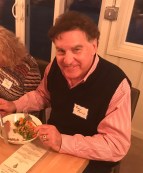
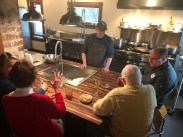
IMG_0021 (1)“Amazing Tastes” is how Fellowship Chair Loretta Himmelsbach described the five-course event held at Vignette Dining Club April 15.  Owner and Chef Mark Wroczynski introduced each course and completed the evening with a short presentation on risotto.  The meal included unusual treats such as caramel seasoned with cinnamon cayenne, pimento goat cheese in a salad, and lavender poppyseed cake.

The group learned there are three types of risotto rice; the one sold most in the US is Arborio.  The chef’s tips for cooking include cooking for 20 minutes in hottest liquid, serving piping hot, and if adding vegetables to sauté them separately and add at the end, rather than cook with the risotto.  He suggests adding a little parmesan and butter at the end, but no cream.

IMG_0020 (1) IMG_0050 (1)   IMG_0051 (1)  IMG_0078

The 23 Rotarians and guests were invited to join the invite-only list for future dinners online.  Future dinners at Vignette include a July 20 Brazilian Carnival with fire dancer, and an Aug 17 dinner co-hosted by Chef Mark’s pastry chef mentor from Chicago with roller derby experience.

IMG_0030 (1)  IMG_0063 (1)  IMG_0005 (1)  IMG_0004

Mark and his partner, Brian, started the business hosting dinners in other people’s homes before buying the property in Fitchburg on Caine Road.

The next Culinary Arts Fellowship event will be at Heritage Tavern, Madison.

“A 55 Year Old Start Up”

submitted by Linda Baldwin’ photo by John Bonsett-Veal

Joel Plant 4 10 2019

From left: Joel Plant, Herb Frank, Renee Frank and Club President Jason Beren

That’s how Joel Plant, Frank Productions CEO, describes their company.  Indeed, Herb and Sylvia (who The Sylvee is named for) Frank came to Madison in 1964 to manage operations for the Capitol and Majestic theaters.  And the rest is history…now Frank Productions booked 214 shows in 148 cities in North America in 2018, with plans for more than 1800 shows this year across the nation.

Here in Madison, the Frank family, including patriarch Herb, sons, Fred and Larry, daughter-in-law Marla and granddaughter Renee all work in the family business with a staff of 55 overseen by Plant.  Their mission statement is “Connecting artists with fans and helping them have fun!”  With their recent merger with the Majestic Theatre, acquisition of the High Noon Saloon and the opening of The Sylvee, Frank Productions will reach even more fans.  Frank Productions also owns facilities in Columbia, Missouri, Nashville, Tennesee, and books 15 more exclusive venues in North America.

The brand new Sylvee is a state of the art venue with a capacity of 2500 and seating for 150.   Situated right in the middle of Madison’s burgeoning Capitol East neighborhood, The Sylvee is right where the action is, and, in the first six months, they sold 70,000 tickets to 53 shows and 34 special events, averaging 1700 patrons a show.  And poured 167 thousand ounces of Spotted Cow!  Plant joked “and it wasn’t even our best seller.”

Frank Productions take pride in their relations with the neighborhood and law enforcement.  “We want to make sure that our business doesn’t have a negative impact on the neighborhood and community.”  While some in Madison have had concerns about other venues suffering with Frank’s expansion, Plant says all indications are that other venues are doing better as well.  And he notes that their presence has had a positive economic impact on the restaurants and other businesses in the area.

What’s next…do more shows…sell more tickets and beer!

Wine Fellowship Gathering on April 8

–photos and summary submitted by Mike Wilson

Wine Event 6 April 2019

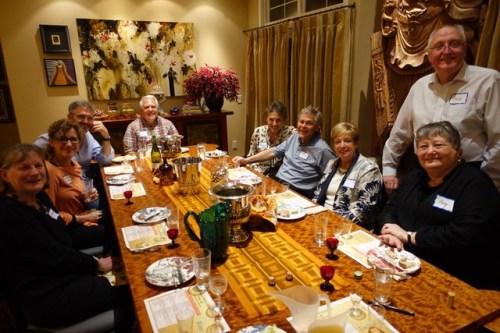
On Monday, the 8th of April, our club’s Wine Fellowship Group met at Mike Wilson’s home to compare six wines with a wine-cocktail counterpart.  Two of the wine cocktails we tried were similar to some I had tried at local restaurants that were similar promoting these and another was recently published in the Wisconsin State Journal.

Wine Event 1 April 2019We started with a Manzanilla from one of the corners of the Sherry triangle in Spain.  This was La Guita (about $10 per half bottle) – a famous one.  It was a very agreeable Dry Sherry.  The cocktail contained the same wine plus Cointreau, Tequila and lime juice for a wine version of a Margarita.  We next had a red fortified wine, Kopkes’s Fine Red Ruby Port, which was excellent and reasonably priced ($9.99 + tax per half bottle).  This was compared to a Port Manhattan that was made with this Port and Maker’s Mark Bourbon and a couple of dashes of Angostura bitters.  The wine became the vermouth substitute.  In both these comparisons, the wine cocktail was preferred.

Next we had two white wines: a 95 pointer Doisey Daene 2014 Barsac – botrytis (noble rot) infected grapes that result in a honeyed wine.  This was the most expensive wine ($45 + tax) tasted and was excellent.  With this we had an Ice Wine Martini (Ice Wines are from Niagara and Germany, but French Sauternes and Barsac can be used interchangeably).  We added Vodka to make the wine a martini.  Next was a 92-93 Pointer Moscatini where we made a martini with Moscato (frizzante white wine from the Piedmonte region of Italy) with Plymouth Gin (least aromatic gin).  The wine alone was preferred – but experimentation made the wine cocktail much better.  Tasters added a little more of the wine to the cocktail from their wine sample and it significantly improved.

Lastly we tried two inexpensive Italian red wines – a Valpolicella (from the Veneto) and an Aglianico (from Campania), two favorites of the host.  The Italian Red Wine Cocktail was Valpolicella with half the volume of Maker’s Mark Bourbon added.  The other was an Aglianico Sour where copious amounts of simple syrup and lemon juice were added to Mile High Rye from Utah, and then the red wine was layered on top of the cocktail components which made for an interestingly layered visual appearance and the sensation of drinking the cocktail portion through the thin layer of red wine.  Both the cocktail versions were preferred by the attendees.

Wine Event 9 April 2019  Wine Event 8 April 2019  Wine Event 10 April 2019

Photo 1: Jennifer & Bob Winding; Photo 2: Tim Muldowney & Jackie Hank; Photo 3: Keith Baumgartner & Peggy Lescrenier

Currently there is a real surge in Cocktails in the beverage industry while wine drinking has stalled. In 5 of the wine/cocktail comparisons the wine cocktail was preferred by our serious Rotary Wine Fellowshipper wine drinkers. The tasting provided excellent means of showing everyone how enjoyable these wine cocktails are, and minimal changes in the formulation of additional wine to the cocktail significantly modified the wine cocktail enjoyment to many attendees.  There is room for considerable experimentation in this exploration of wine cocktails so that every wine drinker can enjoy them.

The tasting provided everyone with the drink formulas so the attendees could replicate them at home.  It was of noted that the Wine Fellowshippers preferred the wine cocktail over the wine in 5 of the 6 pairings.

A great time was had by all, and excellent Fellowship resulted.