Bradley Versus Kloppenburg Debate

–submitted by Mary Borland; photos by Karl Wellensiek

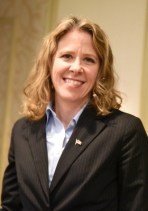
Bradley RebeccaKloppenburg JoAnneThis week’s Rotary program featured State Supreme Court candidates, Justice Rebecca Bradley and Judge JoAnne Kloppenburg. Rotary Club of Madison partnered with WisconsinEye to produce this forum. WisconsinEye reporter Steve Walters moderated the forum and the broadcast was livestreamed to WisconsinEye viewers using computers or mobile devices.

Opening and closing remarks were made by each candidate as to why they should be elected to the WI Supreme Court.   Bradley cited business experience and litigation experience; and Kloppenburg cited experience, independence/non-partisan background.

When the candidates were asked how voters can determine who to vote for, Bradley stated her judicial philosophy and her judicial role models she aligns with to carry out the law as reasons to vote for her; and Kloppenburg said she will stand up to partisan interests and that Wisconsin needs an independent judge, politics versus qualifications is important. There were rebuttals by both candidates with both stating they would put their personal opinions aside when judging.

Questions around open records laws and when to recuse oneself were asked, as well as the candidates thoughts on public campaign financing, with differing points of views. Watch WisconsinEye on Charter Channel 995 and Time Warner Channel 363 to see the forum for yourself as you prepare to vote on April 5.

Our thanks to the Supreme Court Candidates for appearing this week and to WisEye for livestreaming our forum this week.  You can watch the video here.

A Plan to Create Economic Stability for Young Families

–submitted by Rick Kiley; photo by Karl Wellensiek

Renee Moe 1

Club President Ellsworth Brown and Renee Moe

This week’s speaker was President/CEO of United Way of Dane County and our club’s past president, Renee Moe, who presented “What Strategies Will Help Decrease Poverty in Our Community and Create Economic Stability for Young Families?”

In late 2014 the United Way of Dane County convened a blue-ribbon delegation to address this question.  Led by UW Chancellor Rebecca Blank and former Madison Police Chief Noble Wray, the group recently presented recommendations.

Poverty is defined as income for a family of four less than $24,000 per year.  Renée explained our county poverty rate of 14% is similar to rates statewide and nationwide.  About 25% of those living in poverty are children.  Rates are 2-3 times higher for families of color than white families; the rate for single-parent families is nearly ten-fold that of 2-parent families.

Children are especially affected by poverty.  Delayed development can begin early in infancy and be much as two years when kindergarten begins.  The result is the need to address whole families; parents’ stress becomes children’s stress.

The delegation recommends four strategies for addressing our area’s poverty:

  1. Ensure children in poverty are developmentally ready to be successful in school.
  2. Secure family-sustaining employment for young families in poverty.
  3. Increase affordable, available housing.
  4. Provide holistic, two generation, coordinated supports to young parents in poverty.

The United Way has a call to action for those wanting to unite to address poverty, including:

  • Businesses: To hire nontraditional workers in poverty and of color.
  • Nonprofits: To innovate to build capacity.
  • Faith organizations: To volunteer and partner.
  • Elected leaders: To evaluate laws and rules unintentionally keeping people in poverty.

Did you miss our meeting this week?  CLICK to watch the video.

New Approaches to Curing Blinding Diseases

–submitted by Valerie Johnson   

Dave Gamm in labRotarians heard from David M. Gamm, Associate Professor of Ophthalmology and Visual Sciences at the University of Wisconsin–Madison, how new research in gene and stem cell based therapies are helping cure blindness.

Working with a team of 150 researchers, Gamm’s work is leading to new technology that will help to provide answers to the cause of blindness.  The team’s research is also focused on how this could change lives.  “More than 100,000 people in Wisconsin alone are affected by vision loss for which there is no treatment,” Gamm said.

“I get patients coming in every day whom I can’t help,” Gamm said. “That drives me every day to fill that gap.”

His laboratory work focuses on two approaches to curing blindness.  First, the team investigates cellular and molecular events that occur during human retinal differentiation.  Second, they generate cells to use in retinal disease modeling and cell-based rescue or replacement therapies. To meet these goals, they need a variety of human cell types, including embryonic and induced pluripotent stem cells, which have the capacity to model retinal development and disease, as well as to delineate the genetic “checkpoints” necessary to produce particular retinal cell types.

Gamm shared the story of Mr. Reeves, a truck driver with Best disease, who was told he’d go blind, lose his job and that his children and grandchildren would inherit the disease.  The ability to participate in stem cell trial allowed Mr. Reeves to fight for therapies that would help generations to come.  “This is very powerful for both patients and me,” Gamm said.

Gamm is also part of the McPherson Eye Research Institute, a collaboration of interdisciplinary researchers.

CLICK to watch the video on our club’s YouTube channel.

Wine Fellowship Event March 7

–submitted by Mike Wilson

Table Wine 6   Table Wine 7  Table Wine 8

On the 7th of March The Downtown Rotary Club Wine fellowship visited Table Wine, a new wine bar and wine shop that specializes in wines of modest cost.  The Fellowship was introduced to the Wine Table through Cheryl Wittke, and a wonderful event was held.

Table Wine 5

Joy Gander & Cheryl Wittke

Seventeen Wine Fellowshippers met at 6:30 pm, and we had a Floral and Spicy Wine Tasting. The theme is interesting, and similar to the oldworld/newworld concept.  The wines were certainly spicy or floral, and were excellent.

Five wines were rated by me as particularly good, and these were the five best by the group as a whole.  In the Spicy White group the Elena Walch Italian Gurwurtztraminer (2013 @ $19.99) and Matchbook “The Arsonist” Chardonnay were equally adored by the Fellowship (2013 @$21.99), while in the other three categories there were “Clear Winners” receiving >70% of the vote as the best of the group classification.

The individual group “winners” were Le Masciare Fiano de Avellino 2013 @ $16.99 (Floral White), a Shotfire Shiraz (therefore Australian) Spicy Red 2013 @ $19.99, and Luzon Altos de luzon 2010 Spanish blend (Monastrell, Tempranillo and Cab. Sauv. 50/25/25 blend) as the Floral Red.  Each of these wines were clearly the most preferred wines in these categories.

Table Wine1  Table Wine 3  Table Wine 4

Photo 1: Ben Hebebrand & Joy Dawson; Photo 2: Candace & Mark Moody; Photo 3: Steve & Meryl Mixtacki

So if anyone wants to try good reasonably priced wines, consider these wines available at Table Wine.  All in all, a wonderful time was had by all with great wines tasted. Thank you very much Molly Moran, owner of Table Wine (2045 Attwood Avenue).

Seventh Generation Land Ethics

–submitted by Stan Inhorn; photo by Karl Wellensiek

Patty Loew

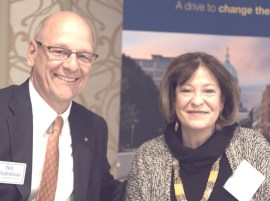
Past President Tim Stadelman and Patty Loew

Patty Loew, an Ojibwe scholar and UW Professor, described insights developed over many years of study of Native practices and beliefs regarding the land on which they live. These insights are common to members from all 12 Wisconsin Native nations. The unifying theme of land stewardship is that there is a spiritual connection with the land, the waters, the animals and the plants. They live close to the land, so they can be the first to recognize changes resulting from human practices and industry.

Christians, Moslems and Jews regard holy places such as churches as sacred, but they also have portable holy items such the Rosary or the Star of David. These followers of the Abrahamic religions have a disconnect in identifying certain bodies of water or wild rice as being sacred. The  entire society of the Ojibwe and Menomonee nations recognize that wild rice lasts forever and is therefore a super food when other sources are not available. In essence, Native peoples pray for sacred spaces that are necessary for assuring the continuation of life on earth.

When Europeans landed in America, it was necessary for treaties to be negotiated in order to preserve the right to hunt and fish. Restricted to Reservations of limited acreage, Natives knew that the Reservation would not sustain the people, so that hunting and fishing outside the boundaries would  be required. In recent years, other more dangerous intrusions have threatened the Natives existence. One example is the proposal for large open-pit taconite mines. The processing of this low-grade iron ore would result in sulfuric acid flowing into wild rice fields and potentially even into Lake Superior. The long-range vision of the Native religion considers how any decision would affect the seventh generation in the future.

The Ho-Chunk Nation in particular is concerned that Frac-Sand Mining is contaminating the air, the land and the water — all of which are considered sacred sites. Lung disease has been attributed to this form of mining. The Red Cliff Ojibwe are concerned that large industrial animal installations possess a real threat of manure contamination of land and streams.  The latest proposed legislation dealing with commercial land development that disturbs the Ho-Chunk nation regards the authority to excavate sacred burial mounds to determine if human skeletons are truly present. Unless one recognizes the religious beliefs and ethics of Native Americans, one cannot appreciate their viewpoint in opposing legislation that affects not only their interests but the welfare of the environment that includes all of us.

If you missed our meeting this week, you can watch the video here.

The Athletic Training Students for Brain Safety

–submitted by Andrea Kaminski; photo by Stacy Nemeth

Winterstein

From left: Emily Campbell, Erin McQuillan, Bailey Lanser, Andrew Winterstein and Club President Ellsworth Brown

Dr. Andrew Winterstein, director of the UW Athletic Training Education program and clinical professor of Kinesiology at UW-Madison, brought three student leaders to speak to Rotary about their work to raise awareness about brain injuries.

The Athletic Training Program prepares students for careers in athletic training. According to Winterstein, these students go on to work not only for athletic teams, but also health providers, industrial workplaces, schools and other settings. He showed a video in which students and faculty of this well-rated program lauded its small class sizes, high quality of instructors, practical clinical learning opportunities, top notch professors and strong science foundation.

Winterstein called injury “the unwelcome houseguest of physical activity.” Injury is inevitable, and it is a public health issue. It is important to consider the true cost of injury, he said. For example, what are the consequences at age 50 of having sustained an ankle injury at age 20? Ankle sprains are the most common musculoskeletal injury, and they are linked with an increased risk of osteoarthritis, a decreased level of physical activity and a lower overall quality of life. Winterstein noted that one million adolescent athletes suffer ankle injuries annually in basketball alone, with an estimated $2 billion in total costs.

Winterstein stressed that ankle injuries are preventable with exercises and the use of braces, yet many Wisconsin high school coaches are not aware of how to apply these resources. It is critical to get information to high school coaches and others.

Sports-related concussions have been a hot topic in the news recently because of some high-profile NFL cases and a link with traumatic encephalopathy. Winterstein notes there are an estimated 300,000 sports-related concussions in high school boys and girls annually in the United States. The majority are in football, but they also occur in other sports. Winterstein called for more research to better understand the causes and impact of concussions.

Winterstein then introduced three students who are active in Athletic Training Students for Brain Safety (ATSBS), a campus group that educates the UW campus and Madison communities on the short-term and long-term consequences of brain injuries including concussions. Formed in 2012 the group focuses on prevention, recognition and management of brain injuries.   Emily Campbell, Bailey Lanser and Erin McQuillan described recent accomplishments of the ATSBS group:

  • Applied for and received a Baldwin Grant to promote a statewide network of campus-based chapters;
  • Created and installed Renny’s Corner, an informational station at Wisconsin Institutes for Discovery;
  • Made presentations to high school anatomy and health science classes to inform students about brain injuries and promote Athletic Training as a career;
  • Held Children’s Safety Night at Wisconsin Institutes for Discovery to inform children and parents about the signs and symptoms of head injury and concussion, as well as how to prevent them.
  • Held a Brain Safety Symposium which featured distinguished speakers – some of them alumni of the program – from Madison and beyond.

The group is talking to campus groups interested in creating chapters at Concordia University, Marquette University and the UW campuses in Eau Claire, La Crosse and Stevens Point. They hope eventually to make ATSBS a regional presence at campuses around the Midwest.

Did you miss our meeting this week?  CLICK to watch the video.