
Which Way WARF?

–submitted by Dave Mollenhoff; photo by Mike Engelberger
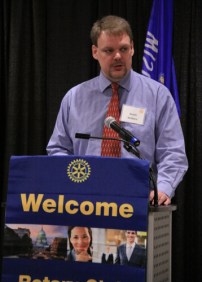
Kevin Walters 3The Wisconsin Alumni Research Foundation (WARF) is a household word to many Madisonians, but few know the story about how a clash of two titanic egos during 1959 and 1960 shaped today’s organization. Kevin Walters, a historian in residence at WARF, unfurled this little-known story in a talk titled “How to Handle Harry Steenbock.”

Created in 1925 as a private non-profit organization, WARF’s mission was to support scientific research at the University of Wisconsin-Madison by securing and commercializing patents from the discoveries of UW researchers and then making their royalty income available for further research—what Walters called a “cycle of innovation.”

But two talented men, Harry Steenbock and Thomas Brittingham, had very different visions on how WARF should evolve.   In 1923, Steenbock, a brilliant biochemist, invented a process to increase the Vitamin D content of food by irradiating it with ultraviolet light; he was confident that this process could eliminate a crippling bone disease called rickets.  Eager to realize this potential, he secured a patent and gave it to WARF.   This was WARF’s first big money-maker.

Thomas Brittingham, a UW-grad and the heir to a lumber fortune, became WARF’s first vice-president, and used his investment talents to multiply WARF’s royalty income and his position to shape policy.

During WARF’s first decades, Steenbock and Brittingham got along, but then Steenbock insisted that WARF’s revenues should be limited to scientific research.  Brittingham thought the organization should support the best interests of the university including the construction of campus buildings.

In 1959 the simmering feud between the two men turned personal and ugly.  Then on April 16, 1960 a massive heart attack felled Brittingham, just 61.  His death softened Steenbock’s ire, but not his fundamental position.

In the wake of this confrontation, UW leaders realized that both concepts were necessary for WARF and the UW-Madison to realize their extraordinary potential.   Today, WARF is nationally esteemed as a highly successful engine of technology transfer and a “margin of excellence” for the UW-Madison.   And, according to Walters, the Steenbock-Brittingham clash 55 years ago deserves some of the credit.

Click HERE to watch the video presentation.
Overture Center’s Mission – Entertain, Educate, Engage

–submitted by Jerry Thain; photo by Donna Beestman

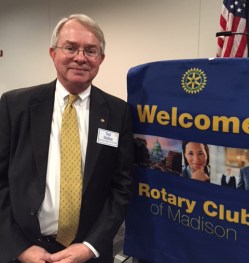
DeDee Ted 12 2 2015Ted DeDee, fellow Rotarian and President and CEO of Overture Center for the Arts, (OC) gave an inspiring and information packed summary of the OC’s impact on the community in his talk to the Club at Alliant Energy Center on December 2.  He began by noting the work of Club members on the OC’s Board & of other Rotarians to various OC activities.  After stating that OC, financially, was “doing great” since its transition from a City operation to one run by a non-profit foundation, he indicated that the many activities of OC could be placed in three basic categories-Educating, Engaging and Entertaining – and then gave some examples in each.
Educating included bringing almost 27,000 school age children to OC programs last year on very inexpensive or subsidized tickets.  The “Any Given Child” program operated in conjunction with the D.C. Kennedy Center provides kids in grades K to 8, throughout the city & MMSD  access to OC activities. The Broadway Diversity program provides internships for students of color in the arts, allowing them to shadow a show director for one week.  The Tommies & Tommy ensemble provide students from nearly 80 schools to display their talents at OC after auditions before professional reviewers to select the best performers.  WPT tapes and broadcasts an edited version of the Tommy Awards statewide.  The Tommy Ensemble is 16 to 28 students chosen from the program for pre-professional training.

Ted noted two significant engagement programs.  One is the Rising Stars program which over the last two years saw 475 local acts presented and 25 finalists each year provided contract opportunities with OC.  The Club Ten Program provides $10 tickets to OC performances, via help of non-profit agencies.  2,300 tickets have been provided since Dec. 2014.  A fine example of this program’s impact came from one recipient who wrote that it provided her “enjoyment from being a part of society that I’m usually excluded from.”

As to entertainment, he noted that four OC art centers are always free and open to the public as an example of free activities at OC. Broadway touring productions have made Madison the number one market for Broadway shows in the state.  (“Newsies” began its national tour by opening in Madison in 2015.)  He cited a study indicating that, since January 2012, OC (not including its 10 resident arts companies) generated $251,000,000 in economic benefits to the community.  He cited Alex Haunty, attending the meeting, for his recognition, at age 23, as the outstanding young philanthropist of the area.  Alex sells arts and cards he designs and uses the receipts to buy OC tickets for disadvantaged people.

Ted concluded his presentation with a heart-felt recognition of Jerry Frautschi (in attendance) and Pleasant Rowland Frautschi for their donations that enabled the existence of Overture Center and their expectation that it would provide education, entertainment and engagement, an expectation that OC is meeting. The OC Foundation report and its 2015-16 Programs for the Community, distributed at the meeting, provide fuller particulars on OC’s activities in these areas.

Dresang Talks about Wisconsin’s Model for Labor

–submitted by Carol Toussaint; photo by Loretta Himmelsbach

Dresang Dennis 11 25 15

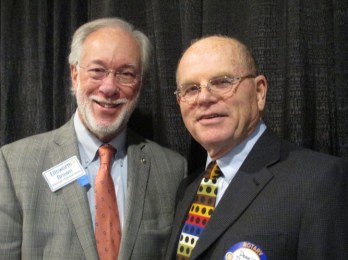
Dennis Dresang (right) pictured here with Club President Ellsworth Brown

Is conflict between workers and employers inevitable?  Professor Dennis Dresang, UW-Madison, did not answer this question so much as he gave us background and information to help us reach our own conclusion.  Dresang, Professor Emeritus of Public Affairs and Political Science, is the Founding Director of the LaFollette School of Public Affairs.

Covering a wide range of economic and political topics from the “company town” of which Kohler, Wisconsin, is widely cited as one model, to W. Edward Deming’s “Quality Management” approach in post-WW II Japan, Professor Dresang presented a chronology of labor/management disputes; one of which preceded Wisconsin Statehood (1848).  Many of us could recall when Kohler (1954-60) or Hortonville (1974) were in the news, but most of us needed Dresang to provide details of some of the other conflicts.  In 1886 when Governor Jeremiah Rusk mobilized the militia, 16,000 workers were on strike at Milwaukee Bayview’s Rolling Mills plant.  Seven protesters were killed and a number wounded.  At the Fox Valley Mills strike (1898), Attorney Clarence Darrow successfully defended the workers.

No talk on the History of Labor Development in Wisconsin or any other state would be complete without recognizing the depression era work of UW Professor John R. Commons.  Dresang covered the worker issues and working with employers required to accomplish the Worker’s Compensation Fund, a national model.

The Wisconsin Idea was not mentioned during the program, but in the opinion of many, Dresang epitomizes what most citizens think of when that phrase is used. While a teacher and administrator at the UW, he has been called upon numerous times to lead a task force by appointment of a governor or by city and county officials when his academic expertise was needed.  (See last week’s write-up in Rotary News for some details).  One particular assignment was while he was on leave in 1976-77 to direct the State Employment Relations Study Commission.  If time had allowed, Professor Dresang would surely have received questions on that topic.

If you missed this presentation, CLICK to watch it online.

Donna Beestman Receives Rotary Club of Madison Club Service Award

Introduced by Deb Archer on November 25, 2015; photo by Loretta Himmelsbach

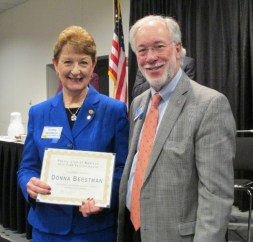
Beestman AwardOur Rotary Board recognizes up to six members each year for their exemplary service in one Rotary’s Five Avenues of Service which are club, community, international, new generations and vocational.  During our November 25 Rotary luncheon, Donna Beestman (pictured here with Club President Ellsworth Brown) was recognized with our Rotary Club of Madison Club Service Award.
Donna joined our Rotary Club in 2002, and she was previously a member of the Wilmington, Delaware Rotary Club.  She is owner and president of Career Success Strategies, LLC.

During her 13 years in our Rotary Club, Donna has been very active.  She is a leader and has served on the Ethics Symposium, Scholar Mentor, Vocational Opportunities, Button Box, Photography and Member Development Committees. She is current chair of our Orientation Committee, and she is a member of several of our fellowship groups.  In addition, Donna is a current board member and was previously on our board from 2005-2007.

Because of volunteers like Donna, our club continues to thrive, and we thank her for her continuing service.

President Ellsworth presented Donna with a certificate and a special pin in recognition of this award, and our club has also made a $200 gift in her name to The Foundation of Rotary International to help fund its many worthy projects and programs.

Congratulations, Donna!

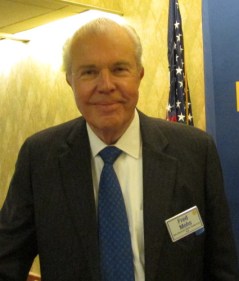
Fred Mohs Tells His Father’s Story

–submitted by Rich Leffler; photo by Loretta Himmelsbach

Fred MohsA 11 18 15As a three-time beneficiary of the Mohs surgical procedure at the Mohs Clinic of UW Hospital, this reporter was especially interested to hear Fred Mohs talk about his father, Dr. Frederic Mohs, Sr. Born in 1910, Dr. Mohs was a medical pioneer. Although he intended to be a radio engineer when radio was the popular technological rage, he got a college job at Birge Hall at the UW. A prominent cancer researcher introduced Dr. Mohs to the work being done in the 1930s on cancer: what exactly was it and how could it be treated? His mentor changed the trajectory of young Fred’s career. He went to medical school.
Dr. Mohs was an admirer of Thomas A. Edison, and he used Edison’s technique of intensive experimentation until he found that zinc chloride in a paste could kill cancer cells while still preserving cellular structure. Much of Dr. Mohs’s work was funded by WARF’s first research grants. He applied this compound to tumors of the skin to kill the cancer, while allowing a pathologist to determine whether the cells on the periphery were cancerous or normal. Very large and invasive tumors, which other surgeons were unable to excise, were now susceptible to treatment.

Dr. Mohs early-on learned the difficulty of communicating medical science to the general public. An interview with the Wisconsin State Journal about his technique resulted in a headline: “Cancer Cure Discovered.” Colleagues were outraged. His license to practice medicine was threatened. Eventually, especially after Dr. Mohs successfully treated a prominent Madison physician for a very large neck tumor, the value of the Mohs procedure was generally recognized.

Today, the Mohs procedure is widely used. In combination with an onsite pathologist, and working closely with plastic surgeons when needed, Mohs clinics allow surgeons to remove skin cancer with a minimally invasive and disfiguring procedure. Thank you Dr. Mohs, and thanks to Fred for telling us the story.

Did you miss our meeting this week?  CLICK to watch the video.

Dawn Crim Receives Rotary Club of Madison Community Service Award

Presented by Carol Toussaint on November 18, 2015; photo by Loretta Himmeslbach

Crim AwardA

From left: Carol Toussaint, Dawn Crim & Club President Ellsworth Brown

I am here as a member of our Club’s Member Recognition Committee.  This is a committee established by our board to annually make recommendations to recognize members for their efforts on behalf of our Rotary Club.  The recognition is in one Rotary’s Five Avenues of Service which are club, community, international, new generations and vocational.

The board receives the recommendations and presents the award.  My job today is to introduce a member who is receiving a community service award on behalf of our Rotary Club.  Dawn Crim.

Dawn is an Associate Dean for External Relations for the UW School of Education.  She is a well organized and busy, busy person.  In addition to her role at the UW, Dawn is involved in many projects and organizations within our community.  In addition to her professional work, family and community service activities, Dawn has devoted a great deal of time to Rotary over her eight years of membership.

She joined our Rotary Club in 2007 and immediately got involved in committees.  Dawn has worked with the Rotaract Club on the UW campus.  She serves as a mentor to one of our Rotary scholars and has served on our Program Advisory Committee.  In addition, Dawn has for six years been an active member on our club’s Community Grants Committee. This is not a small commitment.  She has interviewed grant applicants and attended numerous meetings with other Community Grants Committee members as they develop recommendations for the funding projects each year.  You’ll also have seen newsletter photos of Dawn as part of our Hiking/Skiing Fellowship Group.  Dawn finds time for Rotary and for her continuing dedication to our Rotary Club, we are awarding our 2015 Rotary Club of Madison Community Service Award to Dawn Crim.

The Club has made a $200 gift in her name to The Rotary Foundation of Rotary International, and President Ellsworth presented Dawn with a special certificate and a pin to recognize the community service award.

Congratulations, Dawn.