Tag Archives: Centennial Celebration

Celebrating 100 Years: A Look Back in History

As we celebrate our 100th anniversary, our History Sub-Committee is taking a look back in our club’s rich history and is sharing highlights from the past century.  This week’s message is shared by committee member Rich Leffler:

Committee on Code of Ethics

The Rotary Code of Ethics for Business Men of All Lines

At one time, Rotary had an astounding Code of Ethics, as once required by the Bylaws. But for reasons that are unclear, the Code fell into disuse. Once, it was widely published and distributed. Today, it can hardly be found. We are publishing this remarkable Code of Ethics here, along with a brief history of its rise and fall as a tenet of Rotary.

In 1912, Rotary president Glenn C. Mead proposed that the newly formed Business Methods Committee prepare a code of business ethics for “the advancement of business morality.” (The Rotarian Commemorative Centennial Edition [June 2005], 89) The chair of the committee was Robert W. Hunt of Sioux City, Iowa. Much of the Code was composed by an unofficial committee of Hunt’s fellow Iowa Rotarians while en route to the June 1914 convention in Houston. One of these Iowans, J. R. Perkins, explained that “the articles of the code were revised both as to phrasing and content. The third, eighth, and ninth articles, in their basal ideas . . . grew out of the general discussion. The tenth article, which in the writer’s judgment is the highest ethical upreach of them all, did not appear in [the original] manuscript, tho it was held to be germane to the whole and really expressive of what is fundamental in Rotary.” Perkins also explained that the stunning final paragraph of the “Summary” was “a bit of pragmatic philosophy from William James, but he really borrowed it from European philosophy.”(J. R. Perkins, “History of the Rotary Code of Ethics,” The Rotarian 10, no. 2 [February 1917], 119–21).

The Rotary Code of Ethics for Business Men of All Lines, printed here, was adopted by the Sixth Annual Convention of the International Association of Rotary Clubs meeting in San Francisco in July 1915. Great faith was put into the power of the Code. A report to the 1919 Convention argued that “if the business men of the world would adopt the Rotary Code of Ethics as their rule of conduct, as their guide in commercial intercourse, the world would be a safe place for democracies. . . . Had the business world been operating according to a standard of practices which conform to our Code of Ethics, does any real Rotarian believe that we would have been plunged into a night of horrors such as lasted from August 1914, to November 1918?” (Robert H. Timmons, “Report of Committee on Publicity,” Proceedings of the Tenth Annual Convention . . . [July 16–20, 1919], 430–31)

In 1921, when the Rotary Club of Madison celebrated the sixteenth birthday of Rotary with a full-page spread in the Wisconsin State Journal, it proudly published the Code of Ethics and declared that Rotary is “based on the following Code of Ethics.” (WSJ, February 23, 1921) And the History of our Club recalls that in the mid-1920s the Club’s “leadership began to use it [the Code] as the focal point of a number of somber investigations into the allegedly unethical business dealings of some of its most prominent members.” (John Jenkins, History of the Rotary Club of Madison [Madison, 1990], 56) This latter point deserves scrutiny in future blogs.

But as early as 1921, there were objections to the Code. Ironically, it was Rotary President Mead who asked “Is the Rotary Code of Ethics a code of ethics at all? Is it not a confession of faith or a creed?” (The Rotarian 19, no 1 [July 1921], 39) Similarly, in 1924, Rotary president Guy Gundaker echoed Mead when he observed that the Code was “more in the line of a confession of faith, or a creed.. . . [The Code] should be specific, plain-spoken, and expressed in commonly understood terms; also that its provisions should be given as rules of conduct expressed as ‘Shall and Shall Not.’ This, of course, does not preclude preambles to any of the sections of an informative character.” (The Rotarian 25, no. 3 [September 1924], 42) By 1931, Rotary began to consider itself less a business club than a service club, and Rotary International adopted its “Aims and Objects,” which had application beyond business matters. The Board appointed a committee to revise the Code of Ethics. The Code continued to be published in the Manual of Procedure, but it was no longer separately distributed. In 1943, the Four-Way Test was adopted, and it became a sort of substitute code of ethics with broad application.

In 1951–52, the Board discontinued the distribution of the Code of Ethics entirely. In 1977, an attempt was made to “revive the publication and dissemination” of the Code. But the following year, the Board determined that “because of changes in the realm of business and professional life since the adoption of the code, any revision and updating for the purpose of re-instituting the publication and distribution of the code would be ineffectual.” So the Board voted not to revise the Code or to distribute it. In 1980, reference to the Code was removed from the RI Bylaws.

Although the Four-Way Test is often referred to as a Code of Ethics, it has never been so designated. In fact, the 1981 Manual of Procedure stated that “The Four-Way Test should not be referred to as a ‘code’ in any sense.” So, presently, Rotary has no code of ethics. Our Club is, however, as concerned as ever about ethical behavior, and our annual Ethics Symposium program extends outward to high school students in the Madison area. It is one important way of serving the community.

This introduction is partially based on Doug Rudman, “The Rotary Code of Ethics,” The Rotary Global History Fellowship (An Internet Project) (http://rotaryfirst100.org/history/headings/ethics.htm and Rudman, “Is the Four-Way Test a Code of Ethics?” (ibid.).


Celebrating 100 Years: A Dramatically Mixed Message on December 26, 1944

Rotary Club of Madison-Centennial LogoAs we celebrate our 100th anniversary, our History Sub-Committee is taking a look back in our club’s rich history and is sharing highlights from the past century. This week’s message is shared by committee member Rich Leffler:

The Rotary News issue of December 26, 1944, offered a dramatically mixed message. On the one hand, it announced that the annual Children’s Christmas Party, also called the Kiddie’s Party, was to be held on the following Thursday, which was then the day of the weekly meetings of the Club. The party in 1944 was being held not at the Lorraine Hotel, but at the Bethel Lutheran Church. Meetings had been discontinued at the hotel because war shortages made it impossible to serve large lunches there.

Since the late 1920s, the Club had held a party for the children of Rotarians instead of the usual meeting of the Club in the week between Christmas and New Years. You will see on page 2 brief accounts of past parties for five-year intervals, going back to 1929. Note also that in 1919, the Club sponsored the “community Christmas tree” in the rotunda of the Capitol, and in 1914 the Club was sponsoring an “ornamental lighting system” downtown, which some of the property owners were not supporting.

Rev Vander GraffA very different and even terrible note was struck in secretary Paul Hunter’s account of the talk given to the Club on Thursday, December 21, 1944. The speaker at Rotary that day was Captain Jens J. Vander Graff, who had been pastor at the Stoughton Methodist Church for four years, but who was most recently the chaplain to the Wisconsin and Michigan National Guard units fighting in the Pacific Theater. It is a stunning talk, and Paul Hunter notes that “Much of Captain Vander Graff’s address cannot be printed for various very good reasons.” Although his remarks were shockingly different from the common reports that Americans got from official and media accounts of the war, given his background they must be given credence.

Rev. Vander Graff was not a malcontent. Far from it. He volunteered to become an Army chaplain in 1942. He served at the front for nine months in the Southwest Pacific and was awarded a Bronze Star for his service at headquarters under General MacArthur in New Guinea. Rev. Vander Graff returned to the United States in late 1944 after being hospitalized in New Guinea. In 1945 he did public speaking on behalf of the war loan drive and to recruit chaplains. He was eligible for discharge in November 1945, but he chose to remain in the army until June 1946, serving as a chaplain at various hospitals.

Reading this issue of the News makes it clear that Americans on the home front were blessed, even during total war. Their quality of life was being protected by the sacrifices of the men and women at the front. The soldiers’ experience, however, was so awful that many suffered profound psychological injury. In World War I it was called “Shell Shock;” in World War II and Korea it was “Battle Fatigue;” and in Vietnam, Iraq, and Afghanistan it is “Post Traumatic Stress Syndrome.”

After World War II, the United States adopted the G.I. Bill to help returning veterans rejoin civilian life. And today, we recognize the need to help veterans recover from their service-related injuries, physical and psychological. Our Vietnam veterans were not so lucky; but today, belatedly, their sacrifices, too, are being recognized and they are being thanked for their service. So, at least in this one way Reverend Vander Graff was too pessimistic.

Celebrating 100 Years: A Look Back in our Club’s History – George Wallace Visits Club in 1964

Rotary Club of Madison-Centennial LogoAs part of our celebration to mark the 100th anniversary of the founding of the Rotary Club of Madison, Jerry Thain and Rich Leffler are publishing original documents from the Club’s archives and other sources. We hope that these documents will recall for you the rich history of the Club and the times during this momentous century.

This week, Jerry Thain provides the following history piece:

The Rotary Club of Madison has had many famous people speak to it over the years. Possibly the most surprising name among the list of speakers is that of Alabama Governor George Wallace, whose February 1964 talk was an attack on the pending Civil Rights Bill that was enacted by Congress later that year. Since it was almost universally thought that some version of the civil rights bill that had been strongly promoted by President Lyndon Johnson was certain to be passed, political observers believed that Wallace’s purpose in speaking against it around the nation was not so much to block enactment of the bill as to start promoting himself as a future candidate for President. That campaign, of course, was ended when he was seriously wounded by a would-be assassain’s bullet in 1968.

I trust it goes without saying that this post is in no way an endorsement of the arguments by Wallace but simply the citing of a notable moment in our Club’s history. The Wisconsin State Journal reported picketing took place outside the meeting and there was a report of a supposed assassination plot as well.  As most know, Wallace later recanted many of his earlier views on civil rights and ran for Governor on a different platform.

Celebrating 100 Years: A Look Back in Our Club’s History – National Attention in 1952

Rotary Club of Madison-Centennial LogoAs part of our celebration to mark the 100th anniversary of the founding of the Rotary Club of Madison, Jerry Thain and Rich Leffler will be publishing original documents from the Club’s archives and other sources. We hope that these documents will recall for you the rich history of the Club and the times during this momentous century.

This week, Rich Leffler provides the following history piece:

The Rotary Club of Madison has, from its early days, sought members from a cross-section of the community, including faculty members at the University and leaders in the Wisconsin Historical Society. The Club took great pride in 1952 when Newsweek and Time, the two great newsweeklies, printed stories about two Madison Rotarians, Professor Mac McCarty and Society Director Cliff Lord. Mac was one of the leading figures in the University’s effort to create a state broadcasting network and a television station. He served as Club president in 1975–76. Cliff Lord had been Director of the Society for six years in 1952. The Society is one of the greatest libraries in the world for the study of American History (I should know: my life’s work has depended on the Society’s great research collection).

Continuing in this tradition of broad-based membership, today the Club has as members Mike Crane of Wisconsin Public Radio, who joined on October 3, and Society Director Ellsworth Brown, a member since 2005, in addition to new-member Diane Nixa, co-director of the Wisconsin Historical Foundation. (Ron Bornstein, director of Wisconsin Public Television, was president of the Club in 1992–93; Malcolm Brett, director of Broadcasting at UW-Extension and General Manager of WHA-TV, was a longtime member; Dick Erney and Nick Muller were also members when they were directors of the Society.) Ellsworth, by the way, has corrected one of the few mistakes Cliff Lord made: he has restored the Reading Room to its original state, down to the reading lamps, as it was before the “modernization” done in the mid-1950s. The Reading Room is now an architectural masterpiece. You should take a look.

The October 25, 1952, issue of The Rotary News contained the following report by secretary Brud Hunter.

Celebrating 100 Years: A Look Back in Our History Continued

Rotary Club of Madison-Centennial Logo

THIS WEEK IN DOWNTOWN ROTARY HISTORY

The October 3, 1939, Rotary News summarized remarks made to the Club by Henry Noll, a native of Germany who had been a Madison newspaperman for 36 years, about getting back to the United States after being in Germany in the summer of 1939 and in Vienna when World War II began. He also noted his personal assessment of the political climate in Germany just prior to the war. The Rotary News caption “Interesting Experience” seems quite the understatement.
–submitted by Jerry Thain

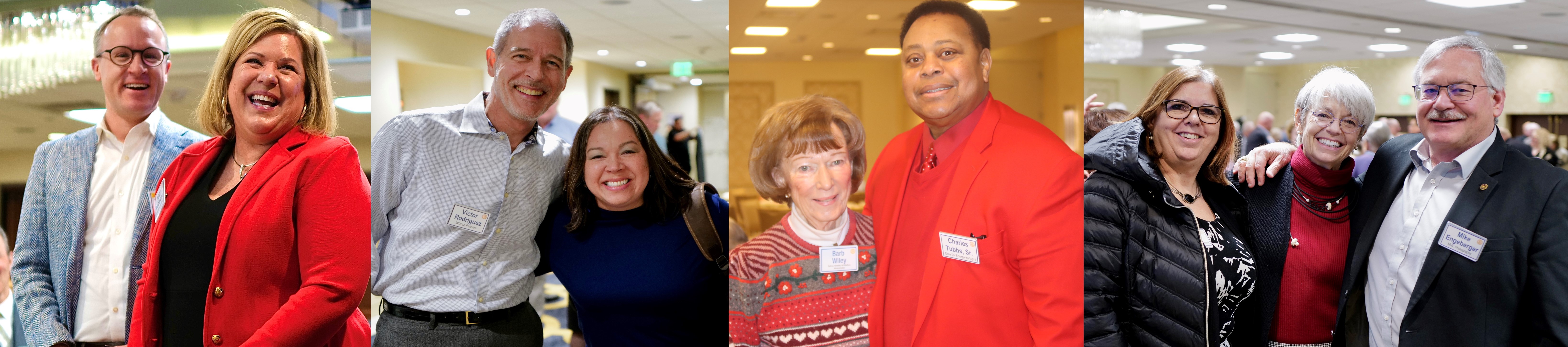
Rotary New Member Coffee Event – To Discuss Packer Game?

Wes Sparkman and Dick Pearson

Nathan Wautier and Jim Sauter

Perry Henderson

Jason Beren

Deb Archer

What do you think Rotarians talk about at a 7:30 a.m. coffee the morning after the Packer/Seahawks game?  Not the eight sacks of Aaron Rogers or the deft hand of Russell Wilson, or even the officiating fiasco.  No, they talk about the excitement of being a Rotarian in a club that offers more special ways to participate than hours in a day.  Not only that, the newest was as enthusiastic as a most experienced member in the group.  Jason Beren was in charge and called on Deb Archer who described the upcoming centennial year celebrations, and President Wes Sparkman who challenged everyone to bring in a new member by July 1st.  Even for those of us who are not “morning people,” it was a great way to start the day.
                                                                                          –submitted by Carol Toussaint