Tag Archives: Madison WI

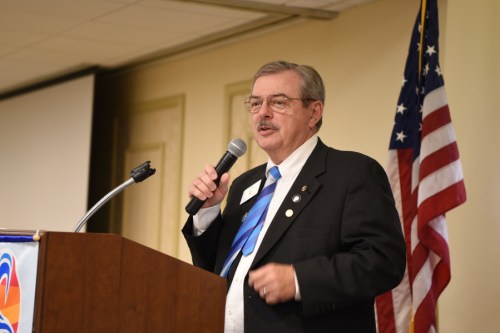
Straight Talk on Civil Discourse

submitted by Valerie Renk; photo by Margaret Murphy
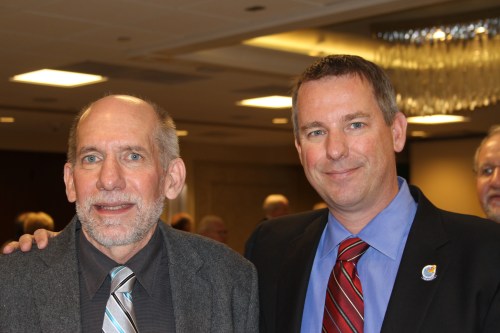
Michael Schuler 9 26 2018

Pastor Michael Schuler pictured here with Club President Jason Beren

Rotary’s Sept 26 guest speaker, Michael Schuler, asked, “Is there is an antidote to toxic talk?”

Schuler recently retired as senior minister of the First Unitarian Society of Madison.

Researchers gather data, test hypothesis, operate on provisional truths, demanding scientists have open minds.  However, even scientist succumb to civil discourse.  Debate over what killed dinosaurs is one example.

The book, “Politics of Resentment” by Kathy Cramer documents this resentment.  People in common conversation treat each other like enemies, even in rural America known for niceness.  Cramer contends political leaders are often to blame for our divided experience.  For example, trash talk, and rowdy events held by Trump’s campaign where dissenters were ejected.  “This is fun,” Trump said.  We are receptive to this bravado.

Rural citizens interviewed by Kramer felt their communities were losing to urban communities, despite data showing otherwise.  Perception matters, and politicians exploit this.  Polls focus on winning and losing, so voters overinvest in winning.  We need to focus less on winning and focus more on what government is doing for everyone.

Schuler outlined strategies to increase the quality of our conversations:

  1. Step out of our comfort zone. Invite interaction with people who don’t share your moral narrative.
  2. Think like a good scientist. Hold your ideas as a tentative theory rather than a final fact.  Apparently, it could well be, it seems, are all good phrases to use.
  3. Be more curious. Ask more questions rather than share your convictions.
  4. Be patient. Sit with discomfort until you have more clarity.
  5. Become more self-aware. Is your tone inviting or challenging?

Michael Schuler served 30 years as senior minister of First Unitarian Society of Madison, one of the largest UU churches in North America.

If you missed our meeting this week, you can watch the video here.

MSO Celebrates 25 Years

submitted by Rich Leffler; photo by Margaret Murphy

John DeMain 9 19 18

From left: Club President Jason Beren, club member Perry Henderson and John DeMain

Madison Symphony Orchestra conductor John DeMain joined us in his first event to celebrate the 25th year of his leadership here in Madison. Twenty-five years is an extraordinary time for a modern conductor to stay with an orchestra. We have been lucky to have him here for a quarter century.

John began by very generously crediting his predecessor, Roland Johnson, for his long service to the MSO and as creator of the Madison Opera as part of the MSO. He credited Mr. Johnson with making the orchestra professional and with recruiting the services of UW faculty and students. John also explained the changes that he has brought. At one time, the orchestra performed eight single concerts a year. When Roland Johnson passed the baton to John, he urged him to build on his work developing an audience. John has tripled the audience during his tenure. Today, the season consists of a series of eight concerts, each performed three times, on Friday and Saturday evening and on Sunday afternoon. The MSO has done more than increase its audience and its string section (now full-sized). In his first year, John initiated blind auditions for prospective musicians. UW faculty joined the orchestra, which encouraged their students to participate as well. The result was fine musicianship. [Anyone who has heard the MSO will agree that it is shockingly good. Its string section is vibrant and its sound has a sheen.]

John also thanked Pleasant and Jerry Frautschi for their astounding gift of the Overture Center, including Overture Hall, which has a splendid acoustic that allows us to hear how beautifully the MSO plays. John also spoke of the several associated organizations and programs affiliated with the MSO.

John concluded on a somewhat somber note. Former UW Chancellor John Wiley was in attendance. He upgraded the School of Music during his tenure. Some of his work is being undone because of funding woes: many of the faculty are no longer tenure-track. They and their students are less likely to join the MSO. However, fine musicians from elsewhere are maintaining the orchestra’s excellence.

The Maestro made one last point: Madisonians should include the MSO in their entertainment options. This reviewer agrees. As an old ad in New York once proclaimed: “Try It, You’ll Like It.”

We express a special thanks to the MSO: The Rhapsodie Quartet: Susanne Beia, Laura Burns, Chris Dozoryst and Karl Lavine.  The quartet performed a movement from the American String Quartet written by Antonin Dvořák.  If you missed our meeting this week, you can watch the video here.

Wisconsin Obesity Prevention Initiative Targets Neighborhoods

submitted by Jocelyn Riley; photo by Margaret Murphy

Vicent Cryns 9 12 2018

“Virtually every organ in the body is adversely affected by obesity,” Dr. Vincent Cryns, the Marian A. and Rodney P. Burgenske Chair and Chief, Division of Endocrinology, Diabetes & Metabolism at the University of Wisconsin School of Medicine and Public Health, told Rotarians on September 12.

Not only are people’s individual bodies affected negatively by obesity, according to Dr. Cryns, but obesity also has a negative effect on society as a whole.  The cost of the obesity epidemic to American society is equal to 4 to 8 percent of our Gross Domestic Product, with disadvantaged communities affected disproportionately.  The even more discouraging news is that there have been three-fold increases of obesity and overweight in the past forty years.  Dr. Cryns cited several causes, including less physical activity due to factors like increasing screen time and the marketing of “tasty inexpensive calorie-dense foods.”

Dr. Cryns is involved with the Wisconsin Obesity Prevention Initiative (OPI), which is compiling and analyzing “zip-code-level data” to design positive interventions and coaching to help deal with this crisis.  OPI is currently working with two community partners, the Menominee Nation and Marathon County, to come up with place-based solutions to the problems posed by widespread obesity.  Possible solutions include incorporating nutritious foods like wild rice into traditional activities like community feasts and improving pedestrian and bike access so that people who would like to walk and bike more can do so safely.  Dr. Cryns encouraged his audience to find out their individual Body Mass Index (BMI; weight divided by height squared) and modify eating and exercise until it reaches healthy levels.

If you missed our meeting this week, you can watch the video here.
StartingBlock: Imagine the Opportunity

submitted by Kevin Hoffman; photo by Margaret Murphy

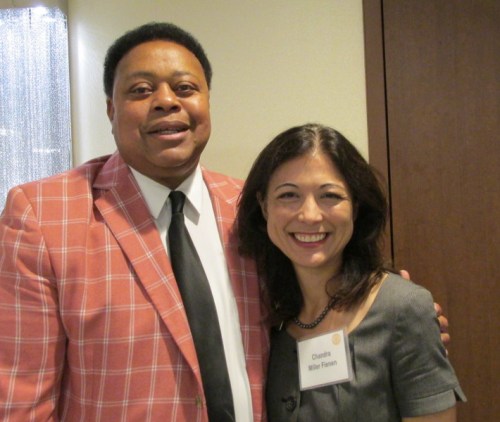
Chandra Miller Fienen 9 5 2018

Chandra Miller Fienen pictured here with club member Charles Tubbs

Chandra Miller Fienen, Director of Operations & Programs at StartingBlock Madison, spoke to Downtown Rotary about what StartingBlock is and how it helps support and foster innovation entrepreneurs.

Recently opened in June 2018, StartingBlock Madison is supported by Madison Gas & Electric, American Family Insurance and the City of Madison.  In collaboration with the University of Wisconsin, StartingBlock Madison seeks to launch early-stage companies by creating a home base for innovation entrepreneurs.  Resources provided include affordable and flexible workspace, speakers on relevant topics, introduction to the startup scene, mentorships, and refining sales and marketing messages.

StartingBlock also helps fledgling companies grow by assisting with finding talent through an onsite recruiter, matching students for internships and paid positions, connecting with professional advisors and mentors, and workshops on financing and operating a business.  There are currently 20 companies, 7 partner organizations, and two venture capital funds involved with StartingBlock.

Innovation is further fostered by showcasing new ideas, collaboration with members of StartingBlock, connecting with investors and advisors, and working with experienced entrepreneurs to bring ideas to reality.

Last, StartingBlock seeks to cultivate a sense of giving back by encouraging supportive practices for employees and the community, staying in Madison once they are successful, and having a positive social conscience and impact.

Summing it all up, StartingBlock Madison’s vision statement is:  Creating intersections that cultivate entrepreneurs, build innovative companies, and drive ideas into reality.

If you missed our meeting, you can watch the video here.

“Show Your Rotary Pride”

submitted by Stan Inhorn; photo by Karl Wellensiek

DG Bill Hoel 8 29 2018

Bill Hoel, Rotary District 6250 Governor, inspired Rotary Club of Madison members to show their Rotary pride. Hoel suggested that Rotary is recognized worldwide for the success of its many programs carried out by its more than 35,000 clubs and 1.2 million members in over 200 countries. He further explained that the clubs are grouped into 529 districts and 34 zones. Rotary continues to grow in numbers, more in other continents than in North America. The  Rotary International website showcases projects that have been completed around the world.

The biggest project ever undertaken by Rotary is the Polio Eradication program that has a goal of total eradication of the polio virus.  No other major project will be undertaken until no more cases are reported and until no virus can be identified in samples of wastewater for at least three years. Although isolated cases are still being found in a few countries in Asia and Africa, occasional cases are reported in the U.S. One such case was recently reported in Minnesota from a boy who had visited a Canadian Amish settlement that had not received the polio vaccine.

Hoel also emphasized that cooperation between Rotary clubs and other organizations is important. Rotary has permanent representatives in the United Nations and indirectly with its subsidiaries such as the World Health Organization and the World Food Program. He described two efforts that involved Wisconsin clubs, one in 1986 and one in 1989. The first involved a period of starvation in Ethiopia, in which a concerted effort enabled tons of dried whole milk to be sent by planeload and cargo ship.  The second, called Hands Across the Heartland, sent food to Moscow during a period of famine.

Hoel suggested that Rotary Pride for all its accomplishments should inspire others to think of becoming a Rotarian. Because of its manpower, Rotary Club of Madison has many accomplishments to be proud of, but it may be able to do even more by collaborating with other clubs in the district.  He invited members to attend the 2019 District Conference, June 7-8, at the La Crosse Center.

If you missed our meeting this week, you can watch the video here.
 

Madison to Launch Professional Soccer Team

submitted by Bill Haight; photo by Karl Wellensiek

DSC_8192

Peter Wilt, managing director of Madison’s newly forming professional soccer team told Rotarians why Madison is ready for its own pro team.

Soccer is popular with young people and approximately 50% of Madison’s population is under the age of 30. Soccer has become the second most popular sport among the 12-24 age range and 4th among all ages. The Madison area has 40 youth soccer clubs and 20,000 registered participants.

People who began playing soccer in the 1980’s when youth soccer began to take off in the U.S. are now among community leaders and decision makers. A sustainable pro team will need passionate fans, a tribal culture, and community pride, said Wilt. Madison is ready.

The team’s name and head coach will be named very shortly and the team’s first of 14 regular home games is planned for April, 2019. The new team will be part of a Tier III division, with teams from mid-sized cities such as Tucson and Toronto.

The team is owned by Big Top Events, which operates the Madison Mallards baseball team and concerts at Breese Stevens Field, also the home of the new soccer team.

Investment in Breese Stevens by the City of Madison and Big Top Events will eventually bring capacity to 5,000 and add suites, upgraded restrooms, club seating, a rooftop deck and enhanced food and beverage options. A season ticket will be in the neighborhood of $274, with game tickets comparable to movie prices, noted Wilt.

Players are being recruited internationally and will also feature local and state players, said Wilt. The new team’s players will be mostly in the 21-25 age range and will be full-time Madison residents, unlike Mallard players who stay with local housing hosts during the season.

The sizable and growing Madison soccer fan base is finally getting a hometown team of its own.

If you missed our meeting this week, you can watch the video here.