
–submitted by Vikki Enright; photo by John Bonsett-Veal
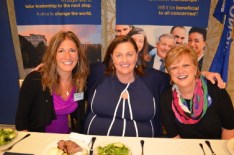
From left: Club President Michelle McGrath, Elizabeth Hudson & Rotarian Janet Piraino
Elizabeth Hudson, who was appointed by Wisconsin’s Governor in 2014 to create the Wisconsin Office of Children’s Mental Health, was our featured speaker on May 17. Hudson discussed the science of Adverse Childhood Experience (ACE) and how early adversity, before age 18, can lead to ongoing struggles in adulthood. She discussed how food insecurity, poor health and toxic stress attack the developing nervous system. When neurodevelopment is compromised, anger, depression and poor health can make kids struggle in school, and as adults, they may continue to struggle in the workplace.
In her work with the Wisconsin Office of Children’s Mental Health, her team received a MARC Grant (Mobilizing Action for Resilient Communities) and is engaging with the business community so they learn how to implement policies that help employees be more productive and offer a supportive environment for working parents.
Hudson also discussed how the Wisconsin Assembly Committee on Small Business Development is addressing the issues of childhood development and health with the understanding that healthy families grow business. She acknowledged the efforts of Rep. Melissa Sargent (D-Madison) who was in attendance.
Hudson outlined some leadership goals for trauma-informed care. They include changes in corrections, instruction in school and recognizing the importance of incorporating mindfulness into business culture. In her work, Hudson has learned that resilient children thrive because they have access to a trusted adult who listens to their concerns. The audience followed up with several questions and comments. There was agreement that adverse childhood experience has always been with us, but the way we recognize and act on these issues has changed as we are more open to discuss problems and try to find solutions.
If you missed our meeting this week, you can watch the video here.











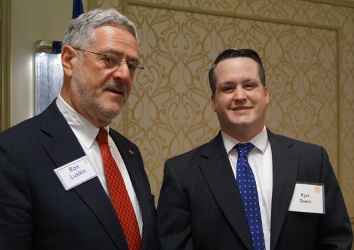 Professor Ryan Owens, a member of the UW Department of Political Science and an Affiliate Faculty of the Law School (and who is developing the Tommy Thompson Center on Public Leadership) spoke to the Club about “The Past, Present, and Future of the U.S. Supreme Court.” He began with an interesting “Thought Experiment.” With the addition of Neil Gorsuch to the Court, Justice Anthony Kennedy continues to be the middle or the median justice, often called the swing vote. But what happens if he retires, and if President Trump appoints a solid conservative such as Paul Clement, who is perhaps more conservative than Samuel Alito? In that case, the new median justice becomes Chief Justice John Roberts, who would then become the most powerful [influential?] Chief Justice since John Marshall. [Though he would be a very distant second.] If Ruth Bader Ginsburg were then to retire, Justice Alito would become the median justice. On the other hand, if Hillary Clinton had been elected, Justice Stephen Breyer might be the swing vote, etc. Very easily, a 6-3 conservative court under Trump might have been a 6-3 liberal court under Clinton. The presidential election of 2016 was, then, a very consequential election.
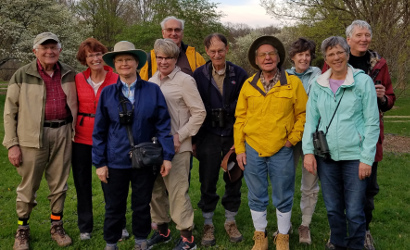 A group of nine Rotarians and guests met at the UW Arboretum Visitor Center for a hike on April 24 for an evening bird sighting. The goal was to observe the courting behavior of the male woodcock. Guide Levi Wood provided information about the rich conservation history of the UW Arboretum and a tour of the Longenecker Gardens which showcases a collection of trees and shrubs. The Magnolia collection was in full bloom and the early lilacs were opening.
 We were pleased to see the Oak planted by Paul Harris and saw turkeys and a red-tail hawk nearby. The hike included a walk through Gallistel and a brief stop at Teal Pond. Curtis Prairie provided the zen-like experience of hearing the courting sounds of the male woodcock who becomes active at dusk. Although the bird was never seen, its presence was clear by the loud, nasal peent calls made on the ground, the twittering sounds made by the wings as the woodcock rises up 100’ or more in an aerial display, the call made at the ‘top’ of the flight, and steep dive back down to the prairie. The Audubon website refers to this behavior as a ‘sky dance’. Female woodcocks are attracted by the ‘lek’ of males performing their rituals and have an opportunity to select the fittest mate.

 Rotary Club of Madison, Wisconsin