Tag Archives: Madison WI

New Member Event at HotelRED

–submitted by Mary Romolino; photos by Jorge Hidalgo

coffee-event-hotelred5  coffee-event-hotelred4  coffee-event-hotelred3

Photo 1: Charles Tubbs and Jeff Quinto; Photo 2: Haley Saalsaa, Jason Ilstrup, Karla Thennes, Leslie Lochner & Craig Bartlett; Photo 3: Leslie Overton, Jennifer Weitzman & Mary Romolino

20161213_080843It was a game of Find the Member Who… that had experienced Rotarians and new club members alike learning fun facts about each other’s unique and sometimes quirky life experiences at the new member event on December 13 at HotelRED. Thanks to Jason Beren, who organized the game, attendees mixed with literally every person in the room in order to match the experiences listed on our game sheets with the Rotarian who lived that experience. It was a terrific way to get to know our newest members and learn surprising facts about those we’ve known for years.

With members like ours, it’s no wonder our club is so dynamic! For instance, new members Jorge Hidalgo marched in President Reagan’s Inauguration Parade, Chris Rich saw a ghost at age eight, a sighting confirmed later in life by his mother; and Jennifer Weitzman has donated a kidney. Leslie Overton started at UW Madison as a music major but instead became a CPA and lived in Washington D.C. for years before returning to Madison.  Jeff Quinto’s family motto is “Often wrong, but never in doubt,” while Karla Thennes’s Minnesota-dwelling parents gave their children names beginning with the letter K. By the time Karla was due they were running low on names. Luckily Karla’s dad saw Miss Minnesota on TV and you guessed it, her name was Karla with a K.

When you meet a new club member, please extend a warm welcome and discover the experiences which led them to where they are now and to our club.  And, thanks to Jason Ilstrup and HotelRED for hosting our event.

20161213_081334


Alexander Hamilton – A “Hot Topic”

–submitted by Roger Phelps; photo by Mike Engelberger

kaminski-john-12-7-16Alexander Hamilton is a “hot topic” these days.  With the incredible success of Hamilton: An American Musical, there is a lot of review and interpretation of this founding father and his role in history.  According to today’s speaker – Professor John Kaminski – Hamilton was a pivotal player at a pivotal time in our history’s foundation and early years.  However, the play offers a somewhat skewed image of Alexander Hamilton.  It mainly focuses on his positive attributes and contribution without offering much offsetting insight into this patriot’s well-established contrarian views in supporting a strong central government, active central government financial controls, and related topics.

Hamilton’s background as an orphaned illegitimate child and his minimal education continued to plague him throughout his career and contributed to his “fear of concealing his background.”  It has an impact on his personal philosophies and his resulting cautious approach to career advancement.  Hamilton’s personal introspection followed him all his life.

He played a key role in the Revolutionary War and joined President Washington’s cabinet as Treasury Secretary.  In that role, he and Thomas Jefferson, the Secretary of State, developed major conflicts on a number of topics.  Most of them involved a different vision of the role and structure of the United States government.  Hamilton preferred a strong Presidency and a strong congress.  He looked to Britain as the model.  He had earlier advocated for a President for Life and Senators for Life – concepts that were rejected by Jefferson, Madison and others in drafting the Constitution.   Jefferson, on the other hand, was more optimistic about the individual states and their citizens to guide the government’s role in shaping this new nation.

Perhaps Alexander Hamilton’s best writing can be found in the Federalist Papers that he authored with James Madison and John Jay.  This set of essays has been instrumental in revealing the insight that went into the wording of the Constitution.

Hamilton played a critical role in the Presidential Election of 1800.  Although he was not officially a candidate, he helped manipulate the process including trying to change the way the Electoral College picked a winner.  This was typical of Hamilton who used manipulation throughout his career to advance his own ideas.  Ultimately the US House of Representatives chose Thomas Jefferson as the winner.

In 1804, Hamilton and Aaron Burr fought a duel over personal honor.  Hamilton was mortally wounded.

Professor Kaminski’s review of Hamilton’s life clearly described a patriot who was radical and revolutionary – a risk taker who had a huge stake in the formation and early years of the US government.  We Rotarians owe him a debt of gratitude to shine light on this important founding father.

If you missed our meeting this week, you can watch the video here courtesy of WisconsinEye.


Cost Effective Reduction of Emissions Attributable to Hospitals

–submitted by Andrea Kaminski; photo by John Bonsett-Veal

thompson-jeff-11-30-16

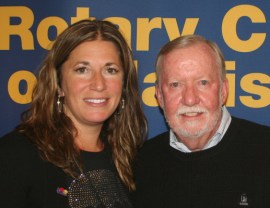
Club President-Elect Donna Hurd with Dr. Jeffrey Thoompson

Anyone who has spent any time in a hospital – as a patient, visitor, staff or volunteer – is aware of the high use of fossil fuels needed to heat, cool, light and operate equipment in these buildings. In fact, our November 30 speaker, Jeffrey Thompson, noted that a hospital is 2.5 times as energy-intensive as a hotel or other commercial building of the same size.

As CEO of Gundersen Health System in La Crosse from 2001 to 2015, Thompson led the organization through a rigorous and successful initiative to reduce its carbon footprint. They did it, he said, to advance their organizational mission to improve the health and well-being of Gundersen’s patients and communities. There were three objectives behind the effort: 1) to boost the health of the local population; 2) lower the overall cost of care; and 3) improve the experience of care at Gundersen.  A goal from the beginning was to accomplish this without passing the costs on to patients.

Emissions from the fossil fuels burned to power hospitals and clinics cause a myriad of public health problems, including cancers, liver and kidney disease, reproductive issues, respiratory disorders, cardiovascular disease and strokes. In addition, hospitals produce hazardous wastes, including pharmaceuticals, which pollute our waters.

With 7,600 employees, 61 clinics and six hospitals, Gundersen now is internationally recognized for its energy conservation and innovation. It operates the only energy-independent hospital in the world.

Thompson stressed that not only was the initiative the right thing to do, but it has been financially successful as well. To fund the initiative Gundersen diverted five percent of the assets it otherwise would have invested in stocks and bonds. The project led to significant savings and an impressive return on this investment.

Gundersen has increased its recycling rate to 40 percent, compared to a national average of less than 10 percent. They have cut cafeteria food waste by 80 percent, preventing approximately 18 tons of food from going to the landfill each year. They have established a donation program for leftover food that provided more than 6,000 meals in 2014. They have reduced hazardous pharmaceutical waste 17-fold.

Conservation should be our first fuel, said Thompson. It is the best place to start and offers the best returns. The Gundersen team looked for conservation opportunities in every aspect of their operations. The hospitals and clinics now are 53 percent more efficient than in 2008.

Gundersen has launched a biomass boiler, a geothermal field, and landfill and dairy biogas operations. They have installed solar hot water and wind power. Working with county government, they now heat and cool one campus completely with biogas from a landfill.  Thompson said this project had a three- to four-year return on investment for the county, and a seven- to eight-year return for the health system.

Gundersen’s investment in the energy infrastructure project had a 10-12 percent return on investment in the same period that its investments in Treasury bills, stocks and bonds returned 5.8 percent.

Thompson has been invited to the White House, the Paris climate talks and Beijing to talk about energy conservation. But he said there is much we can do to conserve energy without even waiting for government to act. The Gundersen project, he said, can be scaled down to the personal level or expanded across different industries. He encouraged people to do more to conserve energy in their personal lives. He also noted that if healthcare, schools and the business community acted together, they could vastly improve the well-being of most of our population.

Did you miss our meeting this week?  Watch the video


The First Folio!: The Book that Gave us Shakespeare

–submitted by Ellie Schatz; photos by Valerie Johnson

dsc00571The First Folio!: The Book that Gave us Shakespeare is on exhibit at the Chazen Museum until December 11. On Wednesday afternoon, Nov. 9, nearly 40 Rotarians of the Special Events Fellowship Group and their guests enjoyed a foray into the life of Shakespeare and the preservation of his works, followed by a social hour at the University Club.

Folio is a term for a big book, usually reserved for royal, religious or reference materials. The Shakespeare folio was published in 1623, 7 years after Shakespeare’s death, the first folio in England devoted to plays. This complicated project, containing more than 900 pages, was put together by 2 of Shakespeare’s friends and acting colleagues. Of 233 copies remaining of the 750 that are estimated to have been printed, the one here is on loan from the Folger Shakespeare Library in Washington D.C., carefully encased under glass and open to the Hamlet soliloquy, “To be or not to be.”

dsc00576   dsc00574  dsc00577

The First Folio contains 36 plays, printed one right after another; The Tempest is the first. Eighteen of the plays had not appeared in print before the First Folio was printed. So we would not have Macbeth, Julius Caesar, The Tempest, Twelfth Night, Measure for Measure, The Winter’s Tale, Antony and Cleopatra, As You Like it, The Comedy of Errors, The Taming of the Shrew, Coriolanus, Cymbeline, and several other plays were it not for this book.

Because of the way in which the First Folios were printed and have been handled over the ages, no two First Folios are alike. A finished First Folio in a calfskin binding cost about £1 in 1623, which today roughly equals between $150-$200. In 2001, a First Folio sold at Christies for just over $6.1 million. The most recent sale was in 2006, when a First Folio sold at Sotheby’s for $5.2 million.

dsc00591

It is presumed that each play was first written down by Shakespeare in his own hand. This handwritten manuscript was most likely written largely in what was known as “secretary hand,” a small script that is hard for us to read today. The author’s manuscript was sent to a scribe or scrivener who copied it over, making what was called a fair copy, a more readable version. Usually, what went to the printing house was the fair copy of a play. There, a typesetter or compositor would read the copy and get to work. Since no copies of the plays have been found written in Shakespeare’s handwriting, the First Folio is the closest thing we have to the plays as Shakespeare wrote them.

dsc00578 dsc00587  dsc00589

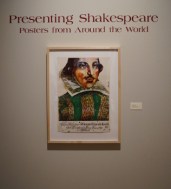
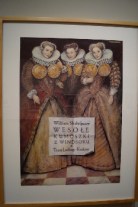
The exhibition also includes 6 panels adorning the walls of the room with general information on the folios and Shakespeare, as well as rooms with posters that have promoted admission to theaters featuring his plays around the world.


Stories Abound From the Grave

–submitted by Moses Altsech; photo by Jeff Burkhart

mccann-dennis-10-26-16

Dennis McCann pictured here with Club President Michelle McGrath

Whatever you thought you’d do after retirement, chances are it didn’t involve looking up graves. And yet that’s exactly what Dennis McCann did after leaving the Milwaukee State Journal. The stories he told us were not of ghosts, but rather of fascinating historical events—like the Peshtigo Fire or the Bayfield Flood—that he got to know more intimately by visiting cemeteries.

More importantly, through his cemetery visits, McCann got to know the people buried there—sometimes ordinary and sometimes extraordinary: Their story is sometimes captured by unique gravestone inscriptions (“In 1958 a contest was held to find the meanest woman in the world. Alas, I married both the winner and the runner-up… But if either are buried in this lot beside me there is going to be a resurrection”) and sometimes left unsaid—as in the case of John Heisman, whose tombstone doesn’t mention his Heisman Trophy fame.

Here in Madison we have the graves of 140 confederate prisoners of war held at Camp Randall, alongside the grave of the woman who once took care of their gravestones.

“Cemeteries are full of stories,” said McCann, obviously relishing the quest for discovering and telling those truly captivating stories.  In one instance, McCann interviewed a grave digger who took great pride in taking care of his cemetery much like he kept his yard at home.  “You got to be a cemetery man,” the man told him. “You got to be dedicated.” In Dennis McCann’s case, it takes one to know one.

If you missed our meeting this week, you can watch the video here.

For the Love of Nature

–submitted by Andrea Kaminski; photos by Karl Gutknecht

aldo-leopold-3

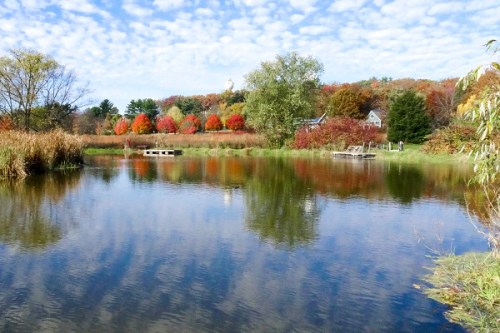
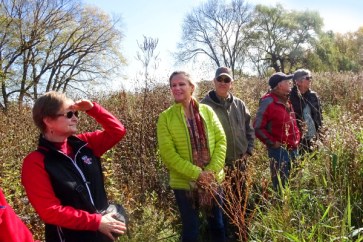
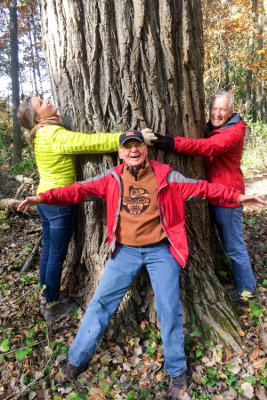
Many things brought a group of 10 Rotarians and guests to the Aldo Leopold Nature Center on Saturday, October 22. Did you know Debbie Gilpin is on the Nature Center’s board? Frank Stein quipped that only one tree grows in Brooklyn, where he grew up, and therefore he loves being among the trees in Wisconsin. Herman Baumann grew up not far from Brooklyn in New Jersey, and he became an outdoorsman and conservation writer after he moved here. Jeff Tews served on the Rotary Community Grants Committee when it made a grant to support the Center’s Campfire Fund, making it possible for 5 out of 14 economically-challenged children to attend summer camps at the Center this year. The rest of us simply were inspired by the opportunity to take a walk in this natural gem in an urban area on a beautiful fall day.

aldo-leopold-5aldo-leopold-4
Karl Gutknecht organized the outing and arranged for a guided tour of the property by Kelley Van Egeren, Director of Development and Stewardship. Kelley claimed to have the best job in the world, and she’s had it for 15 years. She loves the Center’s mission to connect kids, and all visitors, to nature.

aldo-leopold-6

Aldo Leopold Nature Center offers 21 acres of oak savanna, wetlands, prairies and woodlands, and it serves more than 20,000 kids per year. On our walk we encountered a group of Eagle Scouts engaged in a work project. They had obtained donated materials and were working to seat and build new workbenches near the pond. Several Brownies were busy identifying pond critters at a similar workbench nearby.

aldo-leopold-1

We finished our tour at a replica of Aldo Leopold’s home. Kelley explained that Leopold and his wife used a suspended, old-fashioned snow fence – the kind with wooden slats – as a bed for their five children. I wish I’d known about that 35 years ago. We could have saved a bundle on bedding for our kids!

aldo-leopold-7

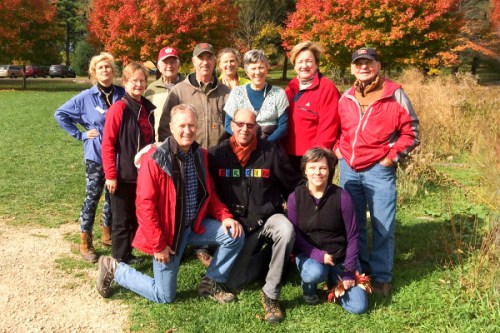
Hiking Fellowship  Downtown Rotarians and guests (front kneeling from left) Jeff Tews, Karl Gutknecht, and Deb Gilpin.  (Standing from left) Kelley Van Egeren, Aldo Leopold Nature Center; Leslie Overton, Dean Nelson, Herman Baumann, Susan Rather, Andrea Kaminski, Kay Schwichtenberg, and Frank Stein.