Tag Archives: Rotary Club of Madison Guest Speaker

Henry Vilas Zoo – Something for Everyone

–submitted by Kevin Hoffman; photo by Mike Engelberger
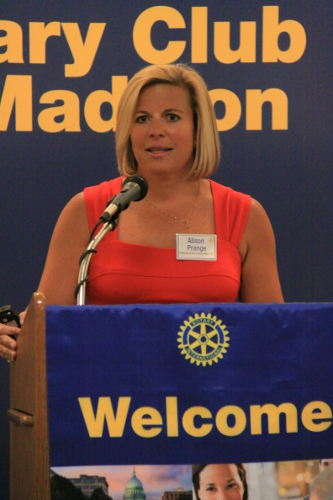
Alison PrangeFellow Downtown Rotary member Alison Prange, Executive Director of the Friends of Henry Vilas Zoo since 2013, gave an energetic and passionate presentation on June 17 about the Zoo and its many programs, and the Zoo Travel Program that went to Tanzania in 2014.

The Zoo was founded in 1911 after a land grant was made by the Vilas family with the stipulation that the zoo charge no admission fee.  It remains a free zoo today – one of 10 in the country that is accredited by the AZA.  In 2014 it had over 725,000 guests that came from Dane County and all the surrounding states making it one of the top attractions in the area.

She hastened to point out that although the Zoo is free it is not free to operate and has a budget of $2,600,000.  There are three main sources of support:  Dane County provides $1,400,000, the City of Madison provides $350,000, and the Friends of Henry Vilas Zoo raise $850,000 through on-grounds revenue such as food and gift shop sales, special events, education programs, memberships, and fund raising.

On Memorial Day weekend the new Arctic Passage exhibit opened with over 3,600 visitors.  The exhibit is the new home for polar bears, grizzly bears, and harbor seals and features underwater viewing for an interactive and engaging experience for both humans and animals.  It also features the Glacier Grill with a dining area that looks onto the polar bear exhibit.

Alison reminded us of upcoming events that help support the Zoo.  On July 17 is a concert featuring the Wisconsin Chamber Orchestra, the 10th annual Zoo Run Run 5k and 10k race, and Halloween at the Zoo – a fun and safe way to spend Halloween with the kids.

The Zoo Travel Program in 2014 was a safari to Tanzania to learn about and understand wildlife in its natural habitat.  The goal of this program is to learn about animal conservation efforts and needs, instead of acquisition.  The travel group was immersed in the habitat of wild animals and were required to be in a vehicle or escorted by trained guides when moving around at night!

The group visited Tarangire National Park, Lake Manyara, Ngorongoro Crater, the Masai tribe, Olduvai Gorge, and the Serengeti.  They saw (among many other animals) elephant, ostrich, giraffe, lions (including witnessing a group of female lions hunt zebra), flamingo, hippopotamus, wildebeest, cheetah, leopard, and the rare black rhinoceros (only 14 left).  It was the experience of a lifetime!

The next program, Great Wildebeest Migration in Tanzania, is scheduled for February 2016.
We Succeed: Latinos in Dane County

–submitted by Ellie Schatz; photo by Mike Engelberger

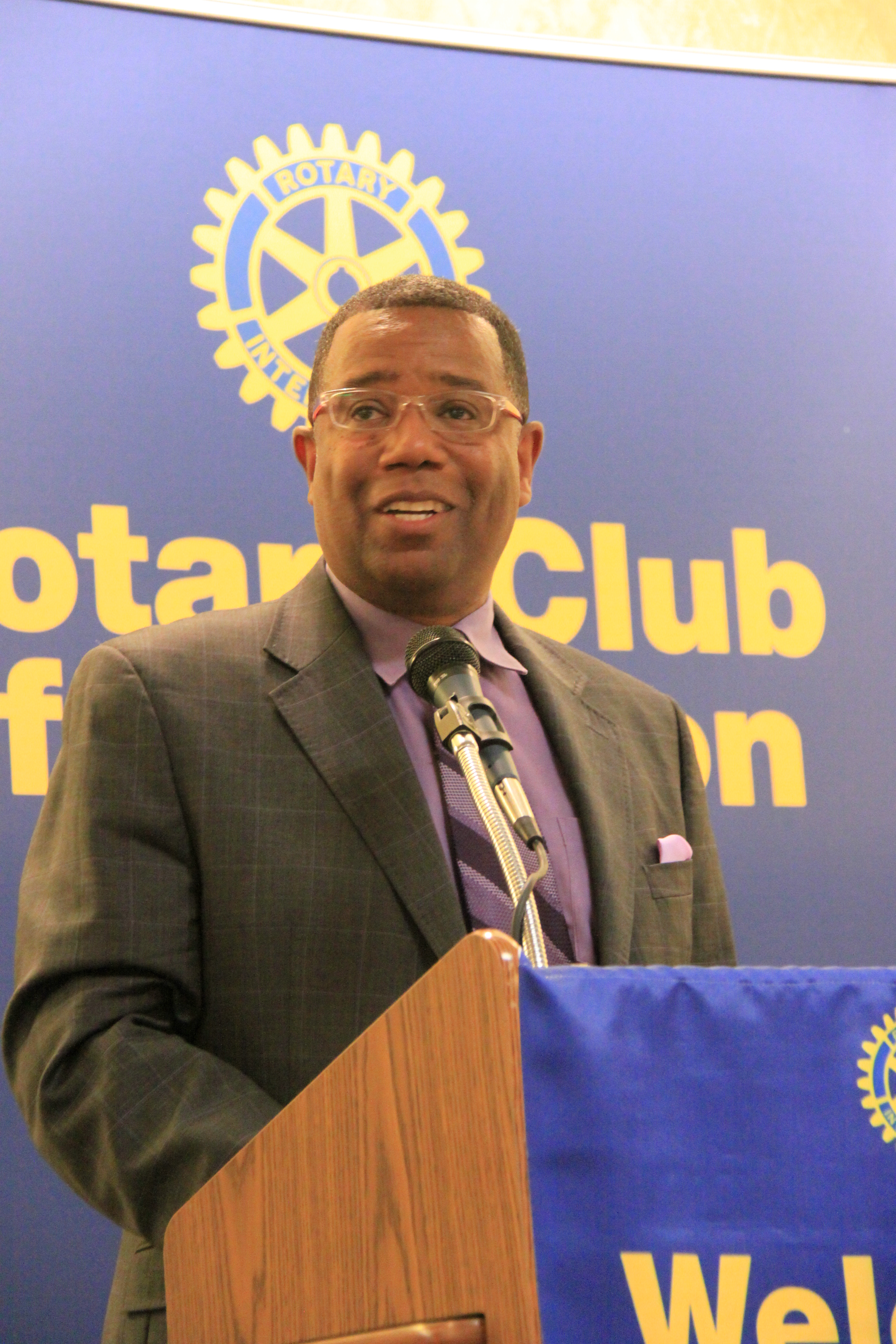
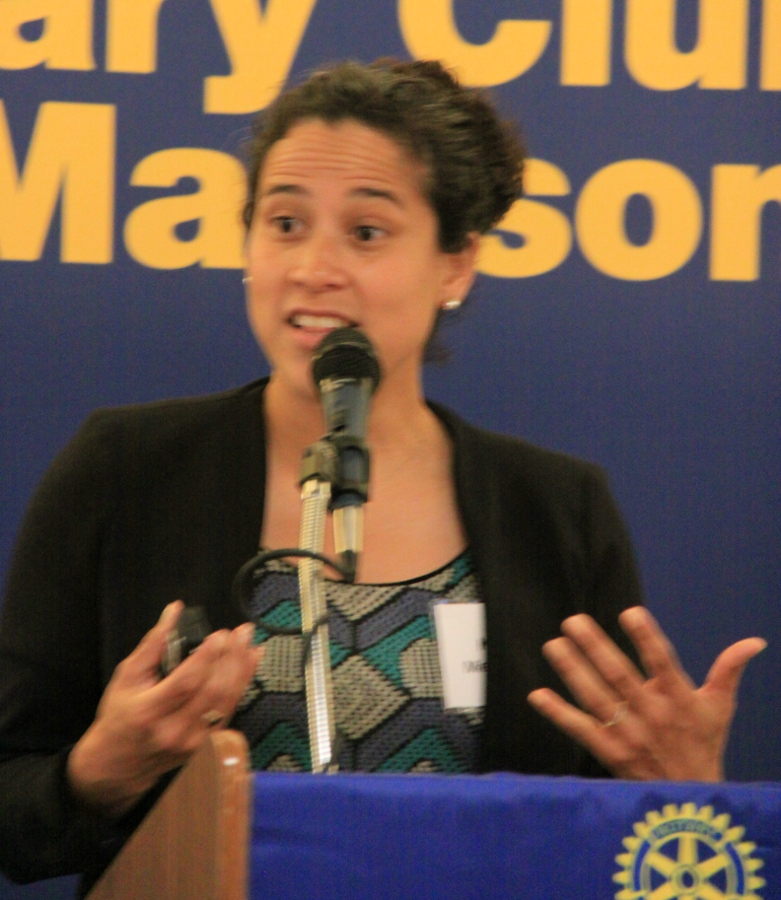
Coller KarenKaren Menendez Coller, Executive Director of Centro Hispano, began her passionate and substantive discourse by reminding us that Latinos in Dane County are a) a growing community, b) here to stay, and c) a presence.

Statistics show that Latino numbers in our community are great. An 80% growth in population in 5 years, 2010-2015, puts their current buying power at $1.5 trillion. There is a 5:3 ratio of men to women as migrant work brings men to the area. Yet, all the charts and statistics, including those documenting low incomes, poor education rates, and housing problems show us nothing about who Latinos are as fellow community members. Most of us, she says, know little about how they are hardworking, take care of their own, and live by strong family values.

Karen emphasized three key ingredients for equity. First is Stability in the Home. Chaos, unemployment, and chronic stresses work against such stability. Many have lost their social network and cope through addiction. Quality support services are critical, but the fact that a single staff member at Centro Hispano now sees 400 cases per year demonstrates the need for change. An example of one new program that provides a pipeline for job placement and career advancement is Caminos Certified Nursing Assistant Program, a collaborative effort between Centro Hispano and Madison College. Of 70 students enrolled since January 2015, 73% graduated and 82% are employed. Their incomes rose from as low as $7.25 per hour to as high as $20 per hour. 79% of the students went from unemployed or part-time employed to full-time positions.

The second ingredient is Youth Aspirations. Karen says that 31% of the Latino population in the county are under age 18, most of them living with the heavy issues of alcohol, drugs, and risk of pregnancy. The answer is to foster hope and meaning, and the way to do this is to engage the students in school. Centro is using a technique called asset mapping to help youth create a pipeline to graduation. Mentors in the community help student see themselves as well as their peers as assets in the community. Centro Hispano provides a base where each young person can feel safe as he or she engages in fun and meaningful activities.

The third ingredient is the Neighborhood Environment. Outreach, including wellness activities and food equity opportunities, smooths the way toward the end goal:  A Thriving Community. Reframing Latino Community Solutions means full inclusion: a community that tells us what they want and becomes engaged in getting there. Solutions include having a community development perspective, using a strategic perspective, and knowing who drives the agenda: the families themselves.

May We Succeed. Here’s to Karen’s call for innovation and engagement NOW.

Gee Shares a Tale of Two Cities

–submitted by Valerie Johnson; photo by Mike Engelberger

Alex GeeFollowing a song with the line “greater things are still to be done in this city” sung by a group from his church’s choir, The Rev. Dr. Alexander Gee, Jr. told Rotarians Madison is often accused of being a tale of two cities: the best place for some and the worst for others.

For the past fifteen months, Gee and members of the Justified Anger Leadership Team convened countless meetings with hundreds of African American Madisonians. They asked what the African American community thinks about racial disparity in Dane County and what suggestions they would make to address the disparity. Five focus areas were identified: education, economic development, incarceration, leadership and capacity development, and family and community wellness.

A framework document was developed, and community leaders were asked to sign up for workgroups in the five focus areas.  The next phase will be for African-American leaders to sit with community stakeholders to find common measurables, stand together and then carry out plans for these focus areas.  “This is an opportunity to stand on the same side,“ Gee said.

The group also plans to raise $1.5 million by January of 2016 to hire staff.  Gee says they will not create programs but rather they will advocate for equity, train for diversity and build capacity for change.

“Designing this document was historical,” Gee said, “Implementing it will be magical.”

In addition to his ministerial, consulting and academic activities, Gee is a co-author (Jesus & The Hip Hop Prophets, InterVarsity Press 2003) and author (When God Lets You Down, InterVarsity Press 2006). He received his Doctoral Degree in Transformational Leadership for Global Cities at Bakke Graduate University (BGU), in Seattle, Washington in June 2009.

The 50-page report is available by clicking: www.MobilizeMadison.com.

We would like to thank the Fountain of Life Covenant Church Choir members who sang the opening song at our Rotary meeting on June 3: Becca May Grant, Alicia Cooper, Lena Archer and Cynthia Woodland.

Memorial Day Remembrances

–submitted by Stan Inhorn; photo by John Bonsett-Veal

From left: Jason Beren, Jorge Hidalgo, Andrea Hidalgo and Moses Altsech

From left: Jason Beren, Jorge Hidalgo, Andrea Hidalgo and Moses Altsech

New Rotary member Jorge Hidalgo recounted the history and significance of Memorial Day in very personal terms. After the Civil War, in which there was a tremendous loss of lives, Decoration Day was established as a time to decorate the graves. In 1902, the name was changed to Memorial Day, a day to recognize soldiers who died in all wars. Memorial Day became a Federal holiday in 1967, and in 1968, the date was established as the last Monday in May. A special flag ceremony is prescribed in which the flag is raised to the top, then lowered to half-mast. In the afternoon, it is raised again. Starting with World War I and to the present, 617,448 American lives have been lost. Since 3/11/2001 in the global War on Terrorism, 6,845 lives have been lost.

Jorge is a graduate of West Point, and his three sons also pursued military careers. He described in personal terms the heartache sustained by those who lose a son in war. First he told of Richard Warner, a close friend of his son Jared from the Milwaukee area. Rich was in a Marine regiment serving in the so-called Triangle of Death in Iraq. He wrote to Daren about the wonderful children he met in Iraq. At age 22, he was killed by an Improvised Explosive Device. A video of his life from childhood to adulthood and then to his memorial service ended with a statement that it is an honor to have lived for others, not for one’s self.

Daren, born on 3/4/86, was an honor student and a wrestler in high school in Waukesha. After graduating from West Point, he took an additional year of training in Ranger school. He also went to Airborne school, and was trained to be a combat lifesaver and a hand-to-hand combat instructor. In 2010 his platoon went to Afghanistan. Before he went, his father asked him what his legacy should be if he were killed. His answer was to support soldiers who return as well as their families. Daren was injured when another soldier tripped a wire to an IED. His injury required antibiotics and treatment in Germany. He returned to Afghanistan, and during passage through a choke point, another IED took his life.

To honor Daren, the Hidalgo family has established a scholarship for a needy wrestler to attend college. Furthermore, the family has promoted the hiring of veterans and their families. They support various charities such as the Fisher House of Wisconsin that will provide housing for families of veterans in the Milwaukee Veterans Hospital. Rotary members were deeply moved by this personal tribute to two of our military who made the supreme sacrifice.

I Didn’t Know There Were Latinos in Wisconsin

–submitted by Bob Dinndorf; photo by John Bonsett-Veal

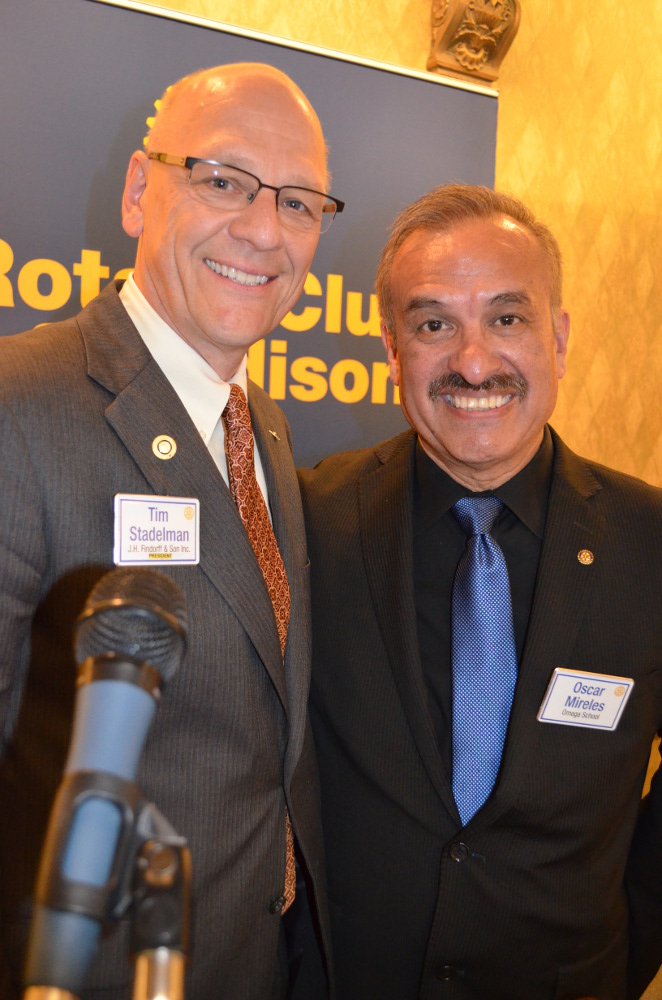
DSC_0023Club member Oscar Mireles provided an engaging and personal presentation after a book he has compiled titled “I Didn’t Know There Were Latinos in Wisconsin.” Oscar talked about his family and reflected on the deep cultural shifts away from and then back to his native Spanish language. His presentation illustrated the Rotary Four Way Test through reading of his original poetry. The room was perfectly quiet as he read. At one point Oscar broke the spell by complimenting the Club’s high quality listening skills.

The Four Way Test and poem titles included: “Lost and Found Language, History Lesson, Why Did you Name Me Javier Dad? and My Mother is a Social Worker.”

The four Mireles children are acknowledged as Oscar’s primary life influencers. They were portrayed onscreen in two colorful summertime slides joyously waving while on a boat ride. Life according to Oscar, is good indeed.

Oscar’s presentation was preceded by a shout out from his longtime table mate, Charles Tubbs. After acknowledging the importance of Charles’s friendship developed over the course of 200+ Rotary meetings, Oscar announced he is ready to expand his Rotary acquaintanceship through sitting at every Rotary table by year end.

Discussion on Updates to Madison’s Beltline

–submitted by Mary Helen Becker; photo by Loretta Himmelsbach

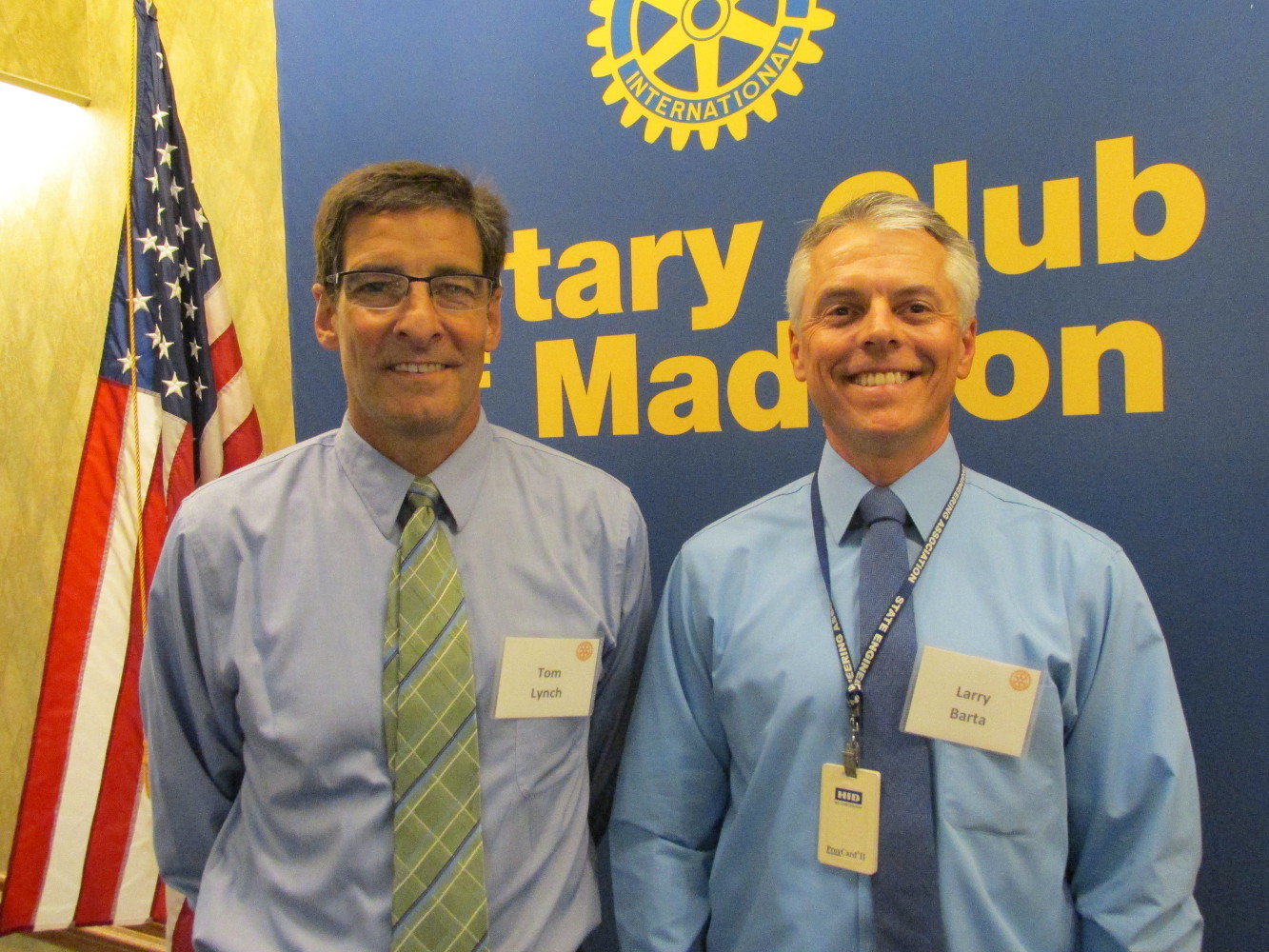
Barta Lynch 4 29 15

Two experts explained the planning and strategy for beltline improvements and changes on April 29. The first to speak, Larry Barta, has worked with the Wisconsin Department of Transportation for 31 years. He has managed improvement projects and corridor studies in all District One counties, including managing the expansion and relocation of 38 miles of I-39 from Dickeyville to Dodgeville. He began by noting that the most efficient traffic plan is the grid. In Madison, because of the lakes, we have a wheel, with heavy traffic on the “spokes” of that wheel. The beltline, which is under major reconstruction at this time, is very important and has several problems that need attention, including too many crashes, bottlenecks, and its age — it is simply too old. Half of the traffic exits are just 4 interchanges. New corridors on the northside of the city, including the North Mendota Parkway and a Waunakee corridor are important. Each day the Verona Road section handles 125,000 vehicles a day. An alternate route between Verona Road and I-90, south of the city, has been suggested, but the cost and impact make it impractical method of removing traffic. Alternate modes of transportation including bus rapid transit, express routes and commuter rail are being considered. Commuter rail through the isthmus and out University Avenue could remove some traffic from the Beltline. The DOT is working with Madison Metro, a separate entity, to plan improvements.

The second speaker, Tom Lynch, has been with Strand Associates for 23 years. He focuses on major corridor studies and environmental impact studies. He discussed “scenario” planning and explained “Madison in Motion” and the Sustainable Transportation Master Plan, including current plans and trends. Bus rapid transit and beltline bus riders could reduce beltline volume. Studying how people travel is important. Increasing use of public transit and bike use could be significant on the isthmus, but less so on the beltline.  The issue is important to all citizens and is being studied and addressed.