Tag Archives: Rotary Club of Madison Guest Speaker

Have the Conversation and Do It Now…

–submitted by Linda Baldwin; photograph by Loretta Himmelsbach

IMG_0265

Jim Jaeger and Sandra Nuernberg urged all Rotarians and guests to begin the process of planning for future medical care.  Jaeger and Nuernberg represent the Association of Spiritual Caregivers working with Meriter Foundation and the Gundersen Medical Foundation in La Crosse.

All of us have likely thought about end of life care; some of us have created a living will or other advance care document.  But how many of us have had the “conversation” with our family, friends and agents about end of life care?   60% of people say that making sure their family is not burdened by tough decisions is extremely important, but 56% have not communicated their end of life wishes.

Jaeger and Nuernberg showed a video about a couple who were having the conversation.   Benefits include peace of mind, putting your family at ease about what decisions to make for you when you are unable, having an agent to represent you who is willing and capable of advocating your wishes on your behalf.  And knowing what you want done at end of life will potentially save money and extend life by taking the pressure off.

Jaeger noted that Advance Care Planning is a process, beginning with you and others understanding that decisions will need to be made in the likely event you will not be able to do so.  Next you need to reflect on what you do want to happen, then have a discussion with loved ones, medical advisers and agents about your wishes.   Those choices will be written down and then this should be part of your medical record.

Also, plan to review this document over time as your situation may change and you may want to alter your plans.  There are resources and organizations to help you have “the conversation”.   For an information booklet answering commonly asked questions about advance care planning, contact Gundersen Health System,
La Crosse, WI 800-362-9567, ext. 56748.

Next in Madison: StartingBlock Madison

–submitted by Larry Larrabee; photography by Loretta Himmelsbach

Austin Reed Wolter

George Austin (center), Madison’s former Planning and Development director and President of AVA Civic Enterprises Inc., provided the introduction about what StartingBlock Madison is planning to do to encourage, develop and grow entrepreneurs by bringing them into an entrepreneur hub that will place them in contact with peers, mentors, investors and consultants.

The building will be located in the 800 block of East Washington Avenue and American Family Insurance is funding the construction of the first 50,000 sq. ft. phase of a 160,000 sq. ft. building.

Founded in 2012, StartingBlock Madison is dedicated to encouraging entrepreneurs, growing Madison’s economy and providing educational opportunities regarding entrepreneurism.  It will be able to do this because of the strong support of MG&E Energy and American Family Insurance.

Dan Reed (left), Managing Director of American Family Ventures, spoke about his company’s investments in new technology companies in areas like automobile safety through their Direct Venture Capital program.  Their support of StartingBlock Madison is an extension of this concept.

Gary Wolter (right), Chairman & CEO of MGE Energy Inc., sees StartingBlock Madison as expanding the Madison entrepreneurship environment and helping to grow the economy.  He explained the stretch goal as “how can I change the world?” and sited those Madison entrepreneurs that have done that such as Jamie Thompson’s Cellular Dynamics, Pleasant Rowland’s American Girl and Judy Faulkner’s Epic.

The positive response to the three presenters and the concept of StartingBlock Madison that represents the combined efforts of corporate, educational, and civic entities including the City of Madison suggests StartingBlock and the entrepreneurs it cultivates are sure to be successful.

We would like to thank Madison City Channel for videotaping our meeting this week.  The program will be rebroadcast on analog basic channel 98, digital channel 994 & AT&T U-verse 99 as follows: Friday, April 17 at 8 PM; Wednesday, April 22 at Noon; Friday April 24 at 5 PM; Sunday, April 26 at 5 PM.  You can also watch this program on the WEB.

Autism Research and Treatment in Wisconsin

–submitted by Carol Toussaint; photo by Loretta Himmelsbach

Graupner Sallows 4 8 2015What is autism and why do we read and hear so much more about it today than even a few years ago?  Drs. Glen Sallows and Tamlynn Graupner addressed that question for the Rotary audience Wednesday, April 8.  They  explained that research such as they are engaged in has added to the understanding of the causes and interventions which means even mild cases are now included in the statistics.

Speaking in tandem, raising questions and responding to the symptoms that trigger parents, teachers and physicians to look for autism (ASD), the speakers noted that “everyone looks for it now” so, of course, it is more  prevalent.  Not that long ago it was thought that between two to five of every 10,000 patients were diagnosed with ASD.  Fewer people were looking for it because no one thought there was a treatment.  Now it is estimated that there are 1 in 108 people in Wisconsin with ASD and reporting is more accurate  because of both research and improved methods of record-keeping.

The news that autism, characterized by symptoms of delayed social language, delayed social interaction and repetitive/unusual interests, can be diagnosed at 12 months or even younger is the key to successful treatment.  That about half of treated children improve to the average range, understanding language, improve on behavior and self care, and most will speak, is positive news.

Dr. Sallows is cofounder and President of the Wisconsin Early Autism Project (WEAP) and has been working in the field of autism for over 25 years.  Dr. Graupner is cofounder  and CEO of WEAP and her research through the UW Waisman Center involves studying the brain bases of the symptoms of autism.  Both are dedicated to continuing to find new ways of addressing autism.  If that results in reporting a higher incidence of ASD, it does not mean an epidemic.  It will mean more attention to and perhaps improved means of intervention at a younger age.

Wisconsin is Open for Business

–submitted by Bob Dinndorf; photo by John Bonsett-Veal

KleefischLieutenant Governor Rebecca Kleefisch discussed our State government’s commitment to making Wisconsin a great place for employers, entrepreneurs, small businesses and workers through tax relief and especially job training.

The Lt. Governor is a former small business owner and news reporter. Widely credited for coining the phrase, “Wisconsin is Open for Business,” LG Kleefisch has played a key role from day one in business growth and retention in Wisconsin.

As Wisconsin’s “Jobs Ambassador” and leader of the Governor’s Small Business Summits and Tax Reform Roundtables, Lt. Gov. Kleefisch touched on a range of topics that could be characterized as “overcoming adversity.” She opened with her personal story about how she staged her run for the Lieutenant Governor’s seat. Rejected by her own party as a candidate, she ran in the 2010 primary against three opponents. At that same time, she was diagnosed with colon cancer. Still hospitalized on Election Day, she was released to vote on the condition that she return for continuing treatment. She did and won on two fronts: the election by 21 percentage points and successful treatment of her cancer.

In terms of overcoming economic adversity, the Lt. Gov. quoted a Wall Street Journal headline: “Uncertainty is the enemy of recovery” as a means of characterizing the Wisconsin approach to economic recovery. She stated “we’ve given families and businesses certainty” and cited several measures illustrating that result in Wisconsin unemployment at 4.8%; 156,000 people have gone back to work and that local property taxes have been lowered.

A continuing issue is the skills gap in Wisconsin that prevents many jobs from being filled. She asked Rotarians to check out the website http://www.jobcenterofwisconsin.com which displays 84,915 jobs are unfilled in Wisconsin at the time of the Rotary meeting (the number had increased to 85,206 less than an hour following our Club’s meeting as this summary was being written). The site will be enhanced soon to add even more job postings aggregated from other sites. As part of the solution, she said “Wisconsin has a fantastic technical college system.” Ultimately, the goal is about fulfilling our State motto: Forward!

Bradley vs Daley

–submitted by Mark Stover;  photo by Mike Engelberger 

Bradley AW  Daley J

On April 7, Wisconsin will do what it has been doing since 1848: hold an election where the people of the state choose who will sit on the State Supreme Court.  This election is between James Daley of Janesville and Justice Ann Walsh Bradley of Wausau.  Justice Bradley is the incumbent and has been on the Supreme Court for 20 years.  Judge Daley, the challenger, has been a judge for 26 years.  Both are natives of Wisconsin.

Through a series of opening statements, structured questions, and closing statements, Rotary Club members got a chance to understand more about the positions of each of the candidates.  When asked what qualities distinguish each candidate, Judge Daley mentioned he was a Vietnam-era veteran.  He retired as a Brigadier General from the Wisconsin National Guard.  He helped start the first veterans’ court in the state.

Justice Bradley pointed to her dedication to protecting a fair and impartial judiciary.  She noted her concern that out of state money funding media supporting one candidate over another introduces a dangerous potential for questioning impartiality of the judiciary.  Justice Bradley suggested that what is needed most in a judge these days is the courage to act independently.

The candidates agreed with each other that transparency of process in the Court’s administrative hearings should increase making those hearings more open to the public.  They also opposed the idea of appointing Supreme Court Justices, each agreeing that the election process was the better route.  Justice Bradley believes the election system should continue to be improved to be the best it can be.  Judge Daley argued that elections should extend to the election of the Chief Justice by the other Justices.

In closing, Judge Daley said he was running because he was unhappy with the decisions made by Justice Bradley over the last 20 years.  He cited cases that he said put roadblocks in the way of law enforcement and made it harder to do business in the State of Wisconsin.  Justice Bradley argued that Chiefs of Police, Sheriffs, and District Attorneys support her because of her work in support of law enforcement.  She again raised her concerns about the apparently increasing partisanship on the Supreme Court and the effect it has on the perception of fairness and independence of the state’s highest court.

In the end, you and your friends, family and professional colleagues will have the final say – as Wisconsinites have been voicing since the state’s founding.  Please vote on April 7.

Climbing for Hospice – Putting One Foot in Front of the Other

–submitted by Andrea Kaminski; photo credit to Loretta Himmelsbach

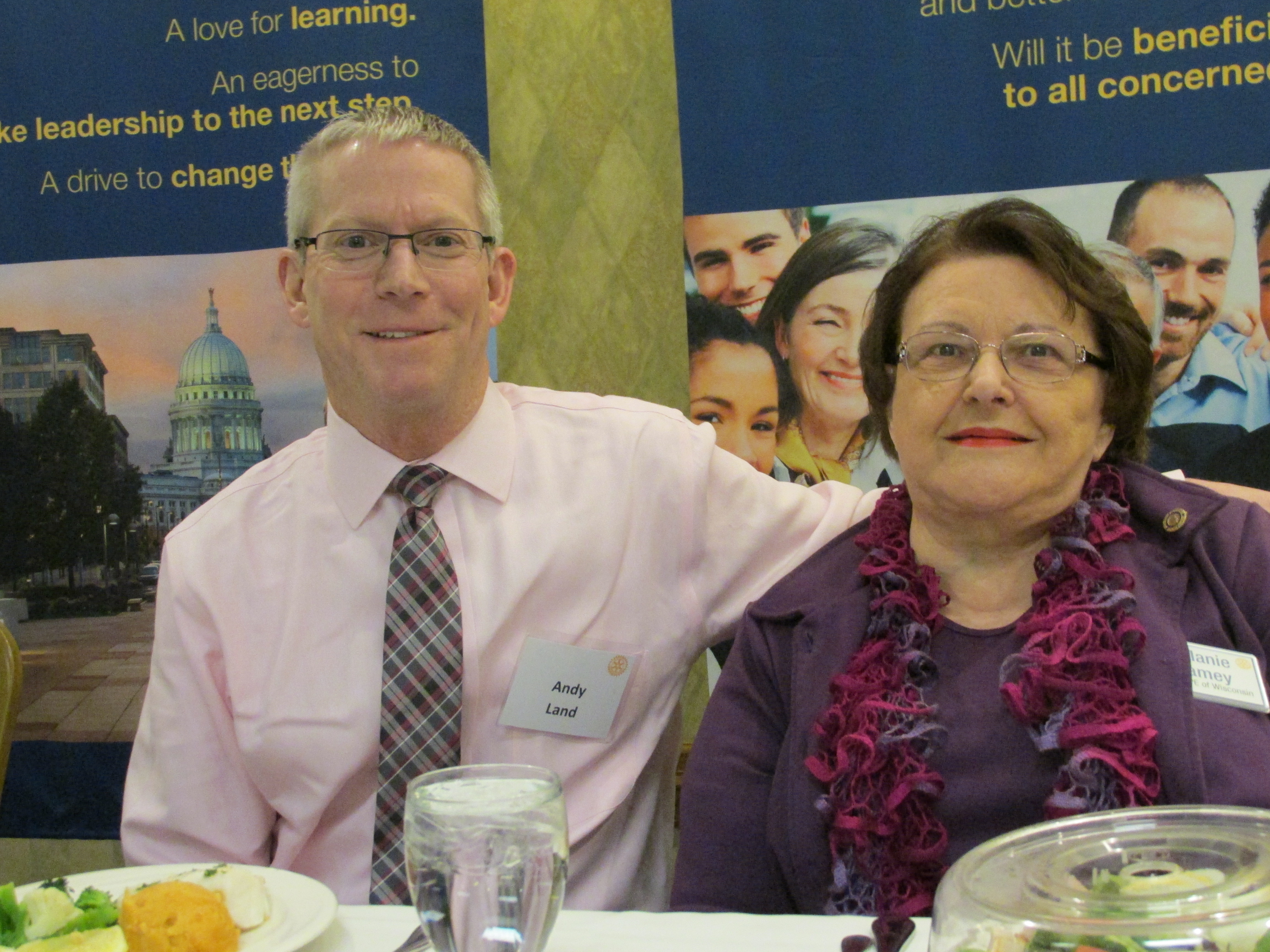
Andy Land and Melanie Ramey

Andy Land and Melanie Ramey

Mountain climbing and hospice are the passions that drive Andrew Land, Director of Hospice and Palliative Care at Agnesian HealthCare in Fond du Lac. On February 18, he treated Rotarians to stunning shots of snow-covered mountain peaks and explained how his avocation and his professional mission are interwoven.

Land began climbing mountains in 1992 with a trek up Mount Rainier. He was working at a hospital in Chicago at the time and was inspired by an article he read. He made the climb with a group and a guide, but never got near the summit. It was so windy people were being blown off their feet.

Land caught the climbing “bug” and eventually took his kids with him on his climbs. It was on Mount McKinley in 2002 that climbing and hospice came together for him. This was a difficult, month-long expedition, and sometimes he wondered why he was there. However, he thought about a hospice patient named John who was excited about Land’s climb. John had told Land to “think of me” when the going got tough. Hospice patients have to keep putting one foot in front of the other, he said, and so do mountain climbers even when they think they cannot go another step.

A few years later, while climbing Mount Aconcagua in Argentina, Land had long discussions with others in his group who had lost family members. When they learned he was “a hospice person” they talked about their experiences and asked questions. What would they have liked to say to their loved ones before they died? And how could someone die so young?

This year, Land will climb Mount Everest funded by his brother Chris, who is two years older and very ill. Chris changed his life insurance policy in order to allow his younger brother to fulfill a dream. Chris only asked Andy to “use my story to help others.”

Having served two terms as President of the Board of HOPE of Wisconsin, Andy is working with Melanie Ramey to make his climb a fundraiser for hospice. For more information, visit: CLIMBING FOR HOSPICE.