Tag Archives: Rotary Club of Madison

Coach Chryst Motivates UW Football Players

–submitted by Ben Hebebrand; photo by Mike Engelberger

Coach Chryst 6 7 2017

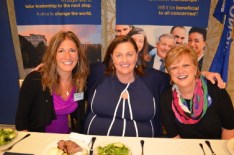
From left: Club President MichelleMcGrath; Coach Paul Chryst and Rotarian Mary Ellen O’Brien

Wisconsin Badgers Head Football Coach Paul Chryst was quick not to engage in any speculation as to how the UW football team will fare this season, proclaiming coaching wisdoms such as “focus on the now, and not the then,” or “you play the next upcoming game and you focus on that game.” Stressing his one-game-at-a-time philosophy, he stated that “we have 12 games and we hope to have the opportunity to play more games.” In a matter-of fact-voice devoid of any hubris, he added there always is the possibility “that we have an opportunity to win every game.”

Chryst, who lettered as a quarterback from 1986 to 1988 as a football player at UW and served as offensive coordinator at UW from 2005 through 2011, told the Rotary Club of Madison at its June 7 meeting how “blessed” he is to have the job in Madison. “I always thought I was lucky to be coaching anywhere, but to do so here in Madison adds so many layers,” he said.

Chryst reminded his audience that his one-game-at-a-time philosophy was reaffirmed to him when pundits talked of “gloom and doom” last year in light of UW’s difficult schedule. “I just don’t know what is going to happen this year,” he said, adding that he and his staff and team started training the Tuesday after Memorial Day, “doing the little things to get ready. We are putting in a lot of time in the weight room.”

As concerns any specific lineup for next year, Chryst stressed that “we have a lot of players coming back,” hinting at the possibility that not many freshmen will see significant action. He singled out the long-snapper position as one that will be filled by a freshman. In addressing the team’s quarterback position, Chryst did not mince words in proclaiming Alex Hornibrook, who started last year 9 games as UW quarterback, as the preferred choice. “He has a chance to be really good,” he said, adding that developing one of two freshmen as back-up quarterback would be a priority.

In answering questions from Rotarians and visitors, Chryst addressed issues ranging from revenues generated by the football program to academic standards for athletes.

As regards revenues, Chryst was clear that the Big Ten network does dictate some decisions, including the decision to play the season opener on a Friday, a day traditionally reserved for high school football. “They don’t ask me about the schedule,” Chryst replied, further explaining that the Big Ten Network television deal most likely is the cause for scheduling peculiarities. Chryst, however, was very firm in letting the audience know that the “TV money goes to athletic departments at universities but not at UW,” inferring that the university system shares in the revenues being generated.

In addressing academic standards, Chryst claimed that “Wisconsin has a smaller recruitment pool because of academic standards,” He stressed the programs’ commitment to academics, singling out academic advisors, learning specialists and tutors working diligently with student-athletes. An outcome of this dedication is the program’s graduation rate. “We have been in the Top 5 in graduation rates in the last 5 years.”

Chryst closed his presentation in speaking about motivation – how he as coach might motivate student-athletes. As a coach, “I am motivated by my players,” and as regards to motivating players, Chryst adopted a no-nonsense attitude: “I am not sure about the rah-rah speeches. The real key is to ask a kid why ‘are you doing what you are doing…’”

Tolkien & Lewis: A Meaningful Conversation

–submitted by Linn Roth; photo by John Bonsett-Veal

Chip Duncan 5 31 2017

(Back row from left: David Hecht, Rotarian Bill White, Chip Duncan, Club President Michelle McGrath, Maxine Austin & Dennis Dresang; Front row from left: Kendra Benedict, Jeanette Yoder & Linda Baumann)

At today’s meeting, documentary filmmaker Chip Duncan gave us background information on his new film, “TOLKIEN & LEWIS – Myth, Imagination and the Quest for Meaning.”  Many members are familiar with some of Tolkien and Lewis’s works (e.g. The Lord of the Rings and The Chronicles of Narnia) from their childhoods, but at that period in our lives, we likely did not contemplate some of the profound topics raised in today’s talk.  In contrast, Duncan’s film seeks to explore broad religious and philosophical issues that have evolved through myth and ritual and that were of deep personal interest to both authors.

In the early twentieth century, Tolkien and Lewis were well-known Oxford academics and authors who were friends and members of a literary club called “The Inklings.”  In 1931, Tolkien invited Lewis and fellow Inkling Hugo Dyson to dinner, and an eight and one-half hour discussion followed that resulted in Lewis’s conversion to Christianity.  Key to this conversion was an examination of the powers of myth and ritual and how they can lead an individual to his/her belief in a “truth,” as manifested in a belief in a religious or philosophical system or lack thereof.  Of course, this is a deeply personal and unique exploration that everyone must make on their own, and this film suggests individuals use imagination as a necessary tool to make that journey.

“TOLKIEN & LEWIS – Myth, Imagination and the Quest for Meaning” will be shown nationally on the Public Broadcasting System (PBS) this fall.

On a personal note, my wife and I have visited an Oxford pub, “The Eagle and Child,” which started serving customers in 1650.  Tolkien, Lewis and The Inklings regularly met there, and referred to the pub as the “Bird and Baby.”

If you missed our meeting, you can watch the video here.

Annual Madison Rotary Foundation Scholarship Program

–photo credit to John Bonsett-Veal & Pete Christianson

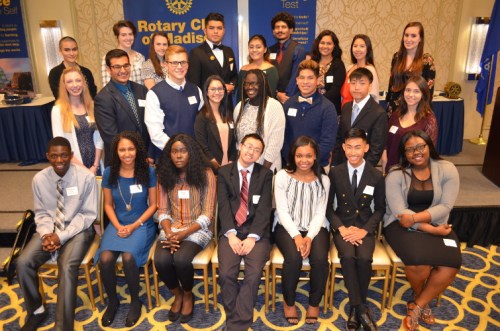
2017 ScholarsAAA

The Madison Rotary Foundation has awarded college scholarships totaling $312,000 to 26 graduates from Madison area high schools, and we honored the students, along with their guests, at our May 24 luncheon.

Students who received these scholarships are listed below by donor scholarship fund:

      Robert M. Bolz Scholar: Rahim Ansari
      Nathan F. Brand Scholar: Lydia Starkey
      Frederic Brandenberg Scholar: Evelyn Cuellar
      Harry French Scholars:  Matida Bojang, Paula Gonzalez, Daniel Obi & Alvin Xiong
      Dick Goldberg Scholar: Violeta Calderon
      Perry & Virginia Henderson Scholar: Terence Agee
      Louis Hirsig Scholar: Ivanna Sanchez-Vineuza
      Thomas Leonard Scholar: Wesley Proctor
      Irving & Dorothy Levy Family Scholars: Hawi Bedaso, Allison Bultman, Soulja
Gamble, Justin Lor, Sarah Matejka, Narik Riak, José Rodriguez, Ryia Steps & Liliana
Teniente
      Andrew McBeath Scholars: Kevin Leuaxay & Alfred Lopez-Daniel
      Regina Millner Scholar: Hannah Kwiatkowski
      Synergy Scholar: Symone Booker
      Worzala Family Scholar: Joshua Isenberger
      In addition, we award a two-year scholarship to a student to attend Madison
College. 
Luis Aleman is the 2017 Wilson Scholar.

Our Madison Rotary Foundation Scholarship Committee annually selects students from participating high schools.  The chosen applicants are students with high academic standing and with character and leadership ability who have made contributions to their schools and communities and have financial need.

This year’s group of scholars had the benefit of hearing from a past recipient, Leen Bnyat, a 2013 Levy Famly Scholar who graduated from UW-Madison earlier this month with a degree in Gender & Women’s Studies and certificates in African Studies and Global Health.

We appreciate the efforts of our photographers John Bonsett-Veal and Pete Christianson who provided us with individual and group photos of this year’s recipients.

We sincerely appreciate the donors who have made scholarships possible thorugh the following named funds:  Robert M. Bolz, Nathan F. Brand, Frederic S. Brandenburg, Harry L. French, Dick Goldberg, Perry & Virginia Henderson, Louis Hirsig, Thomas Leonard, Irving & Dorothy Levy Family, Andrew A. McBeath, Regina M. Millner, Mike & Patty Wilson and the Worzala Family – thank you!  We also have our Madison Rotary Foundation Synergy Fund in which anyone can contribute any amount to to help us fund future scholarships.

Our thanks to this year’s Scholarship Committee for the many hours spent on reviewing applications, interviewing students and developing recommendations for this year’s award recipients:  Scott Haumersen, Marci Henderson, Donna Hurd, Robyn Kitson (chair), Oscar Mireles, Stacy Nemeth and Laura Peck. We also thank The Park Hotel for providing complimentary parking for our scholars and their families.

Our congratulations to the 26 students receiving this year’s scholarships and best wishes for success in their college careers!

As always, the awards program is a motivation for all Rotarians to provide financial resources for the Madison Rotary Foundation Scholarship Program.  Anyone wishing to make a donation may send their gift to our MRF Synergy Scholarship Fund, 2 S. Carroll St., Ste. 255, Madison, WI  53703.

MARC (Mobilizing Action for Resilient Communities)

–submitted by Vikki Enright; photo by John Bonsett-Veal

Elizabeth Hudson 5 17 17

From left: Club President Michelle McGrath, Elizabeth Hudson & Rotarian Janet Piraino

Elizabeth Hudson, who was appointed by Wisconsin’s Governor in 2014 to create the Wisconsin Office of Children’s Mental Health, was our featured speaker on May 17. Hudson discussed the science of Adverse Childhood Experience (ACE) and how early adversity, before age 18, can lead to ongoing struggles in adulthood. She discussed how food insecurity, poor health and toxic stress attack the developing nervous system. When neurodevelopment is compromised, anger, depression and poor health can make kids struggle in school, and as adults, they may continue to struggle in the workplace.

In her work with the Wisconsin Office of Children’s Mental Health, her team received a MARC Grant (Mobilizing Action for Resilient Communities) and is engaging with the business community so they learn how to implement policies that help employees be more productive and offer a supportive environment for working parents.

Hudson also discussed how the Wisconsin Assembly Committee on Small Business Development is addressing the issues of childhood development and health with the understanding that healthy families grow business. She acknowledged the efforts of Rep. Melissa Sargent (D-Madison) who was in attendance.

Hudson outlined some leadership goals for trauma-informed care. They include changes in corrections, instruction in school and recognizing the importance of incorporating mindfulness into business culture. In her work, Hudson has learned that resilient children thrive because they have access to a trusted adult who listens to their concerns. The audience followed up with several questions and comments. There was agreement that adverse childhood experience has always been with us, but the way we recognize and act on these issues has changed as we are more open to discuss problems and try to find solutions.

If you missed our meeting this week, you can watch the video here.

48th Annual Rotary Youth Awards Program

–photos by John Bonsett-Veal

DSC_0109

On May 10, the Rotary Club of Madison honored 48 Madison high school students who received Rotary certificates and cash awards totaling $26,150 to recognize their scholastic achievements and contributions to the Madison community.  Awards were made in the following categories:

For their role in the selection process the following students received $180 and were honored for serving as Community Service Award Judges: Yacoub Alwari  from West High School; Rahim Ansari from Memorial High School; Henry DeMarco from Edgewood High School; Israel Oby from East High School; and Reanna Rasmussen from La Follette High School.

Six sophomores received $225 Wilson Sophomore Academic Improvement Awards for outstanding improvement in academic progress while in high school:  Skylar Bull Lyon from Shabazz City High School; Fatoumata Jammeh from La Follette High School; Dean Johnson from West High School; Gregory Lee, Jr. from Memorial High School; Narai Spencer from East High School and Frank Stroncek from Edgewood High School.

DSC_0065   DSC_0036   DSC_0055

Six students received $300 Junior Academic Improvement Awards for significant academic improvement while in high school:  Allison Conybear from Edgewood High School; Ahmed Fustok from Memorial High School; Georgia Gober from West High School; Jahdai Guerrero Bastardo from La Follette High School; Elayne Quintanilla from East High School; and Rochelle White from Shabazz City High School.


Six students received $500 Senior Academic Improvement Awards for academic progress while in high school: Andrea Fernandez from West High School; Gino Fox from East High School; Mileydi Guzman Rosales from Memorial High School; Chrispin Kenney, Jr. from Edgewood High School; Liam Nicolai from Shabazz City High School; and I’Keya Street from La Follette High School


The $500 Rotary Senior Academic Achievement Awards for top scholarship were presented to: Luna Abresch from Shabazz City High School; David Chen from Memorial High School; Bryan Jin from West High School; Sophia Klimowicz from East High School; Meghan O’Connell from La Follette High School; and Laurel Smith from Edgewood High School.

DSC_0057   DSC_0041


Receiving $1,300 awards for their leadership in Community Service Projects were: Emily DeRusha from East High School; Menatu Maaneb de Macedo from Edgewood High School; William Omohundro from West High School; Brittany Robbins from La Follette High School; Danielle Wendricks from La Follette High School; and Phoebe Woolson from West High School


In addition, Alan Morales from West High School received the $500 Fay J. Meade Community Service Award for use in furthering his education.

DSC_0051  DSC_0008

Six students were selected to attend the Rotary Youth Leadership Conference, and their $200 participation costs were provided by our Madison Rotary Foundation: Anna Bauer from Memorial High School; Eduardo Castillo from La Follette High School; Manolo Delgado from Shabazz City High School; Megahn Mayfield from East High School; Gregory Zentmyer from Edgewood High School; and Kynda Zidani from West High School.


DSC_0002  DSC_0021

Six students received $1,100 Outstanding Senior Awards for academic achievement, leadership and community service: Willa Adams Brenneis from La Follette High School; Seth Goldstein from East High School; Isabel Olsen-Valdez from Shabazz City High School; Ameya Sanyal from Memorial High School; Tyler Sato from West High School; and Alex Thomas from Edgewood High School.

Congratulations to each of these students, and we wish them well in all their future endeavors!

Our thanks to Youth Awards Committee Chair Joyce Bromley and the following program presenters: Dave Billing, Dave Ewanowski, Sandy Gehler, Marci Henderson, Donna Hurd, Melanie Ramey, Becky Steinhoff and Scott Strong.  We also thank past RYLA recipient James Neusen from his remarks about his experience at the camp in 2015.  We thank John Bonsett-Veal for serving as photographer. And we thank the Park Hotel for providing complimentary assorted desserts for the Youth Awards reception.         

Wisconsin’s Research Universities: A Case for Reinvestment

–submitted by Andrea Kaminski; photos by Mike Engelberger

Rebecca Blank 5 3 2017    Mark Mone 5 3 2017

Rotarians heard from not one, but two University of Wisconsin chancellors on May 3. UW-Madison Chancellor Rebecca Blank and UW-Milwaukee Chancellor Mark Mone teamed up to talk about collaborations between their campuses and the challenges they face in maintaining the high quality our universities are known for. The two chancellors have been on the road with this presentation, having also spoken to the Milwaukee Rotary and the Wisconsin Technology Council. Mone is a fellow Rotarian.

UW-Madison has 43,000 students who hail from all 72 counties in Wisconsin, all 50 states, and 121 nations. This year they have a record number of applicants. Blank said the university has excellent retention and graduation rates, and less than half of its students graduate with debt because the university has focused on helping students finish in four years.

UW-Milwaukee has 26,037 students, 84 percent of whom come from Wisconsin. There were 5,300 graduates in 2016. Three-quarters of graduates continue to live and work in Wisconsin when they finish. The most diverse campus in the UW System, UW-Milwaukee has the most students who are veterans. Forty percent of its students are the first in their families to go to college. Mone noted that by 2023 the state is projected to have a six-figure worker shortage. He showed how UW-Milwaukee is producing graduates in the four areas most needed in the Wisconsin workforce: healthcare; business; computer science; and engineering and science.

Both chancellors credit the collaborations and pooling of resources between their campuses for making it possible for a state of Wisconsin’s size to have two great research universities. The two campuses are anchors along a 400-mile “IQ Corridor” between Chicago and the Twin Cities, which is known for its research, industry and technology.

The chancellors gave several examples of collaborations that have pushed the level of knowledge and innovation in the Midwest. Examples include the UW-Milwaukee School of Freshwater Sciences and UW-Madison Sea Grant Institute and energy partnerships funded in part by Johnson Controls centered at the UW-Madison Wisconsin Energy Institute. Mone noted that faculty on his campus alone partner with such Wisconsin industry leaders as Rockwell Automation, Harley Davidson, Kohl’s, Manpower, Northwestern Mutual and WEC energy group.

The chancellors see a major challenge in continuing to attract and retain top talent to uphold the UW’s reputation for excellence. The UW System’s budget has been cut in five of the past six state budgets. Blank noted that currently the state provides about 15 percent of UW’s budget, compared to about 45 percent 20-30 years ago.

Fortunately, the biennial budget proposed this year by Governor Walker includes a modest increase for UW System. It’s not enough to make up for the cuts, but the chancellors stressed that it is greatly needed and appreciated.

The chancellors outlined the following priorities the state should implement to keep the UW strong:

  1. Reinvest in the University as a way to invest in the state economy and workforce;
  2. Provide compensation increases to attract and retain talent. UW faculty and staff have seen on average a 0.3 percent compensation increase, compared to two percent at other major state universities. The proposed budget provides compensation increases but they are tied to savings from self-insurance;
  3. Authorize building projects, in particular those that are funded with program revenue. Budget-neutral examples are the UW-Madison School of Veterinary Medicine parking ramp and renovation of the Slichter Residence Hall.
  4. Don’t pit state universities against one another through performance-based funding. The campuses have different missions and serve different types of students. Each campus’s own performance can be compared from year to year, but it should not be compared with that of other campuses.

The chancellors said the UW is approaching the “tipping point” financially. Faculty and staff compensations are almost 19 percent behind those of peer institutions. Yet every state dollar invested in the UW generates three to four dollars in expenditures that stimulate the economy. And that does not even figure in the long-term economic impact of the university’s graduates who continue to live and work in the state. Truly, we invest in our state by reinvesting in our great state university.

If you missed our meeting, you can watch the video here.