
–submitted by Mike Wilson
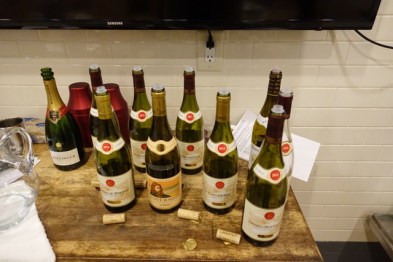
The Madison Rotary Wine Fellowship met at Steve’s on University for a Guigal tasting on April 27. The tasting was held in a side room, most recently the cheese room, but the room was initially created as a Tasting Room.

The tasting started with a Bollinger NonVintage (NV) Special Cuvee Champagne. This is the standard Bollinger champagne, with their other champagnes all being prestige versions or Rose. This was a great wine. I visited Bollinger in 2013 on an Ultimate Champagne Tasting Tour where we had a delightful lunch accompanied by the NV Rose, 2004 La Grande Rose, La Grande 2004, and NV Special Cuvee. On that trip I rated the Bollinger NV Special Cuvee (the same as the wine we drink today) as the best of the 17 NV samples tasted, and only 10% of the 71 vintage/premier champagnes were better. This wine is 65% Pinot Noir and 25% Chardonnay. 85% of all of the grapes used are from Premier and Grand Cru locations (very unusual) and 2/3 of the total grapes used in their Champagne production comes from land they own (also very very unusual). They remain one of the few remaining family owned champagne houses.
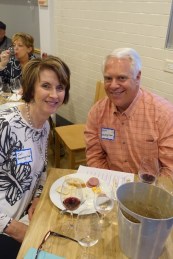

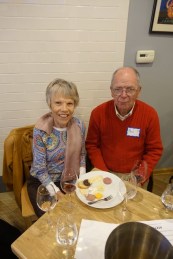
(Photo 1: Juli & Keith Baumgartner; Photo 2: Peter & Leslie Overton; Photo 3: Ellie & Paul Schatz)
The Bollinger history dates back to 1829, and family members have run it for all of this time except in the last few years. The most famous leader was Lilly Bollinger from 1941-1971, who is famously quoted as ” I drink champagne when I am happy and when I am sad. Sometimes I drink when I am alone. When I have company I think it is obligatory. I trifle with it when I am not hungry and drink it when I am. Otherwise I never touch it unless I am thirsty.” Other unique Bollinger features includes the fact that every bottle is hand riddled, and it is the champagne of “Bond” movies.
We then started the task at hand: assessing Guigal wines. Whereas wine has been grown in the Northern Rhone for 2500 years there are no established great old wineries. The region reached it’s lowest acreage in the 1940’s when vineyards being turned into apricot orchards. Etienne Guigal is a late arrival to the region – 1930’s – and ended up being Maitre de Chai of Vidal Fleurie when it was the greatest local winery (now owned by Guigal). In 1946 he established his own Negotiant business. As if to make up for this late arrival, Guigal became the leader of the Upper Rhone (Shiraz and Viognier) region, and currently makes 30% and 45% of the entire Cote Rotie and Condrieu appellations. This is a remarkable feat, to be the most prestigious producer of the Rhone’s finest red and white wines. He early on recognized the potential of the region, and tirelessly worked to acquire the best land and promote the product, that began to soar in the 1980’s. In addition to the Cote Rotie and Condrieu regions Guigal owns excellent properties in Saint Joseph, Hermitage and Crozes-Hermitage. They are major negotiant of the Southern Rhone and are reputed to produce the best Cotes du Rhone yet they do not own any property in the Southern Rhone, rather they buy in wine or grapes from select producers. The bulk of their 10,000,000 bottle wine sales come from this region.


(Photo 1: Jennifer & Bob Winding; Photo 2: Jenny & Loie Badreddine; Photo 3: Steve & Meryl Mixtacki)
The way they make wine is uncompromising, and as a rule they continue to age their wines (estate and negotiant) long after other producers have already sold their entire vintage. Quality is their theme in all aspects of vine growing, and wine making. As Robert Parker says Guigal is “This planet’s greatest winemaker”.
We had 1 Rose, 3 Whites, and 5 Reds. These wines were available to buy from $10.99 through $149.99. I rated the wines very well with the Bollinger champagne and the Cote Rote Chateau Ampuis 2010 being the best, and most of the others matching their 90/91 scores from reviewers being matched. I will be buying the champagne, and did buy the cheaper Cotes Du Rhone Red and Rose for their fabulous value (90 pointers and <$10). A great time was had by all and we had excellent wines and great mushrooms, cheese, bread, and pate snacks.
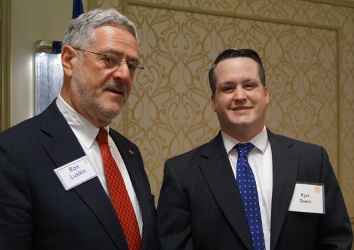 Professor Ryan Owens, a member of the UW Department of Political Science and an Affiliate Faculty of the Law School (and who is developing the Tommy Thompson Center on Public Leadership) spoke to the Club about “The Past, Present, and Future of the U.S. Supreme Court.” He began with an interesting “Thought Experiment.” With the addition of Neil Gorsuch to the Court, Justice Anthony Kennedy continues to be the middle or the median justice, often called the swing vote. But what happens if he retires, and if President Trump appoints a solid conservative such as Paul Clement, who is perhaps more conservative than Samuel Alito? In that case, the new median justice becomes Chief Justice John Roberts, who would then become the most powerful [influential?] Chief Justice since John Marshall. [Though he would be a very distant second.] If Ruth Bader Ginsburg were then to retire, Justice Alito would become the median justice. On the other hand, if Hillary Clinton had been elected, Justice Stephen Breyer might be the swing vote, etc. Very easily, a 6-3 conservative court under Trump might have been a 6-3 liberal court under Clinton. The presidential election of 2016 was, then, a very consequential election.
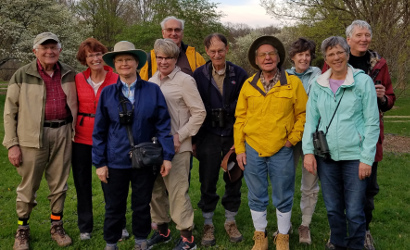 A group of nine Rotarians and guests met at the UW Arboretum Visitor Center for a hike on April 24 for an evening bird sighting. The goal was to observe the courting behavior of the male woodcock. Guide Levi Wood provided information about the rich conservation history of the UW Arboretum and a tour of the Longenecker Gardens which showcases a collection of trees and shrubs. The Magnolia collection was in full bloom and the early lilacs were opening.
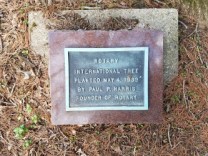 We were pleased to see the Oak planted by Paul Harris and saw turkeys and a red-tail hawk nearby. The hike included a walk through Gallistel and a brief stop at Teal Pond. Curtis Prairie provided the zen-like experience of hearing the courting sounds of the male woodcock who becomes active at dusk. Although the bird was never seen, its presence was clear by the loud, nasal peent calls made on the ground, the twittering sounds made by the wings as the woodcock rises up 100’ or more in an aerial display, the call made at the ‘top’ of the flight, and steep dive back down to the prairie. The Audubon website refers to this behavior as a ‘sky dance’. Female woodcocks are attracted by the ‘lek’ of males performing their rituals and have an opportunity to select the fittest mate.
 Jon Pevehouse, UW Political Science Professor, asked and answered the question, “How should the Trump administration balance power with constraint to maximize our legitimacy and prosperity?” at the April 5 Rotary meeting.

 Rotary Club of Madison, Wisconsin