Tag Archives: Rotary Club of Madison

Dora Zuniga Receives 2016 Mitch Javid Award

dora-zuniga-mj-award-2016

From left: TJ Blitz, Dora Zuniga and Mitch Javid

–Introduction made by TJ Blitz on October 5, 2016

The Member Development Committee has the important responsibility of sustaining and building the membership of the Rotary Club of Madison and encouraging and facilitating a lasting relationship between the Club and its members.

The committee’s goals are to:

  • Continue to strive to keep members engaged and participating to increase retention;
  • Maintain a process of consistent and effective communications tools for members to use when talking with potential new members;
  • and Continue a positive and welcoming experience for new members in their critical first years.

In 2014, the committee developed a new award to recognize a member who is sponsoring new members into our club since this is essential to the future of our club.  The award is named the Mitch Javid Award to honor a distinguished member, and it annually recognizes the member who has served as the primary sponsor to the most new members during the past 3 years.

For those who do not know Mitch Javid, Mitch has been in our club for 48 years and has sponsored 56 members and co-sponsored another 10 members.  This distinguished and very busy member who was chairman of the Department of Neurosurgery says, “I love Rotary.  It is very dear to me. I believe in it and so I want to share it with other good people.”  Mitch received the first award in 2014, and Rob Stroud received it in 2015.

I am pleased to announce that the 2016 recipient is Dora Zuniga who has served as the primary sponsor to 6 new members since July of 2013. Those new members are:  Nick Curran, Mark Fraire, Jorge Hidalgo, Sandy Morales, Tammy Thayer and Alex Ysquierdo.

Dora joined our Rotary Club in 1994 and recently became the new director of development for Wisconsin Public Radio.  She has served on our club board of directors and is a current Madison Rotary Foundation trustee.  She is also current chair of our new member Orientation Committee and continues to be active on a number of other Rotary committees.  Dora is a great connector, and we congratulate her on receiving the 2016 Mitch Javid Award.

Thank you, Dora, and thanks to all members who are sharing the opportunities available through Rotary with others.


The Political Demographics of Wisconsin

–submitted by Kevin Hoffman; photo by Jeff Smith

craig-gilbert-9-28-16

Washington Bureau Chief Craig Gilbert (pictured here at left with Rotarian Stan Kitson) of the Milwaukee Journal Sentinel presented the political climate for the 2016 election.  In a word, the Presidential and Congressional elections are more polarized than any in recent history.

With the two major-party candidates suffering high disapproval ratings, there are divisions both between the parties but also within each party as supporters struggle to reconcile party affiliation with distaste for their respective candidate.  For example, Republican nominee Donald Trump should enjoy a significant advantage in Waukesha County. Traditionally, Republican nominees have enjoyed well over 50% support in polls but Trump is only at 41% with 15% undecided.  Democratic nominee Hillary Clinton is doing well in solidly Democratic Dane County but she struggles to attract the same level of support as President Obama did in 2012.

Also, in Wisconsin there is a significant urban-rural divide that has implications for the general election.  Trump enjoys support in the rural northwest of the state but in population centers such as the southeast, with more reliable and higher voter turnout, he is below the level of support Romney captured in 2012.  Urban Republicans have been slower to coalesce around their nominee resulting in a large number of undecideds.

So, the election will come down to how effectively each candidate can mobilize their “base” areas of support in spite of voter misgivings.  Trump will need to convince the undecideds in traditionally Republican strongholds to vote for him rather than a third-party candidate, cross over and vote for Clinton, or not vote.  Clinton has stronger support within Democratic areas but also needs to convince Sanders supporters, the Obama coalition from 2012, and Republicans turned off by Trump to vote for her.

If you missed our meeting this week, watch the video here.

Milwaukee Bucks Remake

–submitted by Ben Hebebrand; photo by Jeff Smith

feigin-peter-9-21-16

A complete transformation of our state’s professional basketball team, the Milwaukee Bucks, should lead not only to an eventual NBA championship but also a turnaround for a significant portion of the downtown Milwaukee area.

At the September 21 Rotary Club of Madison meeting, Milwaukee Bucks Team President Peter Feigin characterized the Buck’s current development and construction project as one that is “30 percent about the Bucks, and 70% about getting people to be in downtown Milwaukee.”

Feigin outlined construction projects of a 30-acre neglected downtown Milwaukee area to include a new 16,500-seat arena (to replace the old Bradley arena that eventually will be demolished), a practice facility, a health center, parking areas, and an entertainment block featuring a plaza, a potential hotel, and restaurants. The arena will also double as a venue to attract big-name concerts that have eluded the state in recent years.

Matching the NBA’s global reach as is evident in over 100 international athletes playing for NBA teams and games being broadcast in 215 different nations, Feigin announced the Bucks’ “mission to be the most successful and respected sports and entertainment company in the world.” This new mission originates in a new ownership group “that just purchased a 50-year-old team that we are treating as a start-up venture.” As concerns a specific vision for the competitive prospects within the N.B.A., Feigin boldly proclaimed the goal to win a world championship rather than just “being a winning team.”

The mentality of a start-up, according to Feigin, is needed because “we have lost a generation of fans….we have been a bit dormant.” He added that Wisconsin, based on UW’s recent basketball successes and otherwise long-standing traditions, “has a basketball culture we need to nurture.”

When reminded by Club members of significant incentives offered by the state, city, and county, Feigin anticipates four-fold returns on such public investments in the forms of new jobs and associated income tax revenue as well as increases in property values and associated increases in property tax revenues.

When asked by Club members of the team’s social responsibilities and obligations, Feigin referred to Milwaukee as “one of the most racist and segregated cities I have seen,” citing a need for better practices in inclusion, diversity, and leadership. “We are determined to get involved.”

Did you miss our meeting this week?  Watch the video here.

Wisconsin’s Nazi Resistance: The Mildred Fish-Harnack Story

–submitted by Bill Haight; photo by Jeff Smith

miskowski-jon-9-14-16

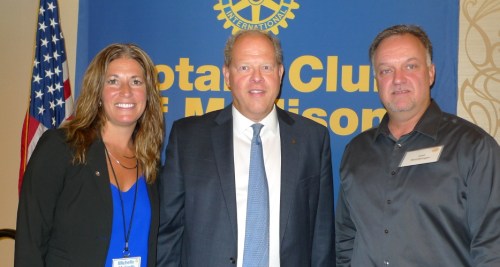
From Left: Club President Michelle McGrath with WPT’s  Jon Miskowski & Joel Waldbinger

Jon Miskowski, director of Wisconsin Public Television, prefaced his presentation of WPT’s documentary on Mildred Fish-Harnack by noting that public broadcasting, which was born on the UW-Madison campus, is celebrating its 100th anniversary in 2017.

The WPT documentary begins as a love story on the UW-Madison campus in1929 when young Mildred Fish, a recent grad and now faculty member, met Arvid Harnack, a Rockefeller Scholar from Germany. After canoe trips to Picnic Point and leisurely walks down State Street, they married. Then Mildred accompanied Arvid back to Germany and the academic life of Berlin University.

Soon her letters home began to tell of her alarm at the rise of the ruthless dictator Adolf Hitler. From the documentary we learn: “At great risk, Mildred used her teaching job to recruit students into the Nazi resistance. The resistance network also included Lutherans, Catholics, Jews, social democrats, Communists, and aristocrats, anyone who objected to the Nazi dictatorship.”

Their anti-Nazi activities, all highly secret, included passing economic and military secrets, translating and sharing foreign speeches and articles with German friends, and hosting resistance meetings.

When Arvid and Mildred eventually got swept up in the Gestapo purge, Mildred had in her pocket an open ticket to the U.S. but she had passed up the chance to escape. She said that her love for Arvid and for the German people would not allow her leave.

After sham trials, Arvid and, several months later, Mildred were executed. Mildred became the only female to be executed on direct orders of Hitler.

Annually, September 16th commemorates the incredible courage of Mildred Fish-Harnack with a Wisconsin school holiday in her honor.

The video and related material can be found at: http://wpt.org/nazi-resistance/main .

If you missed our meeting this week, you can watch the video here.

A Vision for All Graduates

–submitted by Bob Dinndorf; photo by Moses Altsech

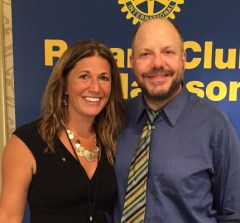
jen-cheatham-9-7-16Madison Metropolitan School District Superintendent Jen Cheatham (pictured at left with Club President Michelle McGrath) addressed the Rotary Club of Madison on September 7th. Her third Rotary address focused on how the Madison public schools are narrowing the racial achievement gap and meeting the financial challenges of the future.
Dr. Cheatham demonstrated progress toward narrowing the achievement gap by citing an improvement in early literacy of 6 percent overall. Within this number is a 12 percent improvement among African American students; 10 percent for Latino students and similar gains for English Language Learners and Students with Disabilities.

High school completion has markedly increased over the past two years from 78 percent to 80 percent. Within this, rate of graduation among African American students improved from 65.8 percent two years ago to 80 percent. Students with disabilities improved by ten percentage points.

Sixty new teachers of color have been hired, significantly more than in past years.

The plan for continued improvement rests on sustained focus on:

  • Early Literacy, increasing services for English Language Learners, Students with Disabilities and Advanced Learners.
  • Personalized learning pathways for high school students,
  • Partnerships with parents, “Grow our Own” to continue diversifying staff
  • Innovation for the future

The financial support of K-12 education in Wisconsin does not support the sustained focus on continued improvement. The MMSD has experienced less than 1 percent revenue growth for going on six years. Staff has been reduced 3 percent–120 positions. A similar reduction is forecast if additional resources are not available. The budget politics does not weaken the resolve of MMSD but does continue to impede aspirations toward closing the achievement gap. The November MMSD referendum offers one solution to the continued resource reduction but is not the sustainable solution.

Did you miss our meeting this week?  Watch the video here.


Newest Members of the Human Family Tree

–submitted by Andrea Kaminski; photo by John Bonsett-Veal

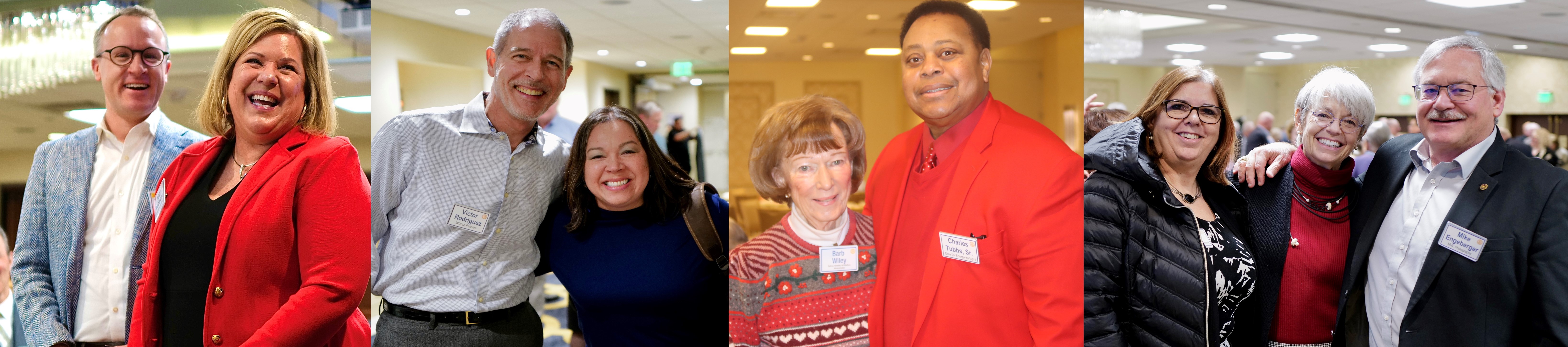
John Hawks 8 31 16UW Anthropology Professor John Hawks (pictured here with Club President Michelle McGrath) told of an astounding find of early hominid bones in a cave in South Africa. He worked with Lee Berger, with National Geographic, whom he described as a foremost scholar in human evolution. With a strong commitment to educating the public about science, the National Geographic and University of Wisconsin media have covered the work since the beginning in 2013, including the amazing moment when bones were detected in the cave.

With two kilometers of underground passages, the Rising Star cave has been explored for more than 70 years. One Friday night in 2013 the team “stumbled” upon fossils in a part of the cave they had not previously explored. The bones included a mandible that was very likely that of a hominid.

Hawks explained that caving requires unique skills (not to mention morphology) that allow people to squeeze through extremely narrow passages. The scientists recruited a team of six cavers, including one UW graduate student. It appeared that all of the team members were women.

A schematic of part of the cave showed extremely narrow tunnels, including Superman’s Crawl, which is less then 10 inches in height, and Dragon’s Back, which is only 7.5 inches wide, with jagged walls and a steep vertical descent.  At the bottom, they found the bones. Moreover, they realized they were looking at several skeletons. The workers painstakingly exposed the bones with paint brushes.

Unlike most other anthropological sites, there were no other animals represented among the bones. Hawks guessed that means the cave was a burial site with very limited access that kept animals out.

Hawks said this is the largest assemblage of hominid bones ever found, and the analysis will take significant time. The team has recruited more than 150 scientists from 15 countries. They have determined that the bones represent possibly the earliest branching of the human genus.

Hawks noted that the government of South Africa was very supportive of the work, sending its Vice President to the announcement along with school groups and others. Information about the project has been made available to the public worldwide through an interactive website. This is all very consistent with the Wisconsin Idea, Hawks concluded.

Did you miss our meeting this week?  Watch the video here.