Tag Archives: Rotary Club of Madison

“Everything He Knew, He Learned in 1721”

–submitted by Linda Baldwin; photo by Mary O’Brien
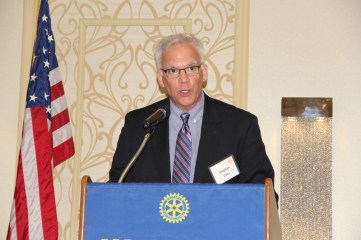
 

Stephen Coss 7 13 16

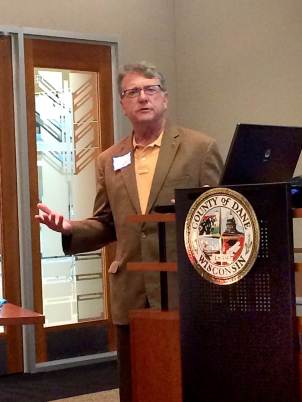
It was a pivotal year for the American colonies, for modern medicine and for Benjamin Franklin, then an apprentice in his brother’s Boston print shop. Professor Stephen Coss discussed his book, “The Fever of 1721.”

According to Coss, in 1721, Massachusetts colonists participated in the first successful rebellion in the colonies against England, the first independent newspaper, The New England Courant, was published, western medicine’s first inoculation experiment was conducted on smallpox victims, and Franklin arrived on the scene as his brother’s printer’s apprentice.

Quite a year. Read the book.

In Boston, the first political challenge to English authority was led by Boston businessman Elisha Cooke Jr. The Boston Caucus, led by Cooke, convinced locals to oust the very unpopular English governor, thus accomplishing the first overthrow of a royal appointee.

While newspapers had been published in Boston and in the colonies under the authority of the crown, James Franklin started the New England Courant with his 12 year old brother Ben as an independent voice, the first in the colonies.

Not a successful business venture, James decided to exploit the inoculation of smallpox controversy to raise readership. Thus began a tradition of independent voices in the press discussing social, philosophical and political issues…social issues poked fun at by Silence DoGood, the pen name of teenager, Ben Franklin. Professor Coss tells us that James didn’t know that Ben was writing the DoGood articles and was outraged when he found out.  This “freedom” of the press was later enshrined in the 1st amendment of the US Constitution.

As small pox raged through the population, New Englander Cotton Mather began promoting inoculation as a way to combat the disease. Together with Dr. Boyleston, through much criticism, small pox inoculation was attempted and thus began vaccination as a successful tool against diseases like small pox.

For Ben Franklin, this was a time of intense education in politics, journalism and public medicine.  He was greatly influenced by Mather in promoting that community service, trying to do good, was a more valuable effort by men in our society than the accumulation of wealth and power. Later, Franklin formed the “Junta” in Philadelphia; a do-gooder group which was a model for Rotary to come.

Did you miss our meeting this week?  Watch the video on our YouTube Channel here.
July 6 Fellowship Luncheon Highlights

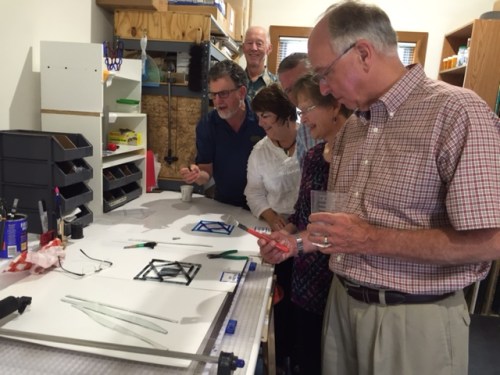
On July 6, members and guests participated in our club’s 24th Annual Vocational Fellowship Luncheon Day.  Instead of our regular meeting at the Inn on the Park, members enjoyed this opportunity to get to know one another better in a small group setting as they learned more about various area businesses.  Here are some photo highlights from this year’s locations:

IMG_4614

Member and guests gathered at the home of Denny Carey for a presentation on how fused glass is accomplished in a live glass studio.  Each guest built a unique decorative piece of glass.

IMG_4832

Terry Anderson hosted members and guests with an overview of this year’s Legislative Council special study committees and the workings of the Council.  The luncheon concluded with an optional climb to the top of the capitol dome for a bird’s eye view of Dane County.

20160706_125136

Jed Engeler arranged for members and guests to hear the stories of Wisconsin citizen-soliders from the Civil War to the present day at the Wisconsin Veterans Museum.


IMG_0921

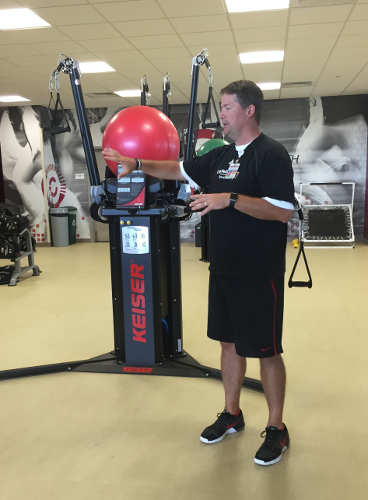
John Sheehan of The American Center hosted members and guests and provided a program and tour the Sports Performance and Rehab Center.

Dane Co Airport 4

Bill White, former airport commissioner, provided an overview of the history, operations and  growth for the Dane County Airport which included a short behind-the-scenes tour of terminal, baggage and facilities operations.

20160706_122024

Exact Sciences Corporation included Valerie Johnson as host were members and guests received an interactive presentation highlighting the challenge of colon cancer and guided tours of the lab.

Today in History: Saying Farewell to “Brownie”


–submitted by Rick Kiley; photos by Valerie Johnson

DSC00484   DSC00488  DSC00496  DSC00500

June 29 was the annual Changing of the Guard “Roast” of outgoing Club President Ellsworth Brown hosted by Club members who have joined during the past year, a.k.a. the Roast Committee.  All agreed it was very creatively staged and “hit all the right notes.” Several veteran members said it was among the best they’d seen.

President Ellsworth Brown began the program thanking the Rotary Office staff and those who supported him during the past year: his wife Dorothy, Assistant Julie Schultz and members of the club.  He thanked the Club for it’s commitment, action, willingness to say “yes” and volunteerism, ending with a quote from Yogi Berra, “It isn’t the heat that gets you, it’s the humility.”

DSC00502  DSC00501

President Ellsworth then ceremonially passed the President’s pin to incoming President Michelle McGrath, and she passed the Vice President’s pin to Donna Hurd.  Past President Tim Stadelman welcomed Ellsworth to the Past President’s Club; Renee Moe presented him the Past President’s plaque and Wes Sparkman presented him a Paul Harris Fellow pin.

DSC00510

The Roast was a Jeopardy-style TV game-show theme.  Of course, one of the contestants was 50-week reigning champion Ellsworth “Brownie” Brown.  The show kicked off with a video from Reno, Nevada, of a trauma helicopter pilot, Ellsworth and Dorothy’s son, Lincoln, and his wife Tia.  Lincoln then made a surprise entrance in his flight suit.

The game show’s categories of Jeopardy-style answers included Early Ellsworth, Hysterical Society, Rotary Rites of Passage, 50 Shades of Brown and Word of the Day.  Of course, the winner was Ellsworth Brown.

DSC00523  DSC00526  DSC00530

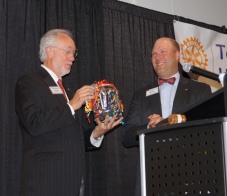
Winner’s prizes included a collection of pens donated by Club members (to enhance Ellsworth’s own collection), a historical pen from a sycamore tree at the place President Lincoln and General Grant once met, and a special edition of the Isthmus with Ellsworth’s caricature on the cover.

Finally, a parting video featured new President Michelle McGrath donating a unique “artifact”, Ellsworth himself, to the Wisconsin Historical Society.

DSC00514

Tax Incremental Financing, a Remarkable But Poorly Understood Urban Development Tool

–submitted by Dave Mollenhoff; photo by Valerie Johnson

TIF Panel 6 22 2016

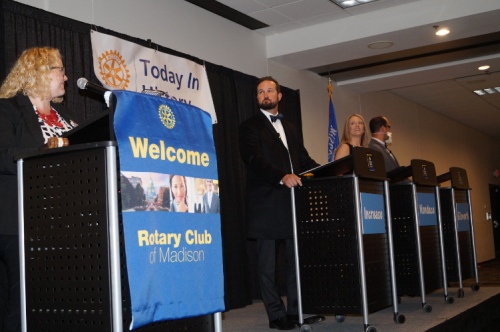
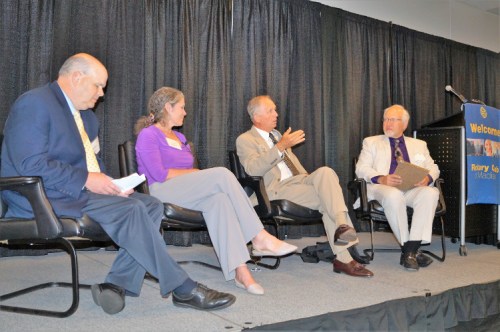
[Pictured here from left: Mike Barry, Natalie Erdman, Dan Thompson and Steve Walters]

Few Wisconsin voters understand what tax incremental financing (TIF) is, but since its introduction in 1975, it has proved to be one of the most powerful and effective urban development tools in Wisconsin’s history.  On Wednesday members were privileged to hear a panel explain this poorly understood topic.  Speakers were: Dan Thompson, former executive director of the Wisconsin League of Municipalities;  Natalie Erdman, Director of the Madison Department of Planning, Community and Economic Development; and Mike Barry, Assistant Superintendent for Business Services for the Madison Metropolitan School District.  The panel was artfully moderated by Steve Walters, with WisconsinEye.

Thompson reminded the audience that by the 1970s the suburbanization of homes and factories left huge swatches of once valuable central city land vacant and blighted.  City leaders sought financial incentives to revitalize downtowns and closed-in neighborhoods.  This was why Governor Patrick Lucey encouraged the legislature to approve a TIF law for Wisconsin.

Erdman explained how the law works by using Tax Incremental District #36, known as the Capital East District.  She noted how this sprawling area along East Washington Avenue from Blair Street to the Yahara River, long known for its car dealerships, had great potential.  However, developers could not undertake projects there because squishy soil required expensive foundations and contamination from old factories had to be remediated.  When the City created TID 36 its real estate was assessed at $75 million.

To realize the district’s extraordinary potential, the City developed a comprehensive plan. Projects included expensive high-rise mixed use projects such as The Constellation and the Galaxie, the renovation of Breese Stevens Field, street improvements, and Central Park refinements.

By 2015 assessed values of land and improvements in TID 36 had soared to $132 million and many more large projects are about to break ground and are being planned.  This huge increase in real estate values caused an additional $1.5 million to flow into the city treasury every year.   Under tax incremental financing these increased taxes are used to pay back the City’s front-end development costs.

During the district’s life—typically about 13 years in Madison—taxes continue to get collected and distributed to all taxing jurisdictions, but at level of the district before redevelopment.  Then when the district is terminated, all taxing jurisdictions start getting the bonus taxes created by the increased values.

Barry explained how school districts and cities work together to enjoy the increases in real estate taxes generated by tax incremental districts.

“Thank God for tax incremental districts,” exclaimed Rotarian Bob Miller who is also mayor of the city of Monona.  “Without it we would be in a sorry state.”  Miller explained how his suburb was able to use TIF to do a $20 million upgrade to Monona Avenue.

Special appreciation goes to Carol Toussaint and Roth Judd for fomenting and producing this exceptionally informative program.

For more information on TIF visit this link: https://www.revenue.wi.gov/slf/tif.html

Our thanks to Michael Barry, Natalie Erdman and Dan Thompson for serving on this TIF panel with Steve Walters of WisconsinEye moderating.  We also thank Dave Mollenhoff for preparing this review article and WisconsinEye for videotaping.  CLICK to watch the video.

“Fun in the Sun”day on June 19

–submitted by Mike Wilson

The Wine Fellowship met on a Hot Sunday Afternoon to try drinks designed for a Hot Sunday Afternoon.  The temperature was 85 degrees outside, so the conditions were perfect.  The tasting topic had been suggested by Meryl Mixtacki.

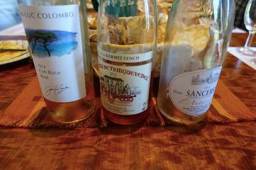
Photo1We started with three Roses: A Rhone from Jean Luc Colombo; a Kermit Lynch Tavel (AOC devoted entirely to Roses); and a Sancerre with 100% Pinot Noir.  The resounding best was the Sancerre L’Authentique by Thomas Labaille in the Loire, sourced from Steve’s Liquor on University Avenue at a cost of $20.
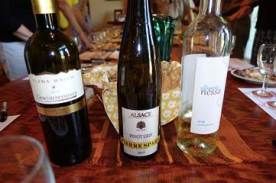
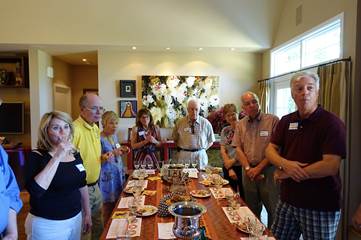
Photo3

Next we had bubbles, a typical heat re-mediating wine, all made by the Methode Traditionale, but no actual Champagne.  The first was a french sparkler made the traditional way – Blanquette de Limoux.  The claim to fame of this region is that that is where reports of bubbly wine made here 100 years prior to bubbles from the Champagne region.  This wine is made from the Mauzac grape known as Blanquette, and they tend not to remove the sediment (lees) so the wine could be cloudy.  Next we tried a Cremant (name for French wines made in the traditional champagne method but not in the Champagne region) de Bourgogne.  Finally from the Antipodes we tried a Tasmanian sparkler, made in the traditional method that Downunder they call “Tasmanois”.  The winning wine was the Limoux by St. Hillaire with a nearly 100% winning rate.  This wine was a little unusual as the other sparklers were NV, but this was a 2014 vintage and the company is one of the top 5 rated Limoux annually ~ a top 100 WS rating and the cheapest of all these sparklers.

Photo7  Photo2

We then shifted to still whites, and had a European mixture. First, from the Sudtirol, Elena Walch’s mild Gurwerztraminer that we had had before at a Wine Table tasting, and this wine is made by the Queen of Gurwertztraminer, Elena.  This was followed by an Alsation Pinot Gris, then an Albarino from Nessa in the Rias Baixus of Spain.  The Unanimous winner was the Pinot Gris from Pierre Sparr.  This is interesting as Pinot Gris is identical genetically to Pinot Grigio just made differently, and this is especially so in Alsace where all Pinot Grigio is marketed as Pinot gris where secondary fermentation and the use of oak aging is common making the wine more complex than the usual acidic Italian Pinot Grigio. It is interesting that Pinot Gris (and Grigio) and Pinot Blanc, are all point mutstions of the very old Pinot Noir (1000 year history of cultivation compared to 200 years of Cabernet Sauvignon) so they are white wines very similar genetically to Pinot Noir.  Also, this maker is a very old Alsation winemaking house that fell on poor times and winemaking, so the local vineyards grower cooperative decided to buy the winemaking facility to ensure their grapes were well made, and the winemaking improved.  All these wines were excellent but this wine was superb – obtained at Steve’s at about $18.

The best was kept to last.  The idea had been to try Sangria and Shandies.  Meryl told the story of Glunz Winery making most of the money they needed to run their winery from the sale of Sangria to CostCo, and when the Mixtackis and Wilsons had visited Glunz in Paso Robles, we met the winemaker AND his dog.  Mike Wilson adapted the mixture, by adding 10% of a blood orange liqueur to the Sangria and forgoing all the fruit typical of a Sangria as the winemaker has added all that effect already – this was a crowdpleaser and at <$10 for the de la costa Sangria by Glunz Cellars and ~$27 for the Solero Blood Orange liqueur (one bottle allows for innumerable sangrias given the liqueur dosage is 10% of the entire drink (10:1 ratio of Sangria mix:liqueur).

Photo11We also tried two Shandy’s; a Pitosi lemonade beer and a grapefruit Schofferhoffer, which were very good.  Back home in NZ 50 years ago we added lemonade to our favorite beer on a hot afternoon to get a refreshing drink.  Here in America you can add Sierra Mist to your favorite beer or just purchase these Summer Shaddies.  A Good Time Was Had By All.

All in all, an excellent “Fun in the Sun”day, and while all the wines and drinks were excellent there were clear winners to everyone, and everyone agreed with that.

American Players Theatre – What’s New?

–submitted by Carol Toussaint; photo by Valerie Johnson

Brenda DeVitaThe Rotary audience learned today just how lucky we are that our speaker, Brenda DeVita, was not pursuaded by her brother who argued against her choice of an acting major.  He wanted her to know that her intelligence and people skills along with obvious loquaciousness were better suited for a respectable career as a lawyer.
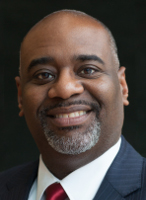
Brenda DeVita knew then, and we now know, that it would have been a big mistake for her not to follow her heart.  As she began and kept acting, she said she “came to understand its power – that in the safety of a dark theater, people (the audience ) can be moved.”  Actors, she added, help people to connect with people they would most likely never know.

Moving to Spring Green, Wisconsin, and American Players Theatre in 1995 when her husband, actor James DeVita, was hired to play Romeo, set a lot of things in motion.  Brenda was hired as an assistant to work along side Artistic Director David Frank.  “Over the years” she noted, “it became clear that our job of matching great people with APT was similar to finding a needle in a haystack.”  Finding those “rare, selfless, hard working, humble, classically trained, kind, collaborative storytellers who like mosquitoes and didn’t want to be rich” would be how they built the core of the company.

In 2014 Brenda DeVita took over as Artistic Director and in her first season, 2015, box office records were set.  Rather than talk about the 2016 season, of which she is justly proud, she directed everyone to pick us a brochure and seriously consider attending this summer.   In response to her question, nearly everyone in the audience raised a hand indicating an experience with attending an APT production.

She shared that financial stability is something APT is proud of and that “tenacity in our budgeting has allowed us to get to what we are calling the Next Great Stage.”  Immediately after the last show on the Hill closes in October, construction will begin and be finished for the following season.  Stay tuned for more news of these developments as they work to rebuild the stage, making it more flexible and exciting, for actors and audience.

Did you miss our meeting this week?  CLICK to watch the video.