Monthly Archives: July 2017

A Gem of a Hike: Table Bluff on Ice Age Trail July 15

–submitted by Leigh Richardson; photos by Jeff Tews

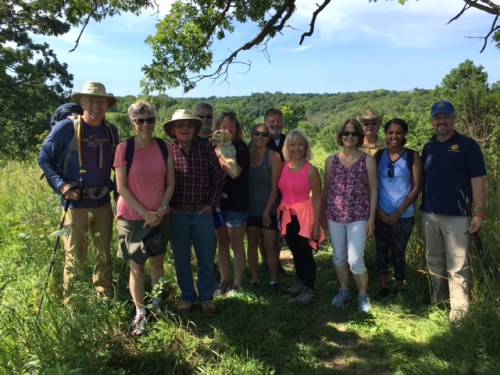
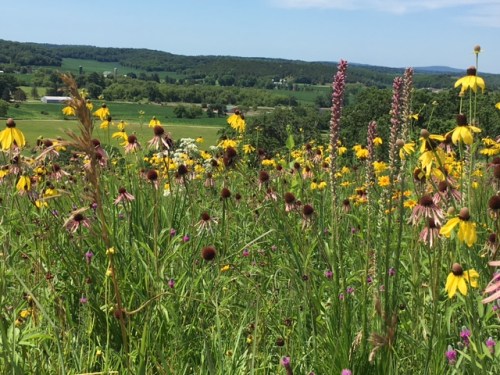
IMG_2524“Embarking on the back road journey 2 miles north of Cross Plains, members of the Rotary Hiking Fellowship had no idea this pristine gem awaited. Towering forests, chin-high rainbows of prairie flowers, and the grand finale– a shelter perched overlooking the driftless region. A view to rival Blue Mounds State Park.

At the bi-section of the Table Bluff Segment of the Ice Age Trail lies the 460-acre “Swamplovers Nature Preserve.”  Even our seasoned hikers were unaware of its existence.

IMG_2525

When rounding a wooded curve, we even encountered an alligator in a bikini!  It elicited frightened gasps until we realized it was merely a lawn statue planted trailside by the lighthearted Swamplovers’ group.

IMG_2527

Thank you, hike coordinator, Andrea Kaminski, for sharing this lovely find!”

Beautiful and Lovely

–submitted by Ellie Schatz; photo by John Bonsett-Veal
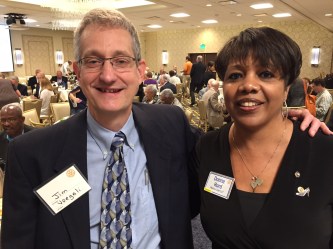
IMG_8369Beautiful and lovely is the story Jim Voegeli is telling of his father Don Voegeli, prolific composer and performer of music for public radio and television, theater, advertising, and educational and promotional films. Beautiful and Lovely is also the name of a children’s song Don wrote in 1964 about the beauty of nature and life as part of the radio series Let’s Sing.

Don Voegeli, music director at UW’s radio station, WHA, until his retirement in 1964, was a 50-year member of our club beginning in 1949. He is noted for 35 years as our club pianist preceding Jeff Bartell, who opened the program by playing one of Don’s songs.

Smiles were universal as we listened to Voegeli’s music and heard the story of his life and love of music. Though much of his music had been destroyed, through thousands of hours over the course of 3 1/2 years of researching, locating, and digitizing, many recordings have been restored.

Nods of recognition and appreciation accompanied the smiles when Jim played two renditions of National Public Radio’s All Things Considered theme song, the music Don is perhaps best known for composing. The newer arrangement we all hear on NPR today marks 45 years of Don’s music being the All Things Considered signature. We also enjoyed learning of Don’s 2-year hiatus from UW, when he headed to Chicago to write jingles, including the familiar Schlitz beer jingle featured on the 1950’s Schlitz Playhouse of Stars CBS television program.

Although Jim made it clear that the amount of information and music that could be packed into his short presentation was minute compared to the array of musical pieces that he would like to share, he didn’t stop with his presentation. 90 copies of a 4 CD set, entitled Beautiful and Lovely: The Music of Don Voegeli, were gifted to Rotarians wishing to reminisce and enjoy at home. Disc 1 contains full versions of the All Things Considered themes; orchestral versions are on Disc 2; the Schlitz jingle, film scores, and themes, jingles, and interludes are on Disc 3 and continued on Disc 4.

So if you missed the Beautiful and Lovely presentation, get a copy of the CDs, which Jeff Bartell says are “remarkable.” OR, you can watch when Jim Voegeli, and David Null, Director of UW Archives, share the Don Voegeli story, Don Voegeli and Wisconsin Public Broadcasting. Go to http://wpt.org/University-Place/don-voegeli-and-wisconsin-public-broadcasting

Did you miss our meeting this week?  You can watch the video here.

Coach Healy Inspires and Motivates

–submitted by Roger Phelps; photo by John Bonsett-Veal

healy cropped

We were talking softball at the July 19 Rotary meeting.  Why?  Because our guest speaker was the UW best winning softball coach in the program’s 19-year history, Yvette Healy.  That’s why!

Coach Healy approached the Rotary podium pretty much the way she approaches her job as UW’s softball head coach – with a ton of energy, inspiration and positive thinking.

A native of Chicago, she is in her 8th year as UW Head Coach.  Prior to moving to Madison, she was the head coach at Loyola University.  Moving to Wisconsin wasn’t easy, she comments.  She was an ardent Bears and Cubs fan before arriving.  But, she’s adapting and excelling in her job.

She was hired to turn around a struggling UW softball team, and turn it around she did.  Under her leadership, the team has consistently moved up in the ranking and now eyes a Big Ten Championship ranking next year. She owes a lot of her motivation approaches to the inspiration she has gained through a handful of inspirational authors whose words echo in her coaching:  “Do something that scares you;” “Just say yes;” “Believe it;” “If you have a big enough WHY, you’ll find a way HOW;” “Take action.  Don’t fill your head with possibilities of negative outcomes;” “If your dream doesn’t scare you, it isn’t big enough;” and “It’s not the best team that wins.  It’s the team the plays the best.”

She made a special point of citing Madison itself as one of the advantages she has in recruiting top talent to UW.  They see this special place and want to be here.

Coach Healy left her Rotarian audience with three final thoughts:  1) When asked whether you’ve accomplished something, never say no.  Say Not Yet!; 2) Show pride of the team you lead. Tell each of them you’re proud of them, and tell them why; and 3) Imagine how good things could be!

Did you miss our meeting week?  Watch the video here.


Prof. Jonathan Patz Describes Health Risks of Climate Change

–submitted by Jerry Thain; photo by Mike Engelberger

Jonathan Patz 7 12 2017On July 12, Professor Jonathan Patz, Director of the Global Health Institute at UW-Madison and a pioneer in researching global climate change and its consequences (he has been active in national and international programs in this area for more than two decades and received a Paul Harris fellow award at the RI annual meeting in Atlanta last month when he addressed a break-out session on the connection between extreme weather events and the explosion of the Zika virus)  described the health consequences of global climate change and his proposals for addressing these issues.

He began by noting that increasingly high temperatures world-wide have significant health consequences.  Climate disruption causes extreme heat waves, increased air pollution and increases in insect-borne and water borne diseases.  It adversely affects food supply and mental health.  Among many studies cited was one noting that US cities are likely to triple their annual number of 90 degree days by mid-century.  Yet, it is not just hotter temperatures that create havoc; the water cycle is altered and rain will fall in stronger fashion than before due to the increase in hot air.

Professor Patz said climate change should be approached as a health issue and noted its impact on energy and the food supply.  He stated that while moving to reduce carbon emissions has a cost, that can be out-weighed by benefits, citing a cost of $30 per ton of removed carbon dioxide emissions being off-set by a benefit of more than $200 in the reduction of air pollution – pollution which causes 7 million deaths a year now.  Moreover, the costs of wind and solar energy are dropping rapidly.  He also cited studies indicating that simply substituting bike rides for auto trips of 2 and 1/2 miles or less in the summer could save 1300  lives annually as well as 8 billion dollars.  As to employment concerns, he noted that far more people are already employed in energy work not related to fossil fuels than are employed by the oil and gas industries.

Although the United States has stated it will be the only major nation not to continue to adhere to the Paris climate accords, it cannot officially leave the agreement until Nov. 4, 2020, and a huge number of US cities and other jurisdictions are expressing adherence to its principles and lobbying to continue to abide by it.  The new RI president has said response to climate change should be a major cause for the organization.  There is a moral issue here because poorer countries are most gravely harmed by climate change when they have been the least responsible for it.  Historically, the United States has been most responsible for the emissions that are a major cause of climate change although China now surpasses us in pollution  (China, however, is taking major steps to increase its reliance on solar energy.)

Professor Patz concluded by noting that full implementation by every nation of the goals of the Paris accords would be insufficient to resolve the problems created by it.  Individual citizens and non-governmental organizations must move to substitute cleaner energy for fossil fuel reliance and develop a healthier society.

If you missed our meeting this week, you can watch the video here.  Our thanks to WisconsinEye for videotaping our meeting this week.

“Make It Big and Make It Loud”

–submitted by Linda Baldwin-O’Hern; photo by John Bonsett-Veal

IMG_8303

From left: Andrew Sewell, Club President Donna Hurd and Mark Cantrell

Andrew Sewell, Artistic Director of the Wisconsin Chamber Orchestra, recalls this advice when he came to Madison 17 years ago.  Sewell discovered that the audience at the Concerts on the Square were huge, unique and a tough crowd.  More than 40,000 weekly concert goers are there to enjoy a picnic, their friends, the beautiful setting AND the music.   Music selections are carefully chosen to entertain this diverse and loyal crowd.  And week after week, audiences flock to the Capital grounds to take in the wonderful performances of the Wisconsin Chamber Orchestra.

As Mark Cantrell, Executive Director of the WCO, points out, these concerts are free to the public but not free to present.  Each event costs $180,000 and Mark thanked the donors and patrons who support WCO for enabling these amazing community events.  Cantrell reminds us that we are lucky to live in a community where great art takes place.  Madison produces concerts and arts events at way above its size.  And Concerts on the Square and events at Overture and the many other venues around the city build community by bringing people together to enjoy, be uplifted and learn.

The Concert this week is a special one celebrating the 100th anniversary of the Capitol building…and of course, audiences will enjoy Tchaikovsky’s  rousing 1812 Overture…cannons and all.  Sewell recalls an early concert when he cued the cannons and ….nothing !!!  Trying it again, Sewell got his cannons and the show went on.

Cantrell and Sewell celebrated the Madison arts community, citing their own collaborations with other organizations and the arts community in general for doing a terrific job in bringing high quality performances to the community.

So this 4th of July celebration continues the centuries’ old tradition of bringing classical music to holidays and community celebrations.

As Gerald Bartell often said, “The Arts are for Everyone…Support and enjoy.”

“Brown Bag Tasting” on June 29

–article and photos by Mike Wilson

IMG_1218

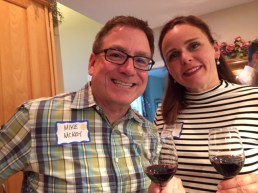
The Rotary Wine fellowship met at Steve and Meryl Mixtacki’s home for one of Steve’s iconic “Brown Bag Tastings”.  Bread, multiple cheeses, fruits, crackers and chocolate truffles were supplied to supplement the extraordinary wines. The organization was superb.  Mike Wilson and Steve Mixtacki engaged in their eternal discussion about glass position terminology on the tasting placemat.

IMG_1217  IMG_1213   IMG_1206

(Photo 1: Steve Mixtacki; Photo 2: Mary Janet & Karl Wellensiek; Photo 3: Juli and Keith Baumgartner)

The first three wines were “Wondering about Whites.”  These were from Italy, Israel and Spain – and the two most liked wines were the Italian Vernaccia and the Spanish Godello. Next we tried “Shades of Pink” explaining the gradation from tawny to pink to just plain “Red Rose” colors. The first was a Guigal Cotes du Rhone that the fellowship group had tasted at Steve’s on University tasting, and this won the honors with most liking this wine.  The pink sweet rose was a Beringer, an infamous White Zinfandel, that had been presented to Steve when he retired from WARF earlier in June, and the other was a Rosata from Petroni.  Petroni of Sonoma is a winery famous for being allowed to have the name Brunello on their label because of the extraordinary quality of wine made by them from the Sangiovese grape taken from Brunello cuttings. The Guigal was preferred by ~60% of tasters.

IMG_1205   IMG_1200

(Photo 1: Jane & John Wegenke; Photo 2: Mike & Mandy McKay)

The next trio was “What is the Country” and included three fabulous red Italian wines, all DCOG (G meaning guaranteed quality – where else do you see such endorsement). One was a 20 year old Sangiovese (Brunello di Montalcino, Il Poggione), a 2000 Biscardi Amarone with the producer scion’s signature and date of signing on the bottle, and a fine 2011 Barolo.  Three of the finest wines that Italy offers, with the Brunello preferred by 47% despite the sediment.  These were all $60 wines.

Steve had prepared two interesting groupings next.  Three variations on a theme with blends of Rhone grapes: Grenache, Syrah and Mouvedre (all of the land of OZ GSM fame).  These were all Californian examples poured from light to dark red in color.  These were from Unti (71% Grenache and 29% Mouvedre), Cline Cashmere (50% Mouvedre with lesser amounts of Grenache and Syrah), and Summerwood Diosa 2013 (80% Syrah and lesser Mouvedre and Grenache). The darker Syrah was preferred, with the Mouvedre a close followup.

IMG_1203  IMG_1204

(Photo 1: Mike & Patty Wilson & Guest; Photo 2: Bob & Jennifer Winding)

Lastly, Steve arranged for three Californian Rhone wines of the same varietals, but the “Even Greater Specificity” meaning each was a 100% single grape Rhone based wines.  Here the Adelaida Mouvedre was preferred, with the Grenache from Cline a close followup.  Incidentally the color followed the rule above; the lightest being Grenache, Mouvedre the next “reddest”, and the Syrah the dark red – perhaps a clue for future Brown Bag Blind tastings.

A great evening was had by all.  Thank you Meryl and Steve Mixtacki.