
submitted by Stan Inhorn; photo by Pete Christianson
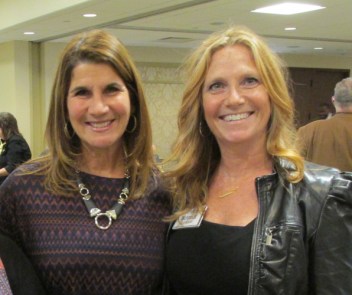
Pam Christenson (left) pictured here with Rotarian Kristin Schmidt
On October 23, 2019, Pam Christenson, one of the organizers of KIVA Greater Madison, described how this program that lends money to low-income people operates. KIVA, which means “Unity” in Swahili, is an international organization that practices crowdfunding, in which small amounts of money are raised from large numbers of people. Other websites that provide crowdfunding are GoFundMe and StartSomeGood.
Here is how KIVA works. A borrower applies for a loan. A review team determines whether the proposal is fundable, and if approved, the borrower is asked to raise the first round of money from friends and family. They must raise at least $25 from 20 people, at zero percent interest. The loans must be paid back within a certain period of time. Additional loans may be requested through KIVA, and these may come from people and companies all over the world.
Pam gave several instances of loans that succeeded in helping local entrepreneurs get started.
A Tibetan woman living in Madison bought a food cart in which she sold Tibetan food. She applied for a loan in order to rent a store on East Johnson in order to open a restaurant. One young engineering student designed a device that would vaporize fluid as an alternative to giving eye drops. Another young man asked for funds to buy corn seed, which he would use to grow corn that would be made into tortilla shells.
In its first year, KIVA Greater Madison has made 237 loans. The majority have gone to women and people of color. World-wide, the payback rate has been 96.9 percent. Experience has shown that microloans have been a successful venture that has allowed hundreds of enterprising people to carve out a new existence. In 2006, Mohammad Yunis was awarded the Nobel Peace Prize for demonstrating that credit is a fundamental human right.
If you missed our meeting this week, you can watch the video here.


 Andy and Dee J. Hall took turns Wednesday telling Rotarians about the mission and accomplishments of The Wisconsin Center for Investigative Journalism, the nonprofit and nonpartisan organization they co-founded in 2009. The Center’s three guiding principles are displayed prominently at the top of its website, WisconsinWatch.org: PROTECT THE VULNERABLE · EXPOSE WRONGDOING · EXPLORE SOLUTIONS. An independent media group such as theirs is necessary, the Halls argue, because traditional media outlets like newspapers are weakening and dwindling and “no news is bad news for our democracy.” The Center has won many awards for its rigorously fact-checked investigative journalism and is increasing the reach of its work through an extensive paid internship program. To date, 48 former interns and fellows have moved on throughout the country and the world using skills and insights they gained at the Center. The Halls cited stories from Wisconsin exposing human trafficking, inmates in solitary confinement (in one case 27 years in a cell the size of a parking space), and concerns about football concussions as examples of the kinds of investigations their Center can conduct free of pressure to make a profit.
 Rotary Club of Madison, Wisconsin