
–submitted by Jerry Thain; photo by Mike Engelberger
 On July 12, Professor Jonathan Patz, Director of the Global Health Institute at UW-Madison and a pioneer in researching global climate change and its consequences (he has been active in national and international programs in this area for more than two decades and received a Paul Harris fellow award at the RI annual meeting in Atlanta last month when he addressed a break-out session on the connection between extreme weather events and the explosion of the Zika virus) described the health consequences of global climate change and his proposals for addressing these issues.
He began by noting that increasingly high temperatures world-wide have significant health consequences. Climate disruption causes extreme heat waves, increased air pollution and increases in insect-borne and water borne diseases. It adversely affects food supply and mental health. Among many studies cited was one noting that US cities are likely to triple their annual number of 90 degree days by mid-century. Yet, it is not just hotter temperatures that create havoc; the water cycle is altered and rain will fall in stronger fashion than before due to the increase in hot air.
Professor Patz said climate change should be approached as a health issue and noted its impact on energy and the food supply. He stated that while moving to reduce carbon emissions has a cost, that can be out-weighed by benefits, citing a cost of $30 per ton of removed carbon dioxide emissions being off-set by a benefit of more than $200 in the reduction of air pollution – pollution which causes 7 million deaths a year now. Moreover, the costs of wind and solar energy are dropping rapidly. He also cited studies indicating that simply substituting bike rides for auto trips of 2 and 1/2 miles or less in the summer could save 1300 lives annually as well as 8 billion dollars. As to employment concerns, he noted that far more people are already employed in energy work not related to fossil fuels than are employed by the oil and gas industries.
Although the United States has stated it will be the only major nation not to continue to adhere to the Paris climate accords, it cannot officially leave the agreement until Nov. 4, 2020, and a huge number of US cities and other jurisdictions are expressing adherence to its principles and lobbying to continue to abide by it. The new RI president has said response to climate change should be a major cause for the organization. There is a moral issue here because poorer countries are most gravely harmed by climate change when they have been the least responsible for it. Historically, the United States has been most responsible for the emissions that are a major cause of climate change although China now surpasses us in pollution (China, however, is taking major steps to increase its reliance on solar energy.)
Professor Patz concluded by noting that full implementation by every nation of the goals of the Paris accords would be insufficient to resolve the problems created by it. Individual citizens and non-governmental organizations must move to substitute cleaner energy for fossil fuel reliance and develop a healthier society.
If you missed our meeting this week, you can watch the video here. Our thanks to WisconsinEye for videotaping our meeting this week.
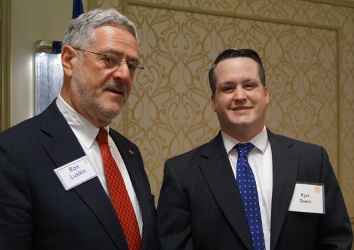 Professor Ryan Owens, a member of the UW Department of Political Science and an Affiliate Faculty of the Law School (and who is developing the Tommy Thompson Center on Public Leadership) spoke to the Club about “The Past, Present, and Future of the U.S. Supreme Court.” He began with an interesting “Thought Experiment.” With the addition of Neil Gorsuch to the Court, Justice Anthony Kennedy continues to be the middle or the median justice, often called the swing vote. But what happens if he retires, and if President Trump appoints a solid conservative such as Paul Clement, who is perhaps more conservative than Samuel Alito? In that case, the new median justice becomes Chief Justice John Roberts, who would then become the most powerful [influential?] Chief Justice since John Marshall. [Though he would be a very distant second.] If Ruth Bader Ginsburg were then to retire, Justice Alito would become the median justice. On the other hand, if Hillary Clinton had been elected, Justice Stephen Breyer might be the swing vote, etc. Very easily, a 6-3 conservative court under Trump might have been a 6-3 liberal court under Clinton. The presidential election of 2016 was, then, a very consequential election.
 Jon Pevehouse, UW Political Science Professor, asked and answered the question, “How should the Trump administration balance power with constraint to maximize our legitimacy and prosperity?” at the April 5 Rotary meeting.
 Entrepreneurship is one of the most important drivers of economic and job growth in our state and across the globe. It is also a topic that is of growing interest to today’s college students. On February 15, Dan Olszewski, the Director of the Weinert Center for Entrepreneurship at UW-Madison School of Business, spoke with us about how UW-Madison is one of the leaders in teaching and inspiring students interested in entrepreneurship as a potential career.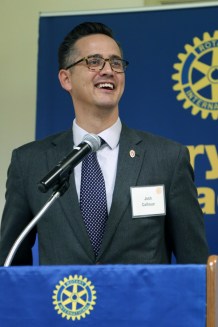
 With the enthusiasm of Jim Cantore of The Weather Channel, Professor Jonathan Martin informed and entertained us regarding the unusually severe nature of November storms in the Great Lake States region. He is a member of the faculty of the Department of Atmospheric and Oceanic Sciences at the University of Wisconsin and nationally recognized for his studies of mid-latitude atmospheric dynamics.
 Rotary Club of Madison, Wisconsin