Tag Archives: Rotary Club of Madison

The”No Hit” Zone

–submitted by Carol Toussaint; photo by John Bonsett-Veal
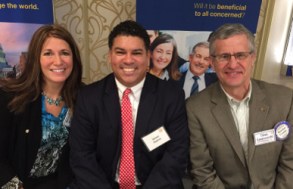
ismael-ozanne-1-25-2017

Club President Michelle McGrath, Ismael Ozaane & Rotarian Dave Ewanowski

We’ve all heard of “no fly zones,” but Rotarians at Wednesday’s luncheon learned about “no hit zones” and what they can do to reinforce a culture of safety.  Dane County District Attorney Ismael Ozanne explained why he cares about reducing corporal punishment of children and why we should all understand that hitting a child puts them at risk for detrimental outcomes that affect every aspect of our community including the criminal justice system.

Simply put, Ozanne explained that the phrase “corporal punishment” refers to inflicting pain to a person.  Citing other standards of public safety we often take for granted, safeguarding early brain development through eliminating corporal punishment should be as commonplace as requiring car seats for infants and children.   Bringing this message to the public needs to emphasize the purpose of such a program and his office has undertaken numerous ways of education through information.

Ozanne predicts that Dane County can become a national leader in working to create a “no hit zone” and noted that Stoughton is the first city in the U.S. to have set it up.  More than two years ago, Ozanne began organizing community conversations and conferences with various professional groups interested in rebuilding the criminal system to make it more compassionate.  Attention is on learning more about the current research and by addressing the root causes of aggression, domestic violence, mental issues and AODA issues.

Asking his audience to get to know more about ways to create and reinforce an environment of safety and comfort for all, Ozanne stated the Dane County District Attorney’s office stands ready to help.

Did you miss our meeting this week?  Our thanks to WisconsinEye for videotaping.  Watch it here.
Tweeting Trumps All Traditional Forms of Expression

–submitted by Ellie Schatz; photo by Stacy Nemeth

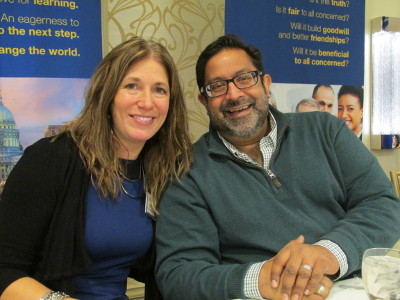
shah-dhavan-1-18-2017

Club President Michelle McGrath with Dhavan Shah

Based on 19 years of team projects that have collected and analyzed data on mass communication, Dr. Dhavan Shah’s formal title for his presentation was: Understanding Election Dynamics Via Social Media. It took a few minutes and a little data for him to share the message that Mr. Trump knew how to use the press and social media to draw attention to himself, and that he honed his communication skills in the course of the presidential campaigns. Our impression may be that social media reacts to the news, but Trump’s tweeting demonstrates that social media actually produces the news. The template is:  so and so tweets, others respond/retweet, this draws attention and creates publicity, and ultimately the press writes about it.

Dr. Shah’s data show that Trump got $2.8 billion in free primary coverage compared to $1.1 billion for Clinton and much less for any of the other Republican candidates. Trump dominated the news coverage for 23 out of 24 weeks, and only Sanders, of all other candidates, got less negative coverage. Although staged media events and unscheduled media events show up as ways of reaching the public, social media dominates, i.e., when Trump sends out a tweet, it gets repeated in social media blasts and the message is amplified through a high volume of retweeting. Trump’s use of social media makes him master of a new medium, comparable to FDR’s use of radio, Kennedy’s use of television, and Obama’s mastery of digital targeting.

Dr. Shah calls this new way of expression the period of Hybrid Media Campaigning. This means that Mr. Trump gave the media what they wanted by attending staged media events and showing up at unscheduled events, both directly covered by the press. But, he relied primarily on using an emerging form of communication: tweeting. This can be seen as having a two-way influence on the news rather than being top down — when a person’s followers retweet and retweet, that shapes the news. The bottom line? The press is complicit in Trump’s success.

If you missed our meeting this week, CLICK to watch the video.  We thank WisconsinEye for videotaping our meeting this week.

Wisconsin on the Air

–submitted by Bill Haight; photo by Stacy Nemeth

mitchell-jack-1-11-2017

Club President Michelle McGrath with Jack Mitchell

Jack Mitchell, PhD, led Wisconsin Public Radio for 21 years, from 1976 until 1997. He was also prominent in National Public Radio as producer of All Things Considered and as a four-term member of the NPR Board of Directors.

His talk chronicled some of the 100-year history of public broadcasting in the state from his book, Wisconsin On the Air. In 1917 the UW physics department moved radio from Morse Code communication to actual voice and music transmission thanks to vacuum tubes that the department made. In an early demonstration of the new medium, an assistant physics professor invited a group of faculty, deans and friends to his home. They gathered to hear a musical recording that was played in the basement of Science Hall, travelled up a wire to a chimney of the adjacent UW heating plant, and was broadcast across town to the professor’s home. The group was not impressed.

But soon the value of broadcasting was seen as a means to several ends, not the least of which was furthering the progressive “Wisconsin Idea,” the ideal of the university as an empowering force for all state residents, Mitchell related.

Experimental station 9XM, “the oldest station in the nation” became WHA in 1922. Over the 100 years public radio, and later pubic television, faced differing opinions about its proper role. Was it a teaching exercise for broadcast students, was it a means to deliver education to the many small schools throughout the state, was it a way to educate farmers, or was it the ideal medium to enlighten state residents through the “Wisconsin Idea”?

Public Broadcasting continues to face many of the same issues it has throughout its history: control, funding, and programming philosophy. Mitchell’s book details the people and activities of that 100-year journey.

If you missed our meeting this week, you can watch the video here.  

Club Enthralled By Stories of Wisconsin Olympians

–submitted by Jerry Thain; photo by Stacy Nemeth

garcia-jessie-1-4-17

Club President Michelle McGrath seated with Jessie Garcia

Those at the Club’s first meeting of 2017 were entertained and informed by the presentation of Jessie Garcia on Wisconsin-connected Olympians from her recent book “Going for Wisconsin Gold:  Stories of Our State Olympians” (Wisconsin Historical Press).

Ms. Garcia is the state’s first female sports anchor, and her life as such included such activities as changing a baby’s diaper in the tunnel at Lambeau Field during a Packers game.  Her book on the Olympics covers stories of many of Wisconsin’s 450 Olympians beginning with the second modern Olympics in 1900 in Paris where native Wisconsite Alvin Kraenzlein not only became the first and still only track Olympian to win four gold medals in individual track events but also introduced the method of taking hurdles in full stride!  In 1904, in St. Louis, Oscar Osthoff, son of the founders of the Osthoff resort in Elkhart Lake medaled in weight lifting and George Poage became the first African-American to medal for the United States.

At  the infamous Berlin Olympics in 1936, Ralph Metcalfe of Milwaukee raced with his friend Jesse Owens, taking the baton from him in a gold medal relay performance.  The Club was treated to a clip from this event (narrated in German).

In 1988, Dan Jansen, who had promised his sister, who had just passed away from cancer, that he would win a gold medal in skating for her, fell down and could not achieve that goal.  However, he did win the medal in the 1994 Olympics and celebrated by skating with his young daughter in the victory lap.  At the 2008 games in Beijing, the US team won what is generally considered the greatest swim race in Olympic history, winning by the length of less than a fingernail, thanks in part to a great second lap by Garrett Weber-Gale of Wisconsin.  Also thanks to a strategy by the team’s anchor swimmer that allowed him to overcome a considerable lead by the French swimmer to win the race.  Jessie Garcia told Club members this heretofore secret during her talk but perhaps that is best left for others to learn from her book, something she told members to do about several scandals from various Olympics that she noted without detail in the course of her remarks.

Ms. Garcia emphasized her love of sports and especially the Olympics but it was unnecessary to state that since this came through emphatically throughout her presentation.  As she noted, the stories in her remarks are only a small sample of those in her book.  The record of medals and games can be obtained from reference books and web sites (she maintains an updated web site about Wisconsin Olympians but the human element behind them is not there but does emerge in her book.

If you missed our meeting this week, you can watch the video here.

New Member Event at HotelRED

–submitted by Mary Romolino; photos by Jorge Hidalgo

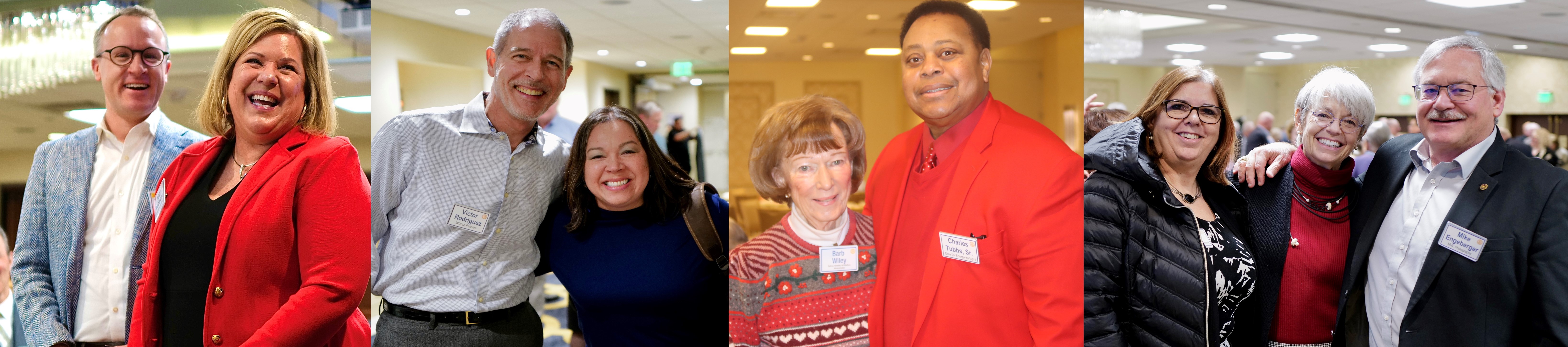
coffee-event-hotelred5  coffee-event-hotelred4  coffee-event-hotelred3

Photo 1: Charles Tubbs and Jeff Quinto; Photo 2: Haley Saalsaa, Jason Ilstrup, Karla Thennes, Leslie Lochner & Craig Bartlett; Photo 3: Leslie Overton, Jennifer Weitzman & Mary Romolino

20161213_080843It was a game of Find the Member Who… that had experienced Rotarians and new club members alike learning fun facts about each other’s unique and sometimes quirky life experiences at the new member event on December 13 at HotelRED. Thanks to Jason Beren, who organized the game, attendees mixed with literally every person in the room in order to match the experiences listed on our game sheets with the Rotarian who lived that experience. It was a terrific way to get to know our newest members and learn surprising facts about those we’ve known for years.

With members like ours, it’s no wonder our club is so dynamic! For instance, new members Jorge Hidalgo marched in President Reagan’s Inauguration Parade, Chris Rich saw a ghost at age eight, a sighting confirmed later in life by his mother; and Jennifer Weitzman has donated a kidney. Leslie Overton started at UW Madison as a music major but instead became a CPA and lived in Washington D.C. for years before returning to Madison.  Jeff Quinto’s family motto is “Often wrong, but never in doubt,” while Karla Thennes’s Minnesota-dwelling parents gave their children names beginning with the letter K. By the time Karla was due they were running low on names. Luckily Karla’s dad saw Miss Minnesota on TV and you guessed it, her name was Karla with a K.

When you meet a new club member, please extend a warm welcome and discover the experiences which led them to where they are now and to our club.  And, thanks to Jason Ilstrup and HotelRED for hosting our event.

20161213_081334


Alexander Hamilton – A “Hot Topic”

–submitted by Roger Phelps; photo by Mike Engelberger

kaminski-john-12-7-16Alexander Hamilton is a “hot topic” these days.  With the incredible success of Hamilton: An American Musical, there is a lot of review and interpretation of this founding father and his role in history.  According to today’s speaker – Professor John Kaminski – Hamilton was a pivotal player at a pivotal time in our history’s foundation and early years.  However, the play offers a somewhat skewed image of Alexander Hamilton.  It mainly focuses on his positive attributes and contribution without offering much offsetting insight into this patriot’s well-established contrarian views in supporting a strong central government, active central government financial controls, and related topics.
Hamilton’s background as an orphaned illegitimate child and his minimal education continued to plague him throughout his career and contributed to his “fear of concealing his background.”  It has an impact on his personal philosophies and his resulting cautious approach to career advancement.  Hamilton’s personal introspection followed him all his life.

He played a key role in the Revolutionary War and joined President Washington’s cabinet as Treasury Secretary.  In that role, he and Thomas Jefferson, the Secretary of State, developed major conflicts on a number of topics.  Most of them involved a different vision of the role and structure of the United States government.  Hamilton preferred a strong Presidency and a strong congress.  He looked to Britain as the model.  He had earlier advocated for a President for Life and Senators for Life – concepts that were rejected by Jefferson, Madison and others in drafting the Constitution.   Jefferson, on the other hand, was more optimistic about the individual states and their citizens to guide the government’s role in shaping this new nation.

Perhaps Alexander Hamilton’s best writing can be found in the Federalist Papers that he authored with James Madison and John Jay.  This set of essays has been instrumental in revealing the insight that went into the wording of the Constitution.

Hamilton played a critical role in the Presidential Election of 1800.  Although he was not officially a candidate, he helped manipulate the process including trying to change the way the Electoral College picked a winner.  This was typical of Hamilton who used manipulation throughout his career to advance his own ideas.  Ultimately the US House of Representatives chose Thomas Jefferson as the winner.

In 1804, Hamilton and Aaron Burr fought a duel over personal honor.  Hamilton was mortally wounded.

Professor Kaminski’s review of Hamilton’s life clearly described a patriot who was radical and revolutionary – a risk taker who had a huge stake in the formation and early years of the US government.  We Rotarians owe him a debt of gratitude to shine light on this important founding father.

If you missed our meeting this week, you can watch the video here courtesy of WisconsinEye.